
The COVID-19 ‘peak’ for Charlotte has moved again. Here’s how that could be a good sign.
A potential surge of coronavirus cases in the Charlotte region could come in mid-July — more than two weeks later than a projection Mecklenburg County officials had previously released.
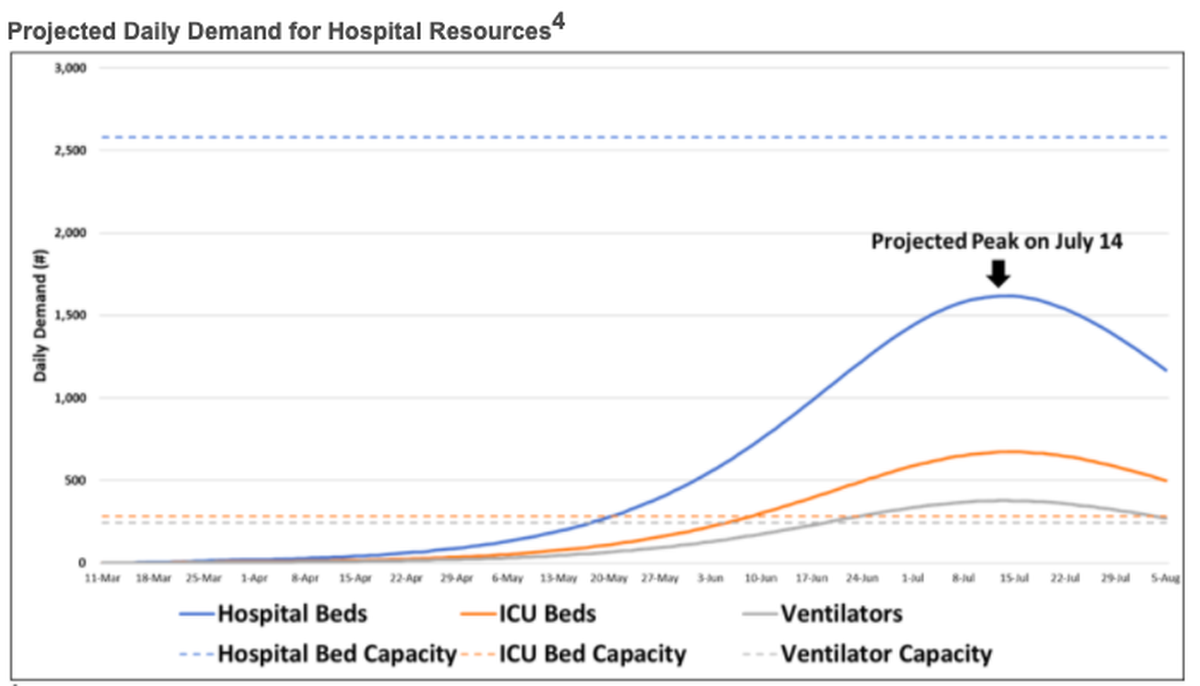
In addition to the “peak” being further away, local health and hospital officials believe a future surge in cases would require fewer intensive care unit beds and fewer ventilators than previously expected. However, a surge would still likely overwhelm current hospital capacity.
The change comes as stay-at-home orders and social distancing have helped “flatten the curve” of the pandemic, meaning the infection spreads over a longer period of time, reducing strain on health care services. Projections can change frequently, and a potential peak being further away is generally a good sign, health officials have said. The rate of spread and hospitalizations due to COVID-19 have slowed in the last two weeks, health officials say.
The revised coronavirus peak comes as North Carolina and Mecklenburg leaders prepare to gradually reopen on Friday some businesses previously deemed non-essential.
The county’s latest model, released Tuesday morning, shows there would be a daily demand of 1,615 hospital beds when the region reaches its peak date on July 14, assuming there’s partial compliance with social distancing guidelines. The projections apply to Mecklenburg and surrounding N.C. and S.C. counties — a population of about 2.3 million, which local hospitals serve.
A spike in COVID-19 cases in mid-July could also require 672 ICU beds and 377 ventilators, according to county spokesperson Rebecca Carter. An earlier projection, with a June 16 peak, showed a possible demand of more than 2,000 ICU beds and more than 700 ventilators.
But there are only 283 critical-care beds and 243 ventilators in the county, Mecklenburg officials said last month.
A possible coronavirus surge could leave health care providers without “enough beds, staffing, supply and life-saving ventilators to care for everyone in our community and region,” local officials have said.
In the past week, an average of 65 people were hospitalized in Mecklenburg’s acute care facilities — a decrease over the last 14 days, officials said.
Carter said positive COVID-19 cases are now doubling about every 21 days, a significant extension of the prior doubling rate of every six days in mid-April.
Mecklenburg uses the University of Pennsylvania’s coronavirus model, which Public Health Director Gibbie Harris has said provides “middle-of-the road” projections for when hospital resources could be overwhelmed. Projections incorporate information from Mecklenburg County Public Health, Atrium Health and Novant Health.
Flattening the curve
An earlier projection showed Mecklenburg could peak with coronavirus demand on hospitals between mid-April and mid-May. Once stay-at-home orders were put in place, the peak projection date was moved to June and then again, on Tuesday, the projection shows a peak later in July.
Flattening the curve, however, is not synonymous with reducing the total number of COVID-19 infections, Harris has emphasized.
Officials have warned the coronavirus forecasts can be volatile, similar to rapidly changing predictions for hurricanes and other natural disasters. The models are imperfect due to limited testing capacity — and sweeping assumptions about the precise infection rate — epidemiologists caution.
Projections released on April 20 indicated the region would peak on June 27 under 45% social distancing — meaning residents reduced their activities and travel by less than half than normal. Under 30% social distancing, officials had said a June 16 peak was possible — or, perhaps a peak on July 17, assuming 60% social distancing.
New modeling on Tuesday did not incorporate scenarios with those various social distancing benchmarks. Still, officials said Tuesday there’s been a “slight decrease” in social distancing over the last 14 days, based on mobility tracking data. The projection released Tuesday showed a peak date assuming 45% social distancing.
Officials did not specify other parameters used to calculate the new July 14 peak, such as the population’s COVID-19 infection and hospitalization rate, average length of hospitalization, and how many patients would require intensive care and ventilators.
It is unclear how relaxed stay-at-home restrictions, allowing residents to venture outdoors for more activities as soon as May 8, could influence the county’s projections. Harris has also said the county will be impacted by neighboring communities, including those in South Carolina, reopening more quickly than Mecklenburg.
This story was originally published May 5, 2020 at 4:50 PM.