

City near Charlotte plans to remove Confederate statue. Calls grow for more to come down
The city of Salisbury plans to remove a 111-year-old Confederate monument, as calls grow across the Charlotte region to relocate similar statues seen by many as symbols of racism and hate.
Salisbury officials confirmed on Twitter Friday that the city council is in tentative discussions with the local chapter of the United Daughters of the Confederacy “to permanently relocate” the Fame statue on Innes Street.
Renewed attention has also focused on getting rid of other Confederate monuments in the Charlotte region, as well as ones nationally. That activity has been spurred on by widespread protests for the Black Lives Matter movement and against police brutality in the aftermath of the killing of George Floyd, a black man, by Minnesota police.
But Karen Cox, a UNC Charlotte historian who is writing a book on Confederate statues, said the issue of replacing such statues “didn’t just pop up again” for African Americans because of Floyd’s death or the Black Lives Matter movement.
African Americans, she said, have always held contempt for the statutes.
Removing monuments “can be a sign of good faith to stay on the road” to removing all markers of racism and inequality, Cox said. “It’s only a start.”
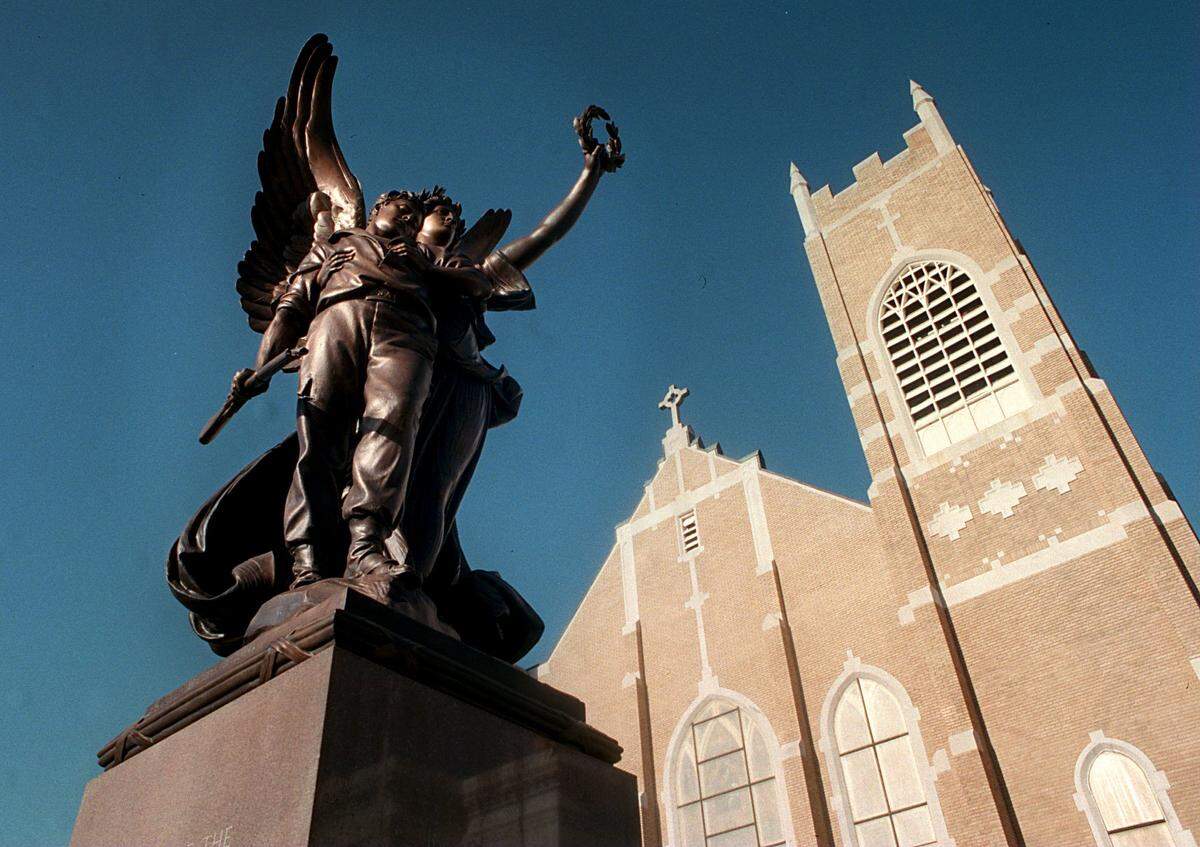
A contentious site
The statue in downtown Salisbury would be moved to the Old Lutheran Cemetery on North Lee Street, Observer news partner WBTV reported.
The bronze statue was dedicated in 1909, WBTV reported, and depicts the muse Fame holding a dying Confederate soldier with one arm, and a laurel wreath held high in the other hand.
The statue also has been a focal point of protests and conflict in the city.
The Salisbury Police Department recently arrested two people — one white and one black — in connection with shots fired as two separate groups of protesters gathered near the Fame statue. And paint has been thrown on the statue twice as well, WBTV reported.
The cemetery opened in 1768 and includes 175 Confederate solider tombstones that were installed in 1996, according to the station. Salisbury is about 45 miles north of Charlotte.
At its meeting Tuesday, the city council is scheduled to discuss the issue, Mayor Karen Alexander told the Observer Friday.
‘Consider the harm’
The Salisbury statue is among more than 95 monuments honoring the Confederacy across North Carolina, according to state records. Most were dedicated between 1900 and 1925 during the era of Jim Crow, the Observer previously reported.
In Cornelius, the pastors of Mt. Zion United Methodist Church told the Observer they want a Confederate statue moved from outside their church.
The church owns neither the statue nor the land on which it sits, pastors Jonathan and Angela Marlowe said. The monument has been owned and maintained by the Mt. Zion Monument Association since it was installed in 1909, the pastors said.
“We call on the Mt. Zion Monument Association to consider the harm their monument causes to our Black brothers and sisters,” the Marlowes said in an email. ”We ask them to listen to all the voices in our community, particularly the Black community of Cornelius, as they consider what to do with their monument.
“We stand ready to assist them as they go about the hard process of listening to their neighbors.”
In a statement emailed to the Observer, association chairman Donald Archer said the group is reviewing what to do with the monument.
“In today’s politically charged climate, many people do not view this memorial as a significant and valuable piece of history,” according to the statement. “Due to this climate, the association is exploring all options available to protect and save this significant part of the history of Mecklenburg County and ... North Carolina.”
In Union County, no one has called for removing the 1910 Confederate memorial that’s in front of the Old County Courthouse in downtown Monroe, and commissioners haven’t discussed the topic, county spokeswoman Liz Cooper said.
Calls for change in Charlotte
Meanwhile, in Charlotte, Corine Mack, head of Charlotte’s NAACP chapter, said it’s also time to remove two Confederate monuments in the city — a 1977 statue owned by the city in city-owned Elmwood Cemetery, and a Confederate memorial off Kings Drive owned by Mecklenburg County.
Mack also said Stonewall Street, named for Confederate Lt. Gen. Stonewall Jackson, should be renamed George Floyd Street. “It isn’t enough to do a mural,” she said, referring to a Black Lives Matter mural painted in uptown. “We need substantive change.”
Removing the two Charlotte monuments “is the right thing to do for the black community,” Cox said.
And so would renaming Stonewall Street, she said, noting how the street travels through an area where blacks were displaced in the name of urban renewal.
The Elmwood Cemetery monument originally stood outside Old City Hall in uptown before then-City Manager Ron Carlee had it moved in 2015, the Observer reported at the time.
Charlotte and Mecklenburg County spokespeople did not respond to requests for comment.
SC park petition
And in Rock Hill, a petition started a week ago that asks the city to change the name of Confederate Park. The petition received 3,250 signatures by Thursday.
The petition calls for renaming the site Friendship Park or Friendship Nine Park to recognize the 1961 McCrory’s lunch counter sit-in.
Ten students from Friendship Junior College in Rock Hill were arrested for refusing to leave McCrory’s. Nine of the students declined to pay their fines and became the first civil rights sit-in protesters in the nation to serve jail time.
This story was originally published June 12, 2020 at 11:32 AM.