Gentrification is at the doorstep. Can Black investors protect this Charlotte community?
When Malcolm Graham drives down Beatties Ford Road, the view is much different than what he sees.
Past his windshield are desolate streets and dilapidated buildings. But his eyes light up.
He imagines a streetcar, taking students from Johnson C. Smith University to pizza parlors and ice cream shops on Charlotte’s west side. He imagines no one loitering on corners of convenience stores, and buildings filled with shops and businesses. He sees Beatties Ford restored — becoming again a place where Black businesses and Black families, especially, thrive.
But with the constant thrum of construction lingering in the air, there’s also a nervous energy. Residents are skeptical of what will happen to their community — one of the last frontiers in the uptown footprint so far unscathed by gentrification.
Those residents who talked with the Observer recently say they’re worried the same fate that befell other historically-Black neighborhoods in Charlotte is ahead for Beatties Ford: Developers take culturally rich, but struggling neighborhoods to white and wealthy — seemingly overnight. Property values and rent costs soar and the new development hurries displacement of both poor and minority residents.
Neighborhood advocates and longtime residents say they would like to see renewed investments in the community, which they say city leaders have neglected for decades. Now, under plans for redevelopment and attracting new businesses, the area is considered a key “gateway” into uptown.
Graham knows that residents are concerned about the ramifications of development, like being priced out of their homes. But, according to him, there’s one thing sets this project apart from the others.
“The thing that makes this project so amazing is that the individuals who are involved in it actually live in the corridor, and they’re investing in the corridor,” he said, standing in a grassy plot where a commercial building will sit in a couple of years.
“These are young African-American investors who saw value in their community and are willing to invest in it. I think that means a lot… to protect the history and the tradition.”
Only time will tell whether the development on Beatties Ford is for the residents or for someone else.
For Tiffany Fant, a community organizer who grew up near Beatties Ford, the uniqueness of having Black leaders and developers lead the charge is far from a guarantee gentrification won’t transform life here.
“Just because developers are Black, it doesn’t mean the effects of development will be any different if they’re not intentional about it,” Fant said. “If they move in the same way as a white developer, what’s the benefit?”
The evolution of Beatties Ford Road
Fant used to walk by herself from her house to the library during her childhood. On her way, she’d see family members, and maybe even stop to buy candy with a quarter.
She’s 41 now. She lives in Washington Heights, near the community where she was raised. And though the buildings look the same, Fant says the community is vastly different, a result of “denying people access for years.”
Professionals, such as doctors and lawyers, have moved away and taken their businesses with them. An economic decline has corresponded with the area having one of the highest crime rates in the city.
Fant says Beatties Ford has lost the sense of community it once had, but she said no one is admitting why.
“People want to put the onus on the residents and say this is why the community is the way it is,” she said. “They’re not saying that they strategically destroyed Black neighborhoods with highways.”
Starting in the 1950s, the construction of Charlotte’s highways split thriving historically Black neighborhoods and displaced homes and businesses, leading to a domino effect that reverberates today. The Charlotte Agenda recently took a look at how highway construction harmed Black Charlotte neighborhoods.
Graham and other city leaders recently have said there’s work to do before the community is attractive to business investors and developers. Graham said at a September press conference that the city has begun ramping up code enforcement in the corridor.
Graham has said he believes Beatties Ford residents want a “safe and clean” place to call home.
Alesha Brown, leader of community advocacy organization For the Struggle, says she agrees but she takes issue with whose shoulders the fault has been placed on.
“Folks don’t have these problems down in South Park,” she said. “It’s a gross failure of the city.”
She argues that the safety and cleanliness has always been the responsibility of the city to maintain, that the state of the community is a result of negligence.
“Yeah, everyone wants it to be safe and clean,” Fant said. “But let’s talk about why the city isn’t maintaining our walkways. Honest and bold leadership would say that the city has neglected this side of town to develop every other side of town, and now we have to figure it out because of our proximity to uptown.”
Many of Beatties Ford’s residents are elderly and on a set income. Others are living in poverty, and Fant said displacement is not an option for the community.
“We can’t afford that in a historically Black area of town,” Fant said. “We can’t displace people here. There’s nowhere for them to go but the street.” Fant is a board member of For the Struggle as well as a volunteer with Historic West End Partners, an initiative aimed toward preserving the culture of Charlotte’s West End.
Fant agrees that Beatties Ford Road needs development. She goes to North Lake or the University area to get drinks and shop, and she’d like to be able to “live, work, and play” in her own backyard, she said. But Fant also mentioned Charlotte’s poor economic mobility opportunities.
She said protective policies need to be put in place, too.
The city’s Aging in Place program allows senior homeowners to apply for property tax relief, and Graham said there are already existing seminars, programs and resources in place for those in need. For the Struggle helps Beatties Ford residents complete applications.
“We’ve got to do business in a different way on this side of town. This is a resilient community, but it has the potential to be vulnerable if we don’t,” Fant said. “We can’t afford to get it wrong, and we have every opportunity to do it differently.”
Graham and others see opportunities here, too, and have put that idea at the center of the campaign to jump-start development.
‘A choice we make’
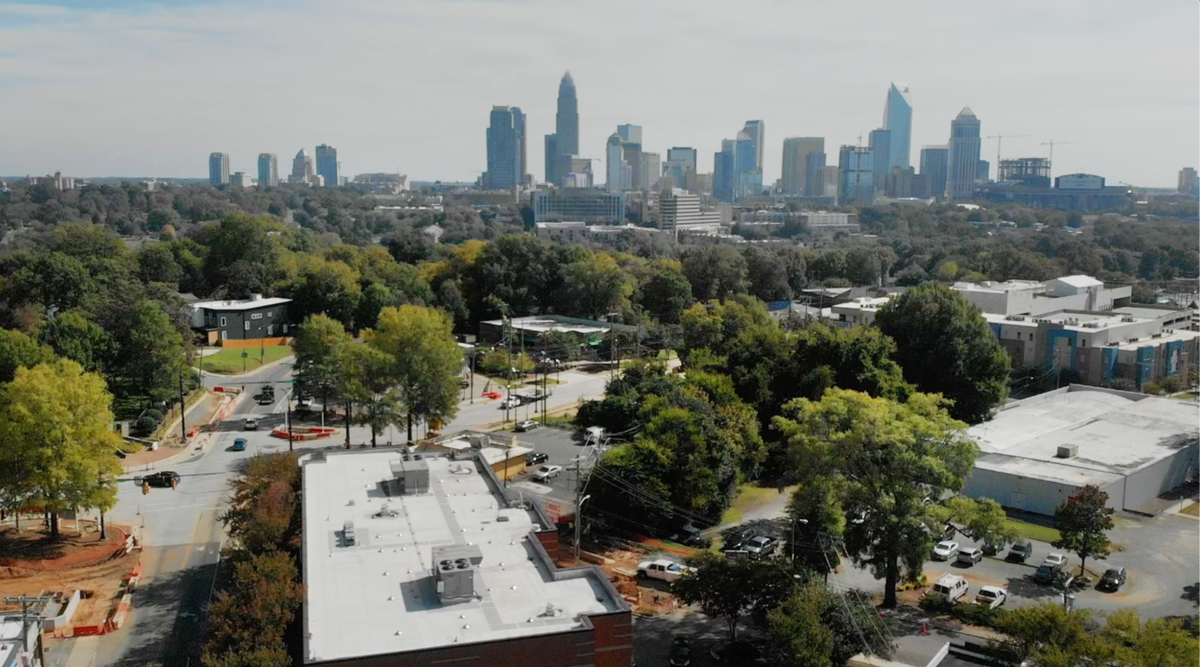
The neighborhood has been designated both as a “Corridor of Opportunity” and “Opportunity Zone” — both government programs aimed at bringing more business to the corridor and improving the quality of life for residents.
The city’s earmarked $24.5 million in total for all six Corridors of Opportunity the city hopes to revitalize. The areas include West Boulevard, Central Avenue and Albemarle Road, and Graham and North Tryon streets, along with Beatties Ford and Rozzelles Ferry. Some of the money will be allocated for crime prevention, and the city has already been bringing violations into compliance through code enforcement. The city will also provide infrastructure improvements and gap funding for developers who need more money to complete their projects.
At a Corridors of Opportunity press conference in September, city leaders including Graham announced a developer’s purchase of a parcel of land on Beatties Ford Road. Gathered under a tent as rain splattered noisily above, Graham said that he wanted residents to be part of the change, not victims of it.
But afterwards, community members who were not invited to the event expressed their frustration at feeling left out of the conversation. Residents asked the same question over and over again: “Who is this development for?”
Local organizer Kendrick Cunningham, who grew up near Beatties Ford Road, said community input is integral to the success of the development.
“If you don’t have community input, you need to get out on the ground and ask,” he said. “Otherwise, the impact is unintentionally going to be more gentrification and more displacement in what is essentially the strongest Black community in Charlotte.”
Already, construction projects line Beatties Ford Road, starting at the Rozzelles Ferry crossing in front of Johnson C. Smith University.
Black business owners and developers along the corridor say they fear if they don’t invest in the area, someone else will — but not with the same priorities.
Darrel Williams is founding partner of Neighboring Concepts, a design firm that Williams said has a vested interest in the communities they work in, which are often places that “no one else will go.”
The firm is housed on West Trade Street, right before it turns into Beatties Ford Road. It’s in Mosaic Village, one of the firm’s projects. Williams, a former county commissioner, lives in Wesley Heights — another Charlotte neighborhood that’s quickly gentrifying.
Williams said the firm worked with the police department and the Wesley Heights Neighborhood Association to identify high-crime areas, and the firm helped the neighborhood acquire nearby properties.
“That’s a good kind of gentrification, right?” Williams said. “We helped them improve those homes. That part was good.”
But as upgrades lead to higher land values, taxes shoot up and protecting homeowners who can’t afford higher property tax bills — especially senior citizens, Williams said — is a challenge.
Just a short walk up the road, Madie Smith-Moore glances at the group of people gathered on the sidewalk near her family’s convenience store, which she plans to renovate soon.
“I think it’s time to repurpose these spaces and hopefully contribute more to the neighborhood as it changes, and it is changing,” she said. “People being priced out of their homes is unfortunately a problematic symptom, and for some there will be little recovery if any, but that’s the way cities grow.”
Anthony Lindsey, a realtor who has sold properties in the area for the past 25 years, said he hasn’t seen any change in the neighborhood since he went to college at JSCU over 40 years ago. He said he used to walk to the university from LaSalle Street, and on the entire strip, the only major changes have been the addition of the police substation and Mosaic Village.
“That’s the problem,” he said.
Lindsey said market studies have been done to identify what residents want and what’s missing in the area, and that he’s confident the city will do the needed work to create programs to prevent displacement while creating new investment in the corridor.
“They have to keep the community in mind. It can’t be one or the other,” he said.
Lindsey said the goal should be creating a community with housing for various income levels so that poor people aren’t driven out.
“There’s no reason we have to do that,” he said. “That’s a choice we make.”
Across from the store Smith-Moore’s family owns, Dianna Ward has invested in a small vacant shopping center. She wants to rent to minority-owned businesses.
Ward closed on the property a year ago. She hopes her investment will encourage others who have more resources to do the same.
“We have professional athletes here. We have business owners with a lot of money,” she said. “Bring that money to the West side. I mean, if I can do this, then definitely people with far more resources can.”
But it’s not just about making a profit for Ward — that’s why her buildings only house businesses owned by people of color.
“The significance is I’m getting to do something that is not just about the money. I feel this in my spirit, feel it in my heart that this is something that I want to do to make a difference,” she said. “I asked myself, ‘What am I doing to make a change?’ And I was like, if I’m going to invest this money, let me invest it here.”
Christopher Dennis, who is renovating two shopping centers on Beatties Ford Road, knows firsthand what displacement is like.
He was among the 120 business owners displaced when his rented office space’s building on North Tryon was sold last year — just one example of gentrification in Charlotte pushing out small businesses.
His commercial development business, E-Fix Development Corporation, hopes to provide affordable space for other businesses owned by people of color in west Charlotte. Dennis said the businesses that will fill the shopping centers will bring needed amenities to the corridor.
“We saw this as an opportunity to give back to the community and be an agent driving the change that we’re seeing on the Beatties Ford corridor,” he said. “I’ll say I’m a developer, but I also wear a community hat.”
While breaking ground is already underway under the city’s redevelopment plan, much of the change in store could take years.
William Henry Hughes, Jr. is a son of west Charlotte — his family has been rooted there for generations.
He’s a member of CGE Ventures Group, which bought several lots in Beatties Ford in 2016. As part of their plans for the land, they will create a mixed-use development that will house a restaurant, retail spaces, and offices.
Hughes hopes it will create good-paying jobs and encourage more professionals to return to the area. Business tenants could be moved in, he said, by 2022.
For neighborhood advocates, the work to head off a wave of gentrification on Beatties Ford starts now.
‘Liberation is at stake’
Brown said she thinks it’s wonderful that Black developers have been given this opportunity to develop a historically Black corridor in Charlotte.
“But at the same time, we need to make sure those Black developers are listening to people that are already part of this community,” she said.
UNC Chapel Hill professor Mai Thi Nguyen, whose research focuses on community development and inequality, said Black developers aren’t the sole antidote to solving gentrification. She said what’s more important is whether they’re centering the protection of residents and if they’re mission-driven instead of profit-driven.
“If the price of land and housing will be pushed higher, that has the potential of bringing in gentrification,” she said. “There’s things the city and developers can do to not have that happen.”
She said creating a land bank in the area is an option, to maintain permanent affordable housing. She also said property tax relief, context-appropriate development, and creating more opportunities for home ownership, especially for older residents, would be effective.
“If you see luxury condos, that’s a signal that the place is changing,” Nguyen said. “I think you can make a place better but you have to be intentional about not having displacement and serving the people who currently live there. If you don’t do that, who are you making the place better for?”
Nguyen also said the language used to describe the area as unsafe or unclean is coded.
“What they aren’t saying is that there hasn’t been government investment in making this place a livable environment. If you look around, are the roads paved? Has there been support and services provided to this community?” she said. “It’s not like they can all of a sudden reverse the tides of history. Education will not suddenly give them (wealth) to buy a house.”
Nguyen acknowledged that historically, Black families have been denied opportunities to own capital. They couldn’t even own land until the 1800s. Centuries of oppression are at play, she said.
And to prevent gentrification and displacement, Nguyen said it will take residents holding elected officials accountable at public meetings and voicing their concerns — a challenging responsibility, she said.
“This has to be tracked really. There has to be some level of analysis of what happens to residents that have been there and if they get to stay there or not,” she said. “There are a lot of advocates, but I don’t think anyone is actually measuring this or tracking it to an adequate degree in Charlotte.”
The effects of gentrification are at the core of Charlotte’s ranking in a 2013 report that showed the city as dead last among major American cities in opportunities for economic mobility. Meaning, if you’re born into poverty, it’s harder in Charlotte to climb out.
Gentrification accelerates the disparity, Nguyen said.
“Black families might have to move somewhere else and will be pushed farther from job centers,” she said. “They can’t build wealth. They just keep on getting displaced and the wealth goes to other people. I would think that elected officials in Charlotte would be more aware of how capital and investment of capital and public dollars can shape outcomes for poor families.”
The development isn’t the problem itself, Brown said. It’s everything that comes after. And without community input, she said negative impacts are likely.
“There is no one 100% in opposition to this. I think opposition comes when you don’t keep the community involved, I don’t know if they’ve hit the mark yet or really understood what it takes to engage a community,” Brown said. “We are very protective over our neighborhoods because we have to be. Community, that’s what’s at stake. History, culture, and unity is at stake. Liberation is at stake.”