2020 meant missed moments and losses big and small. But 2021 brings glimmers of hope.
In the cemetery near the railroad tracks, in rural Nash County, the widow visited her husband’s grave. Brenda and William Taylor had been married 23 years, ones filled with laughter and prayer. Her husband had been a pastor, a Godly man known for his wit.
Ask him how he was feeling and Pastor Taylor might reply: “With my hands,” and that was his sense of humor, said his younger brother, Vernon. And now late on a mid-December afternoon, the sun casting long shadows, Vernon and Brenda stood next to the gravesite and wept.
He’d been gone for two months and the ground still hadn’t quite settled. The bed of flowers that once covered the length of the grave had turned brown. A fresher bouquet on one end waited to be replaced by the headstone.
This was only the fourth time Brenda had come to the cemetery. She stood a few minutes before she turned to Vernon and broke the silence and said, “I can’t take it no more. I’m ready to go.” With that she began a slow walk toward the gate.
Sometimes she still felt sick, herself, and sometimes she feared that the coronavirus was not done with her yet. She could not know who had contracted COVID-19 first — whether she caught it from William, or whether her husband had caught it from her.
They’d entered the hospital around the same time to be treated for the virus. Only Brenda returned home. She hadn’t been able to tell her husband goodbye. Among everything she’d lost, that was one more thing: the opportunity for a proper farewell.
What we lost
The most fortunate among us did not lose someone in the past year, but chances are we all lost something. Stories of loss came to define 2020: lost lives and lost homes and lost jobs. Lost opportunities, for a lot of us. At the least, a lost way of life, in ways large and small.
What did you lose in this lost year?
North Carolina’s first positive virus case became public on March 3. Here and everywhere, the dividing line between the Before Times and everything after came about a week later, March 11. I will remember that Wednesday the way people of older generations remember where they were when Kennedy was shot; the way people in and around my generation remember where we were on 9/11.
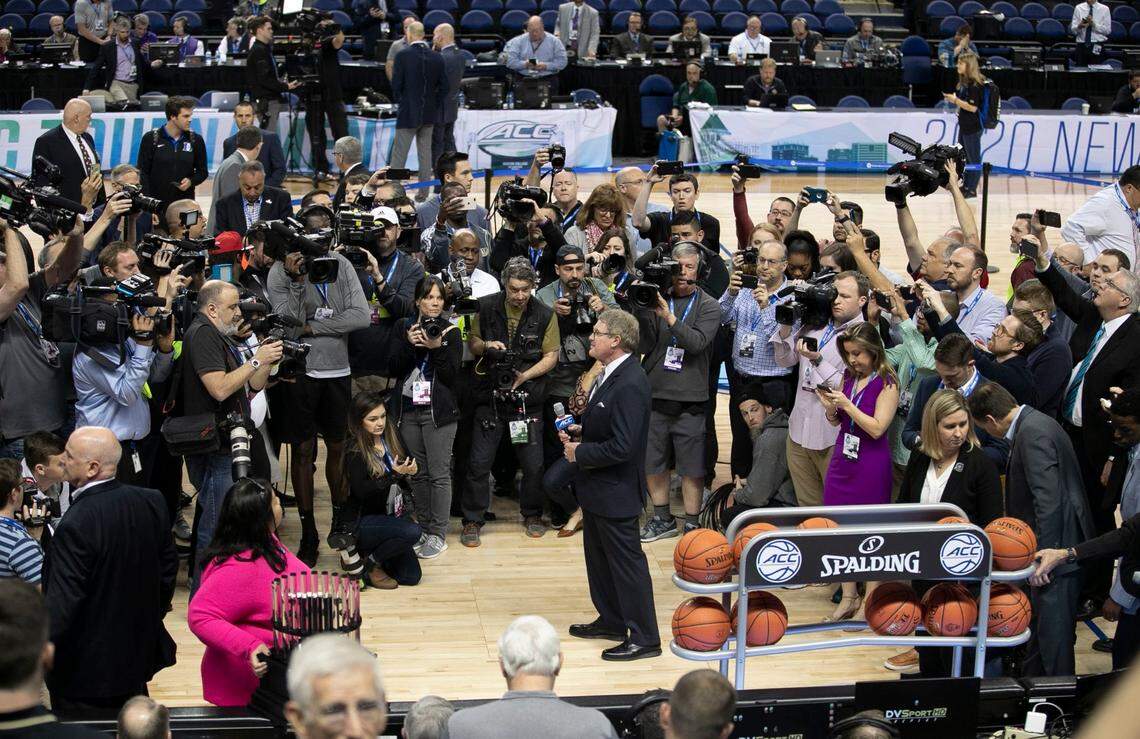
What were you doing when you realized the virus had arrived in America — that life was going to change in unpredictable and unimaginable ways? That Wednesday night I was in Greensboro, covering the ACC tournament. North Carolina and Syracuse were playing one of the last college basketball games of the season, though nobody knew it at the time.
I found an empty row in the upper deck of the Greensboro Coliseum and reflected upon the weirdness, because already things had become weird: Players detailing their hand-washing habits; league officials contemplating what then seemed like a wild idea: tournament games without spectators.
Then an NBA game abruptly stopped after a player tested positive. Almost simultaneously, actor Tom Hanks revealed that he and his wife, actress Rita Wilson, also had the virus. Revelations and reactions emerged in real time on Twitter. I didn’t know it at the time but sitting there in the stands, staring in bewilderment at the words on my phone screen, I was doing something that would also become ubiquitous. It was the first of many doomscrolling sessions of 2020.
Soon the ACC announced the tournament would go on without spectators, much to the chagrin of those I interviewed. One group lingered in their seats, playfully chanting, “Hell no, we won’t go.” Another, a father and son, had traveled from Syracuse for their first ACC tournament.
The next morning John Swofford, the ACC Commissioner, explained how the tournament would continue in a mostly empty building. Then, about 10 minutes before Thursday’s first game was set to begin, he announced the tournament was off.
“We’re all dealing with a very fluid and unknown enemy worldwide with the coronavirus,” Swofford said then. “We don’t know entirely what that means for the future.”
In 2020, life came at you fast.
Driving home that night, the highway felt empty. I was struck by the eeriness of it, as if people had already decided to hunker down and wait things out. Only thing was, there was no endpoint to that wait and little understanding that, indeed, our collective actions would decide how long it would last.
It became one of the first assumptions people had to lose: the belief that the pandemic would pass quickly, that life would soon resume as usual.
Around Raleigh and the rest of the state, it felt like the world paused. Businesses closed. Schools sent students home. Those of us in jobs with an office learned to work from home. We all became familiar with Zoom and only seeing our friends and loved ones on a computer screen.
The places people gathered, where regulars were like family, sat empty. It was like that at the Nashville Diner in mid-March, chairs turned on tables. Familiar customers walked inside to order their coffees and biscuits to-go and some thought it wouldn’t be long before things would be like they were.
“Probably a good week or so,” one man told me on March 18, after he placed his order.
“They say two weeks,” said Tammy Davis, one of the owners. “I see it longer than two weeks. I’m seeing us going into May.”
A few weeks ago I revisited the Nashville Diner, and Davis and her husband were still doing takeout-only for breakfast. They said four regulars had died from the virus. Some of the customers were still in denial. Some things hadn’t changed.
Missing life’s milestones
Early on, just about every day reaffirmed that COVID would be with us for a while — that things would not just get better, that it would not just disappear. By late March and early April, stories began to emerge around the state, slowly at first, about those lost to the virus. Among North Carolina’s first victims was a man named Sypraseuth Phouangphrachanh, though everyone called him Officer Bud.
He was born in Laos, spent part of his childhood in refugee camps and wound up in Montgomery County, North Carolina, where he became a beloved middle school resource officer. Students adored him.
Once, on Superhero Day, he wore a Superman shirt under his uniform, and so that became a nickname: Superman. The man of steel. And now, at 43, Officer Bud was gone, and with it a small-town’s sense that the pandemic was something happening somewhere else, far away.
“It’s broke our community in that, oh wow, this really is real,” Chanda Stokes, the principal at West Montgomery Middle, told me while she mourned. “I mean, Bud — Officer Bud? Like, the one that always laughs and always healthy and never sick? Officer Bud? What?”
We all had those moments when the pandemic came to feel more real, when it affected us in some unique way, and more often than not, those moments involved loss. High school kids missed out on their proms and their in-person graduations, and the boys on the Westover High basketball team in Fayetteville lost the chance to complete an undefeated season with a state championship.
“Everything we worked for is gone,” one of the players, D’Marco Dunn, said at the time.
A lot of younger kids lost things: dance recitals or band concerts or the magic of a Little League game on a warm spring night, followed by ice cream with the team. I remember nights like that from when I was 10 years old. It’s a small window, to experience those moments when they’re meant to be experienced, and before you know it, the window has closed.
Seems all of us lost something like that. Birthday parties. Work farewells. Maybe a wedding day postponed to a time we hope is better. We lost moments with people outside of our homes, and many of us lost the chance to say goodbye in person, to hold a hand or give a hug or whisper one last word.
By late April, when Cleora Mann died, the virus had claimed about 300 lives in North Carolina. Mann was 103 years old, a mother of 16 who outlived four of her children, a woman born into the Jim Crow South and who for decades endured its atrocities.
She’d lived almost half of her life without indoor plumbing before, little by little, her children afforded her finer things. One of them built her a big brick house on her land in Louisburg, and in early May she was buried on that land. She’d come to rest after she’d died alone in a nursing home the virus had ravaged.
“I envisioned us having a big celebration with 500 or more people,” Larry Mann, one of her sons, told me the day of the funeral. Instead there was only a small group, and a grandson holding up an iPad so that others could watch from somewhere else.
Since then, more than 6,700 North Carolinians have died of the virus. Thousands more have been hospitalized, with that number, too, expected to climb, stretching health care workers’ capacity to take care of patients, and themselves.
Mourning
Back at the cemetery in Nash County, Vernon Taylor stood alone for a moment beside his brother’s resting place. He said there was a church here once, an old wooden church that had been among the first African-American churches near Rocky Mount.
A hurricane came through and flooded it out, though, and now there was just the cemetery where Taylor’s brother had been buried. The dirt was still loose, and grass hadn’t yet grown over the grave. Taylor had hoped it would have looked nicer by now. His brother deserved better.
Better than dying alone in a hospital. Better than a small funeral his own wife couldn’t attend.
“If COVID hadn’t been here, we couldn’t have had a church in Rocky Mount big enough to hold it,” Vernon said, and soon he too had stood in the cemetery long enough for one day.
What we learned
Not everything we lost in 2020 will be missed. Some of it, some might argue, needed to be gone. In May, the pandemic coincided with the police killing of George Floyd, which inspired the kind of nationwide social justice and racial equality movements not seen in America in more than 50 years. In North Carolina cities and around the country, protesters marched with the message that Black Lives Matter.
Confederate monuments came down, or were pulled down, in a lot of places — Raleigh included. For 105 years one such monument stood downtown, on the grounds of the state Capitol. One end of Hillsborough Street stopped at its pedestal. When crews began removing it one summer day, in June, two women, both Black, bid farewell with music.
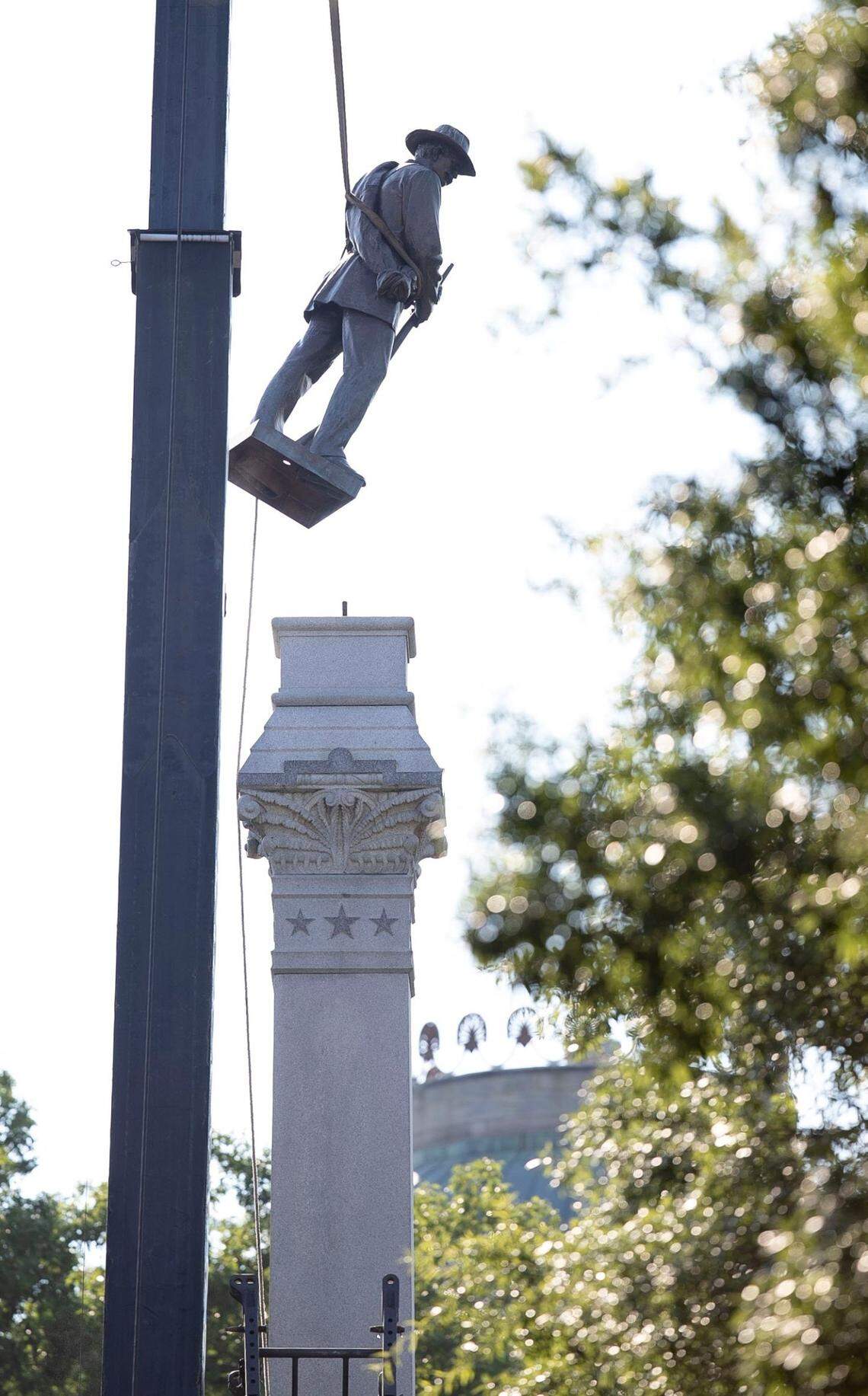
“My family, along with so many Black families here, in North Carolina, have helped build this country,” Carly Prentis Jones, a classical Opera singer, told me that day. “And so (I’m) just glad to see this go. And so we wanted to serenade the statue goodbye.”
She and a cellist named Shana Tucker gathered in the shadow of the monument and performed “America the Beautiful” and “Lift Every Voice and Sing,” which has been considered the Black national anthem for more than a century. To me, it remains one of the most beautiful scenes of 2020, Jones and Tucker on a sidewalk on a quiet Sunday morning, making music.
Part of 2020 came to be about finding beauty in unexpected places. It came to be about the little discoveries alongside all of the losses.
The morning after the first night of protesting turned ugly in Raleigh, in late May, there were a lot of those small moments. People walking into downtown carrying brooms to sweep up broken glass. Volunteers scrubbing away profanity that’d been spray painted onto buildings. Others creating art.
On Fayetteville Street, a young woman named Quana Gill left chalk drawings on the sidewalk, near a smashed-out window and a store that’d been looted. She was on her knees coloring in a heart when she said, “People are upset, and angry. People don’t have a voice. And it’s sad, everything that’s going on in the world. The pandemic. A man getting killed.
“And then this? This wasn’t Raleigh yesterday.”
In the longest year of our lives, we learned things about ourselves, and about our society, and sometimes those lessons were good and sometimes they were not, depending on where you looked. At times we learned the importance of faith. In a lot of little towns throughout the state, church parking lots filled up on Sundays, people honking their horns to punctuate a prayer.
“We had horns blowing to say amen,” Pastor Tim Stevens, of the First Baptist Church in Micro, told me on Easter Sunday. “And I don’t know if I didn’t get more horn blows than I do ‘amens,’ so we might let them bring some of those air horns next time they’re in church.”
That would be a while. There were legal fights about in-person church attendance, about gathering in crowds, and sometimes people did what they wished, regardless of rising case counts and deaths and the orders that Gov. Roy Cooper mandated an effort to limit both.
It was a year learning to embrace wearing a mask. Except for those who didn’t.
“Why — I mean, the biggest thing to me, is that I’m being told what to do,” a man named Chad Barker said in June. “That I’m begin commanded that I have to do this.”
It was a year of trying to avoid crowds. Except for those who wouldn’t.
“People been cooped up and they’re ready to get out,” a man named Talmadge Coates told me in late May, when he and thousands of others stood in line, in defiance of a governor’s order, to attend a race at Ace Speedway in Alamance County. “I think they need to open this economy back up, too. And let people be smart about what they’re doing. I mean, we’re not dummies.”
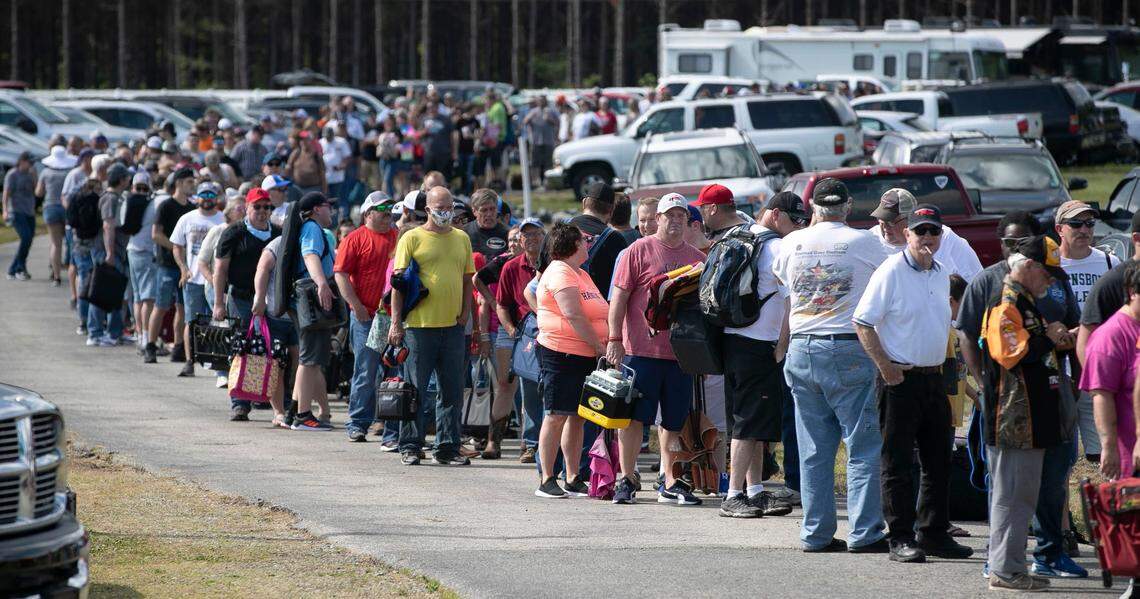
Coates was “not trying to get all political,” he said that day.
“But Trump, everything the poor man does, it ain’t enough. You know? And God bless Trump, and God bless America, man. That’s all I can say.”
It was a year of public health officials and scientists pleading with people to listen.
“And how do we restore trust?” Dr. Mandy Cohen, the state’s Secretary of the Department of Health and Human Services, asked during a recent interview.
It was a year of losing things that will be missed. Maybe that restaurant where you and your wife had your first date. Or the neighborhood bar where you and your coworkers gathered for happy hours, when you still went into an office.
In Garland, a small town down east in Sampson County, an old shirt factory closed, a business casualty of COVID. For decades they’d made Brooks Brothers shirts there, including ones for presidents, and the factory sustained the town.
Years ago, one of the workers there, a woman named Gaynelle Bryant, had been flown up to New York City, on the company dime, to attend something of a Brooks Brothers bootcamp. Now, in July, she and more than 100 of her colleagues were out of work.
“Some days, if it rains, I just walk from the window to the door,” she told me then. “I hate being at home. I like being where people are.”
It was a year of learning how to be alone, and learning how to become good at it — or at least a little better. In my world, quiet morning walks to the coffee shop nearby, or around the neighborhood, became a salvation. A four-day hike in the wilderness of the Smokies, the mountains alive with fall color, provided a mental reset and the perfect socially-distant activity.
And yet no matter how hard we try, the realities of the moment remain inescapable. In North Carolina we’ve surpassed the half-million mark of confirmed cases of the virus. We passed 5,000 deaths, then 6,000, and the rate is multiplying all the time.
The numbers have reduced our losses to data points, the figures blurring together. Just this week, between Tuesday and Wednesday, more than 150 people in this state died from the virus. The total 2020 toll will approach 7,000.
In Nash County, a widow and a brother remains in mourning.
A final farewell
Brenda and William Taylor were together for 25 years, married for 23. Their anniversary was her birthday. The last time they saw each other was in September, the day Brenda arrived in the hospital with severe COVID-19 symptoms. William had arrived a few days before.
They were wheeling him toward the ICU when Brenda noticed. She didn’t know it would be the last time she saw him alive. There was no conversation, because he was not in any condition to talk. Later, she learned, in moments of lucidity, he’d called out her name. But she couldn’t be by his side.
“I told them to tell him I was here and that I loved him and everything,” Brenda said, and she hoped the message made it back to him. At the hospital, her condition deteriorated and she had to be intubated and placed in a medically induced coma.
She knows how it sounds, she said, but she insists that she became aware of her husband’s death while she was in a coma. He died on Oct. 4. He was 70. She awoke from her coma on Oct. 10, to her grown children telling her that William had died.
“I told them, I said, ‘I already know,’” Brenda said, and her children asked her how. “I said, God came to me and told me.”
Now she is less certain as to the why of it all. Why she lived while her husband died. The day she awoke was the day of her husband’s funeral, and she watched it on a screen. She cried , she said, “Because I didn’t have a chance to say goodbye.”
Sometimes, still, she encounters lingering COVID-19 symptoms. And sometimes the question of why keeps her up at night. Why he died. Why she lived. She has come to believe that God “brought me out for a reason.”
“I don’t know right now,” she said. “But I know there’s a reason.”
▪ ▪ ▪
It feels like we’ve reached some sort of finish line, those of us fortunate enough to make it through 2020. Undoubtedly there will be jokes about that, about having made it. And yet, well, we made it, and perhaps that’s worthy of celebration.
Now at the end of the year there is hope, as there is always hope in a new beginning. Vaccines are here, and in some cases have already been distributed.
The healing is starting. Already a new social media trend has emerged: the vaccine selfie. It’s better than doomscrolling, at least.
Soon the calendar will change, and no longer will “#2020” apply to whatever the next year has in store. An ideal 2021 would ease the pain of our losses while emboldening us for having survived them.
It would bring a return to normalcy, though after everything, what will normal be, anyway?
This story was originally published December 31, 2020 at 11:16 AM with the headline "2020 meant missed moments and losses big and small. But 2021 brings glimmers of hope.."