
Charlotte fiber Internet expands — but some homeowners aren’t happy
It’s been years since the much-celebrated arrival of fiber Internet locally gave way to early neighborhood complaints about ruined yards, winter nights with no heat due to cut gas lines, and damaged underground pipes.
While there’s far less public attention on the issue now, city records and homeowner complaints reviewed by The Charlotte Observer show there’s still problems with fiber companies working locally.
In the Shannon Park neighborhood in east Charlotte, homeowner Marlee Murphy was facing a busted pipe and gushing water. The leak, she told the Observer, started on a Friday in late July, in front of a home she owns and rents out.
The damage occurred, Murphy says, as a contractor — working on behalf of Google Fiber — was in the neighborhood to install cables to extend faster Internet service to the area. The contractor dug a hole nearby and was working in the right-of-way strip of land between the street and the home. When the crew saw water pooling above the surface, a pipe in Murphy’s yard had already burst.
Luckily, one of Murphy’s tenants turned off the water on the property. But what happened next, according to Murphy, was anything but good luck.
“We lost (use of water service) for four days, and we had to pay $450 because they just stuck a hole they didn’t tell or ask us about — and it wasn’t even for improvements,” Murphy said. “This was like, I didn’t choose this. I am not going to use this.”
Charlotte home damage from fiber install
When it comes to private property, there’s no official tracking in Charlotte of how often crews cause damage while digging for fiber optic cable installations. Five years ago, there was widespread damage at homes in Highland Creek, in north Charlotte, as Google expanded. As one city official put it: “Retrofitting a community with 21st century infrastructure and technology is tough.”
But the pains of construction, many leaders argued, would be well worth the gains of super-fast Internet service, more competition for consumers, and an expected boost to economic development.
The Observer, in 2016, reported on how frustrated residents in a number of Charlotte neighborhoods flooded the city’s 311 service with complaints of damages on their property.
However, the issue also affects public infrastructure — and officials, still years later, are keeping diligent track of how often contractors puncture publicly-owned lines.
In 2019 and 2020, damage to Charlotte Water equipment, mostly underground, by fiber optic contractors happened 281 and 306 times, respectively. The ZIP codes with the most damages to public infrastructure in recent years were 28269 (including Highland Creek and areas like the Nevin Community, and others along W. Sugar Creek Road); 28277 (including Ballantyne and Piper Glen); and 28216 (including some west Charlotte neighborhoods as well as Mountain Island), according to an analysis of Charlotte Water data by the Observer.
Almost all of the cost to fix the water lines and equipment was recouped from the company responsible for the damage, public records obtained by The Charlotte Observer show.
But in cases where individual homeowners run into problems, it’s less clear who is footing the bill.
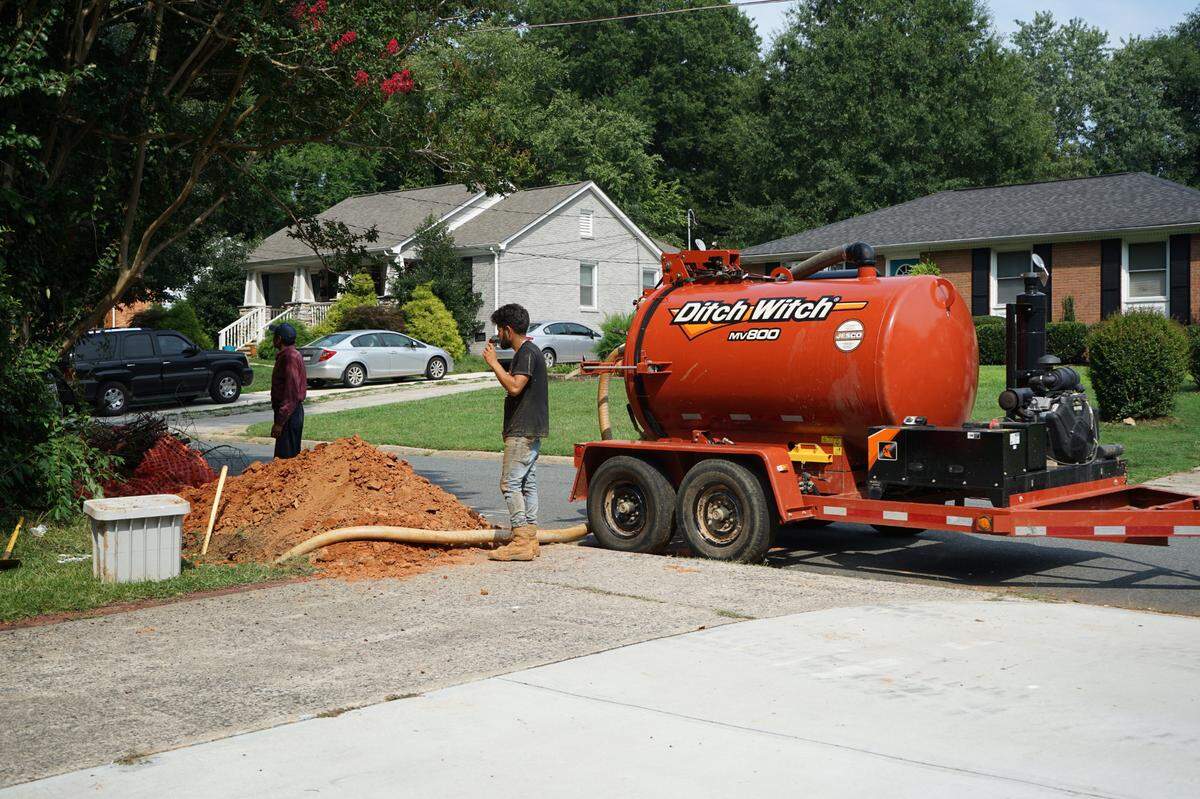
The contractor Murphy says damaged her water service line offered to make a repair to restore service — but she says she did not trust their response or work after hearing from a plumber she called that the repair job would be more extensive. The plumber quoted her a price of $450, according to Murphy.
She says the contractor, Hyper Networks working on behalf of Google, refused to reimburse her for the plumber’s repair and instead wanted to do the job themselves, at no cost to her. When she wouldn’t accept, Murphy says, the contractor offered her $200 in cash to not file a claim or take her complaint to Google.
But Murphy did complain and she says a Google Fiber manager working in Charlotte recently followed up. It took almost three weeks but she’s since been promised she’ll be reimbursed in full. A Google representative, she says, told her they’d investigate the contractor’s attempt to avoid Google finding out about the problem.
Hyper Network was still working in the neighborhood when an Observer reporter visited recently. A crew member said when property is damaged, the company or Charlotte Water will make repairs. Representatives for Hyper Networks could not be reached for interviews for this story. The company is based in Pineville. A spokesperson initially said someone would be available to comment but later could not be reached by the Observer after several attempts.
In a statement, Google Fiber said, “As we build out our network across Charlotte, Google Fiber strives to be a good neighbor, working to minimize disruptions in neighborhoods and taking complaints seriously. If anyone is experiencing issues, we want to hear from them.”
Google runs a 24/7 hotline for issues related to construction: 1-877-454-6959.
Cost of repairs
Public records indicate damage to public infrastructure has generally cost less in recent years compared to when Google first started work in the Charlotte area. However, in 2020, Charlotte Water recorded more incidents of line hits and other problems caused by fiber contractors than in the two years prior. This comes as more fiber competitors have joined the market.
▪ In 2017, Charlotte Water recorded 448 cases of utility damages with almost $1.2 million repair cost. Among these damages, most weren’t blamed on Google Fiber but instead on contractors for one of Google’s largest competitors: AT&T.
▪ In 2018, Charlotte Water recorded 179 cases, with close to $790,000 repair cost.
▪ In 2019, there were 281 cases, with almost $780,000 repair cost.
▪ In 2020, 306 cases, with damage cost of approximately $681,000.
This year, as of April, the city has had over 80 repairs on records.
While Charlotte Water customers will often call 311 first if they see a leak or suspect damage, the water service does not make repairs or take on issues of damage on private property caused by contractors. That means if crews working in the right-of-way to install cable or Internet lines hit water or sewage or gas lines, it could be the homeowner’s responsibility to resolve the issue. However, calling 311 can still be a smart move as Charlotte Water workers may be able to help locate water shutoffs to prevent waste and extensive damage.
Horizontal drilling
Online reviews of construction firms conducting wiring for these companies in Charlotte show complaints about contractors damaging irrigation systems on lawns. Similar complaints have popped up in other cities where fiber companies are competing.
News coverage shows homeowners and city officials are upset with the damages in places like Raleigh and Nashville.
Subcontractors of fiber companies typically install underground fiber lines through horizontal directional drilling — a method of lateral underground boring that is more time and cost effective than traditional vertical excavations, Charlotte Water spokeswoman Jennifer Frost said. Workers start by drilling a pilot bore on the ground’s surface and install the fiber line horizontally until it is pulled out from an exit point.
A report by Occupational Safety and Health Administration pointed out that while the the technique is more time-efficient, it is hard to avoid existing underground utility lines during the installation process due to limited visibility. Essentially, the worker cannot see what else is under the surface while operating a machine that’s creating a channel underground.
Utility companies and others who want to dig in the right-of-way are required to take precautions to avoid causing damage. One of the first steps is to use 811 — North Carolina’s call-before-you-dig phone line. This process notifies other utility companies of work in the area and representatives use flags and paint to conspicuously mark where equipment — like telecommunication lines and water or sewer pipes — are buried.
It appears fiber contractors are filing required right-of-way permit requests as well as using 811 but even with underground utilities marked, drilling can be less precise and result in damage.
Frost says Charlotte Water has noticed that most fiber contractors commence work seemingly expecting there will be damage to property. Typically, a door hanger notice is placed at each home that explains the construction and gives a number for complaints.
But reimbursement isn’t simple. Frost had the issue herself — once she had to pay $500 and call a plumber to fix the water line that was hit by a Google Fiber subcontractor during the drilling process. After multiple attempts of calling the number she was given, she said, the work “never got it completed.”
“It was a nightmare,” she said, “It was just so cumbersome trying to get in touch with them and go through their process ... It got to a point where it wasn’t worth it.”
Murphy says she’s concerned that some Charlotte residents could be taken advantage of — particularly those renters or homeowners on fixed-incomes who can’t afford an emergency plumber bill and would have to rely on a fiber contractor’s repair on their property.

Meanwhile, representatives for telecommunication workers have raised concerns about the quality of installations, like those in Charlotte, that use subcontractors.
A 2020 report by Communication Workers of America, which represents AT&T workers, found that AT&T has used more than 700 subcontractors in the construction and maintenance process of its network. Over 96% of 1,500 AT&T technicians surveyed for the reported said that works performed by subcontractors caused quality issues, since they were paid by the projects instead of by hourly wage.
“AT&T contractors have a track record of causing accidents that damage utilities, public property and private homes across the country,” CWA wrote in the report.
In a statement to the Observer, AT&AT wrote, “for construction projects, we work closely with local city staff to fully comply with permitting procedures. Additionally, utilities are marked before we or our contractors begin work.”
Ansco & Associates, a major contractor for AT&T fiber projects locally, did not respond to the Observer’s request for comments.
Fiber Internet limited in Charlotte
Google Fiber’s arrival in Charlotte changed the landscape of internet companies’ competition in the city — as well as the amount of damage they caused, Frost said.
“Google Fiber announced its [fiber network] and all the competitors tend to match it,” she said, “there is a huge difference before Google and after Google.”
Google Fiber arrived in Charlotte in July 2016. Long before its official launch, the company had announced that the construction process would be “disruptive”, but stressed the long-term benefits of brand-new fiber-optic network that “sets the stage for the next 20 to 30 years,” the Observer reported in January 2015.
The hope for the city-wide high-speed internet never come to realization. After the company started its service in Highland Creek in 2016, Google Fiber abruptly halted its expansion plan throughout the U.S., “likely due to the high costs,” CNET reported.
Charlotte is one of the 16 metro areas with Google Fiber services. But within the city, it is still not accessible to all neighborhoods. The company mainly serves apartment communities instead of single-family homes, since it is more efficient to wire hundreds of homes in the same building instead of hundreds of standalone houses, Axios Charlotte reported.
The company told Axios Charlotte in 2018 that it chose to improve services in areas that it was already available, instead of moving to new neighborhoods. Recently, the company announced that it would end its cable TV services for all Charlotte customers and focus on upgrading customers’ internet, the Observer reported in July.
This story was originally published August 16, 2021 at 6:00 AM.