Hundreds rally for abortion rights at Freedom Park as Supreme Court likely to reverse Roe
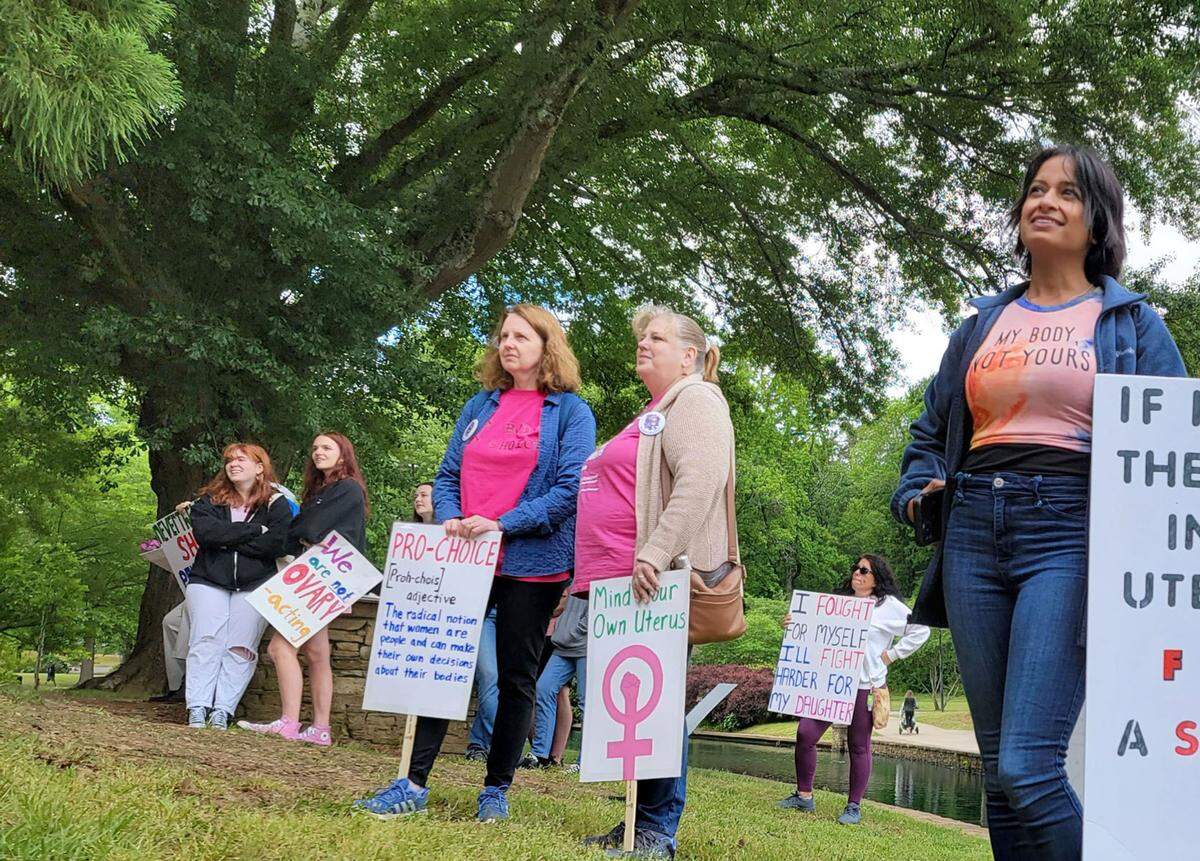
Hundreds of protesters gathered Sunday around Freedom Park’s stage to rally for abortion rights, flanked by signs that read “Charlotte is pro-choice” and “Abortion is healthcare.”
They gathered on Mother’s Day. It was just days after Politico published a leaked draft opinion from U.S. Supreme Court Justice Samuel Alito that indicated there were enough votes to overturn the landmark decision in Roe v. Wade.
Dozens of women, elected officials and supporters took turns speaking to the crowd during the three-hour event. Among the many signs were such messages as, “If you’re so against abortions, get a vasectomy,” and “mind your own uterus.”
A few speakers disclosed that they, or someone they knew, chose to have an abortion. Some recalled their decades-long fight for abortion rights. And many emphasized to voters that it’s not too late.
“You have so much power here,” Irina Kogel, a refugee from Belarus, said into a megaphone. “And the only thing keeping these people in power is you being afraid to use your power.”
Leaders from several Charlotte reproductive rights groups, including the Reproductive Rights Coalition, Charlotte for Choice and the Black Abortion Defense League, organized the protest.
“Who here read the Alito opinion?” Brooke Adams, an organizer with the Reproductive Rights Coalition, asked the crowd. Almost all those in the crowd raised their hands.
“And did you think it was absolutely as ridiculous as I did?” Adams asked.
Adams, who wore a colorful “clinic escort” vest, said she’s walked hundreds of pregnant people for about five years to Planned Parenthood appointments in Charlotte.
“We have people who drive from Tennessee,” Adams said. “We’ve had people from Texas and lots from South Carolina... Sometimes, we’re gathering money from our pockets to help somebody make their last-minute appointment. I just can’t even imagine oppressing people who are already so oppressed.”
‘Butcher shops’
Robin Levy told the crowd that in the 1970s, one of her friends got pregnant at 17. Levy said at the time, there were no abortion clinics and her friend had to get an abortion at what was known as a “butcher shop” instead.
“We lost many, many women due to these butcher shops,” Levy said. “My generation of women have worked so hard so that our daughters and our granddaughters have equality. If this fails, we will now be turning back the clocks.”
Beside Levy, Eta Auslander sat on the edge of the stage. The two came to Sunday’s protest together. They’d both gone to dozens of abortion rights rallies in Ohio before Roe v. Wade was decided, Auslander said.
“I’m really angered that something that has been law for 50 years is having another conversation,” Auslander said. “I think that it’s unfair to have to go through all of this again.”
Mother-daughter protesters
In the 1980s, Gloria Currah, 52, worked as a chaperon at a Buffalo, New York, abortion clinic and protested against abortion restriction at the time, she said. On Sunday, Currah’s 17-year-old daughter Olivia protested with her.
“She’s a big part of my activism and why I care,” Olivia said. “But I think it’s sad that we’re both fighting for the same thing that you fought at my age.”
The mother-daughter duo brought a handful of family friends and neighbors with them. “I hope to make people more aware of how serious these issues are,” Currah said.
Concerns about other issues too
Many of of those who spoke warned that if Roe is overturned, other landmark decisions guaranteeing interracial marriage, gay marriage and contraception could be in jeopardy too.
“For the first time in my life, I am afraid to exist,” Coral Kirkwood Enosh said. “I am afraid to walk down the street because if Roe v. Wade gets overturned, it’s just the beginning.”
She wrote, “My body, my choice,” across her chest. On her back, she wrote “Keep God out of my uterus.”
“The next thing that we’re going to see roll back are my privileges to exist, my rights as a bisexual woman, my rights in an interracial marriage,” Enosh said. “Those are all at risk.”
Although she’s scared, Enosh said she’s encouraged by the number of people at Sunday’s protest. “This shows me that we have people who are ready to fight, who are ready to stand up and make sure that we are safe,” she said.
Impact in NC
The case that sparked the potential Supreme Court ruling, Dobbs v. Jackson Women’s Health Organization, involves a Mississippi law that prohibits nearly all abortions after 15 weeks.
If the Supreme Court rules to overturn Roe this year, every state in the Southeast is expected to immediately outlaw abortion — except North Carolina and Virginia, according to the Guttmacher Institute, a research group that supports abortion rights.
North Carolina already has a law that prohibits abortions after 20 weeks, but it’s not been in effect under Roe. The Guttmacher Institute said if the Supreme Court guts Roe, it’s “unclear if the state’s law would be implemented quickly.”
However, if Republicans win a veto-proof super-majority in state legislature races in the upcoming midterm elections — or the governor’s office in 2024 — the 20-week allowance could be in jeopardy.
This story was originally published May 8, 2022 at 2:43 PM.