
Charlotte museum tops $1M goal to save Siloam School, part of Charlotte Black history
A piece of Charlotte’s Black history will be preserved to educate future generations, as the Charlotte Museum of History announced Tuesday that it exceeded its fundraising goal to save the Siloam School.
Built on 1 acre in the 1920s in Northeast Charlotte, Siloam School is surrounded by development construction and new apartments near UNC Charlotte. The now-dilapidated 1,196-square-foot, wooden schoolhouse was one of thousands of Rosenwald-era schools built for African-American children in the segregated South.
The Gambrell Foundation’s $500,000 gift pushed the museum’s preservation project over the $1 million mark.
“Save Siloam School Project can now move forward with restoring this important piece of Charlotte history,” Terri White, president and CEO of the Charlotte Museum of History, told The Charlotte Observer.
Silver Star Community Inc., a Matthews-based nonprofit that saves Black historic spaces, started the multi-year effort to save the one-room schoolhouse several years ago. “Without their efforts, the Siloam School may have faded into obscurity,” White said. “We’re really thankful to them for identifying this school.”
Why it matters
Rosenwald schools were the only places where Black children had access to education due to racism during the Jim Crow era, White said.
“Preserving these sacred spaces is vital to ensuring that future generations know the true history of our community,” Sally Gambrell Bridgford, president of The Gambrell Foundation, said in a statement. “I truly believe that being able to do things like see the actual school, stand on the floors and touch the walls will transform the way visitors experience our history of segregation and inequality.”
Listed on the National Register of Historic Places, Siloam will be one of the only Rosenwald-designed schools in Mecklenburg County devoted to history programming.
“This is a true commitment for us and reminder we’re telling everyone’s history,” White said.
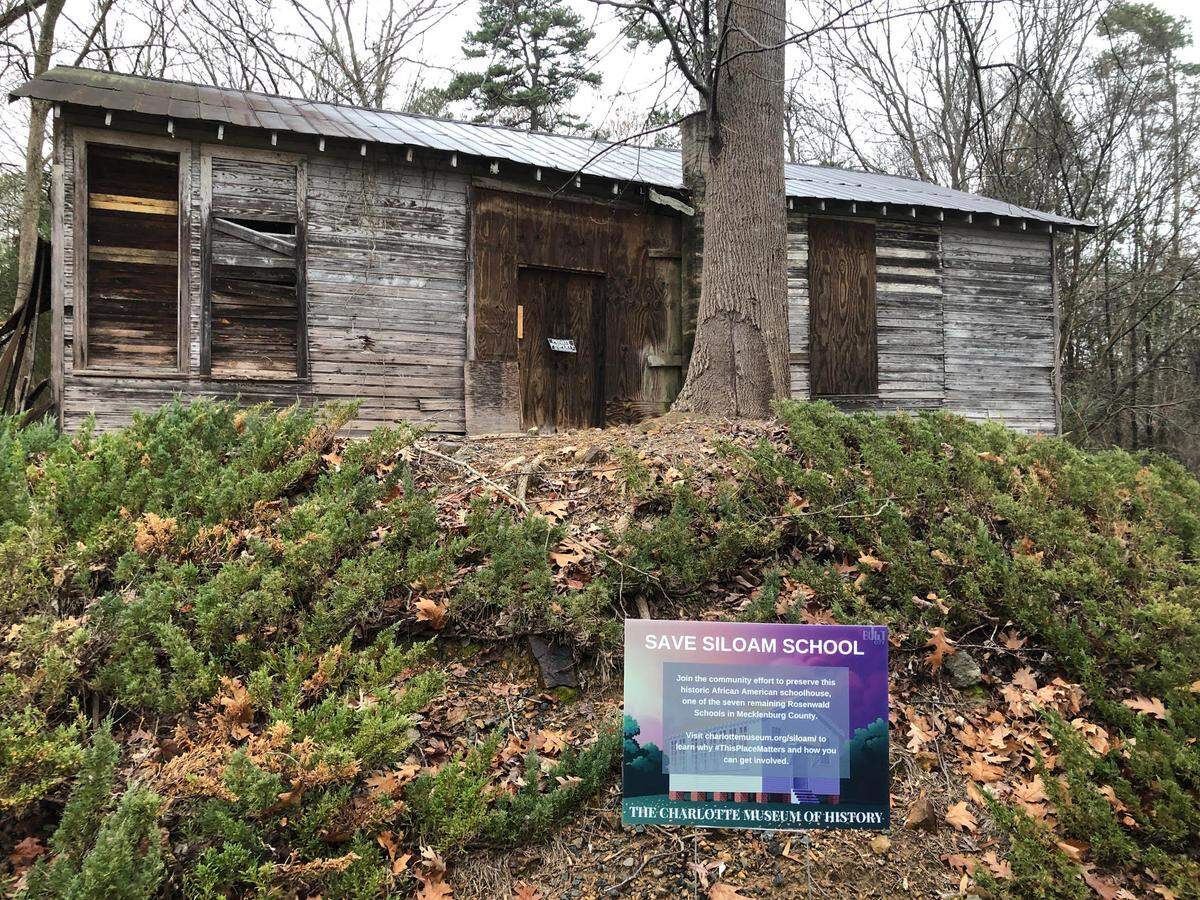
Siloam School, then and now
In the early 1900s, the Rosenwald schools program offered matching funds and architectural plans. It produced more than 5,000 schools, including 813 in North Carolina and 26 in Mecklenburg County, according to the museum.
But the Rosenwald Fund didn’t pay for Siloam School. Instead, it was funded by the Mallard Creek-area community in north Charlotte.
“We think it’s special because it represents Charlotte and Black Charlotte advocating for itself,” White said.
It’s unclear when Siloam School closed. But in 1951, the Mecklenburg County Board of Education sold the property to a family for $500, according to the National Register of Historic Places documents.
The building also had been used as an auto body shop before it was abandoned decades ago, White said.
The priority now is to keep the structure safe, White said, until it can be moved to the museum’s 8-acre property at 3500 Shamrock Drive.
What’s next for the school
Siloam School will be moved in the spring, between April and June, White said. Developer Tribute Companies has offered to help with the move, she said.
Then it will take about a year to restore the building, which will be used for an exhibit and community space.
The exhibit will focus on the 20th-century Black experience and the region’s history of racial discrimination and injustice, according to the museum.
“It’s going to be the see-with-your-own-eyes foundation for our expansion and commitment to Black history,” White said.

Two celebrations will be planned, including a sunrise event to represent a new era for the building after it’s moved, followed by a homecoming celebration when the restoration is complete, White said.
The project shows the museum’s commitment to diversity and telling the complete history of Charlotte, White said.
It also shows the community’s commitment. Along with The Gambrell Foundation’s major donation, donations and in-kind gifts were made by individuals, Mecklenburg County, Lowe’s, Tribute Companies, Sandra Wilcox Conway, city of Charlotte, Porter Durham, Bank of America, Hoffman Mechanical and Walmart, according to the museum.
“We definitely recognize it took large and small gifts to make this happen,” White said.
This story was originally published November 1, 2022 at 2:45 PM.