The tables do turn when you take care of an aging parent — even 400 miles away
READ MORE
Care, change & coming to terms
One family became TikTok stars. Another is paving caregiving as a two-way street. This Charlotte Observer series gives an inside look at what it’s like to care for aging parents.
Expand All
Late Tuesday evening last week, a day before Thanksgiving Eve, I hit the gas pedal hard and headed up Interstate 85 from the Queen City to Williamsburg — again.
That’s where my mom lives. It wasn’t the usual “I’m coming home for the holidays” kind of trip. It was more like my bi-weekly trek to Virginia to check on my 91-year-old mother.
It’s a ritual I’ve had since moving to North Carolina this summer, when I started my new job at The Charlotte Observer. My role as the race, culture and community engagement editor is an exciting and busy job with a lot of moving parts. It’s a fresh start for my curious mind. Success requires 100% of my attention.
Then there’s my nonagenarian mother, who also demands my attention, even if she doesn’t always like to admit it. She lives alone, in another city and no longer able to drive. However, albeit frail, my fiercely independent and plainspoken mother still can get around better than most in her cohort — she can even climb stairs. My mom’s needs are simple relative to others. She still has a lot of good luck going for her and that’s a blessing.
Across the United States, there are tens of millions of adult children caring in some form for their elderly parents, according to AARP. The “caregiver” title is not one I claim easily.
Knowing I’m not alone gives me comfort.
But even with a trove of resources online and support groups, the holidays always seem to magnify the caregiving challenges.
“Families are much more mobile than they ever were. The idea that you’re going to be living in the same town or in the same house, or the same street as your parents, just doesn’t happen very often anymore,” says Heather Burkhardt, executive director at the North Carolina Coalition on Aging in Raleigh.
Most of the time, it’s an overload of extra responsibilities piled onto an already busy life — scheduling doctor’s appointments, ensuring prescriptions are filled, making sure the house is kept tidy, making sure she is eating. And that’s the easy stuff. More complicated is finding good home care help, tag-teaming with major appointments, such as her upcoming cataract surgery.
The driving back and forth saps my energy. Caregivers often get so wrapped up with taking care of another, they forget about their own needs.
Much has been written about the demands adult children face when caring for a parent with cognitive decline. Often people forget the part about coming to terms with a rapidly shifting relationship between parent and child — a total role reversal. Or is it?
Known to friends as Ethel and hailing from Ohio, my mother would be indignant if anyone said my role is her caregiver. I’m still her daughter. She still is Mom. My best buddy, my confidant, my greatest cheerleader. My mother fully supported my move to Charlotte. But I don’t believe either of us fully grasped what my being gone would look and feel like.
“The tables have really turned,” she’ll say wryly. I’m not always sure I like how they have turned.
Richmond-based gerontologist E. Ayn Welleford once told me caregiving is a two-person lift. It’s not a hierarchical structure where one person has charge over another. Each person can support the other, because in life our goal should be to support and uplift each other. I came to really appreciate that over the Thanksgiving holiday. I will be reminded of it all through this holiday season.
A decade of slow change
Mom was diagnosed in 2012 with amyloidosis, a rare disease, and doctors treated it with chemotherapy. Treatment worked and saved her life, but the nasty side-effect was memory loss. My mother’s memory is draining, like a slowly emptying tub.
She wasn’t always alone. A few years back, a close friend took care of her, but he died in 2016. A turn of events in my journalism career landed me in Virginia a year later. Back then, she still drove. She had her routines, but cognitive decline continued.
I have help taking care of Mom. My older brother manages most of her financial affairs. I have an older sister too, but she is not in a position to assist much. They live in New Jersey and New York, respectively. Because I live closest, much of the immediate responsibilities fall in my lap. That’s often the case, Burkhardt said, with one family member shouldering the weight.
When the pandemic swooped in, things intensified.
Between the confusion about COVID-19, the rush to produce a vaccine, to get the most at-risk vaccinated first, daily escalating death rates and general guidance to stay indoors, Mom’s routine abruptly halted. I was there, but being a working journalist (2020 was a blistering time for news) I didn’t have time to spend with her. When I did, I was generally wiped out.
She missed out on a lot of the social interaction necessary to prevent feeling isolated. We tried crossword puzzles and books and other activities to keep from being bored from the TV. My college-age son was around for while and that helped. Fussy about wearing a mask, Mom didn’t want to go out. She eventually forgot how to drive. That was a huge loss for us.
Even as the pandemic seems to be in the rear view mirror, we as a family are continually adjusting to this fluid reality with caring for our mom.
On the surface it seems easy. Put her in a nursing home, some say. Adamant thumbs down from Ethel. Well, hire a home health aide then. Sure, if my last name were Rockefeller. Without long-term care insurance (note to self, get it soon), paying for private in-home care has a sticker shock, averaging upwards of $30 an hour. That adds up fast in a month.
One of the biggest misconceptions is Medicare pays for in-home care for the elderly — it does not, says Burkhardt. Medicare mostly is designed to pay only for rehabilitative services, or maybe a skilled nursing facility. Medicaid covers in-home care in some cases, but there are income benchmarks my mother exceeds.
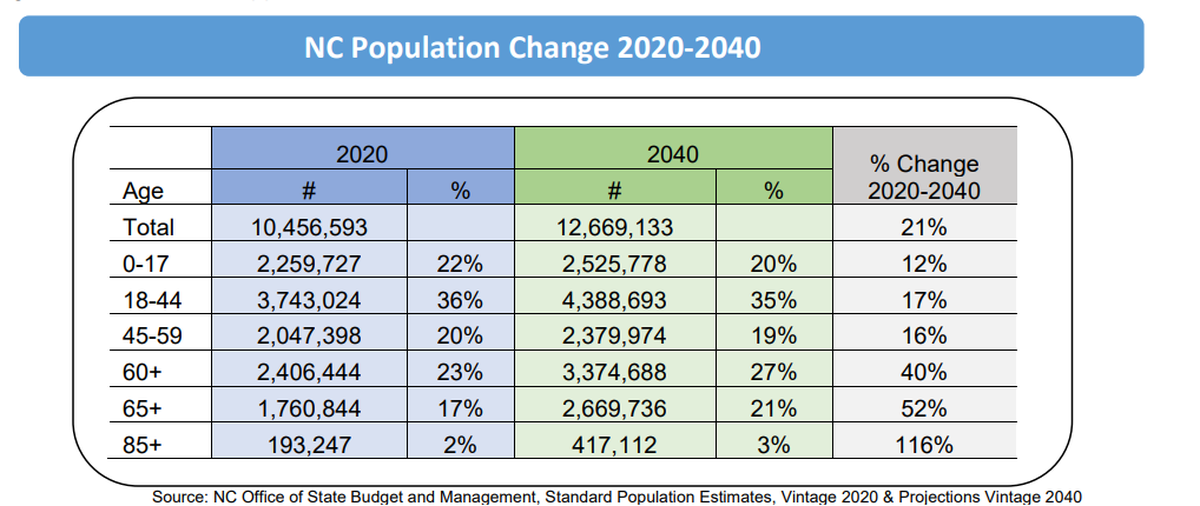
Plus, there is a national shortage of people working in the home health care field. In North Carolina, the 85+ cohort is among the fastest growing demographic, Burkhardt says, quoting data from the state office of budget and management.
In the next 20 years, this group will grow by 116%, contrasting the general population, which is expected to grow by roughly 21%.
“We’re going to have this huge growth of people with health care needs, who are aging,” she said. “We just don’t have the number of people to take care of them, whether it’s children or people in their own families. With a health care shortage crisis, we don’t have enough people entering into these health care jobs to be able to be paid caregivers as well. It’s a real need and concern.”
A two-man lift
The Thanksgiving plan was to drive up to Williamsburg and cook the day before. I would work remotely Thursday, eat dinner with Mom, work remotely Friday and drive back to Charlotte Saturday. Maybe I would even put up the Christmas tree. I ordered groceries and had a few sides planned.
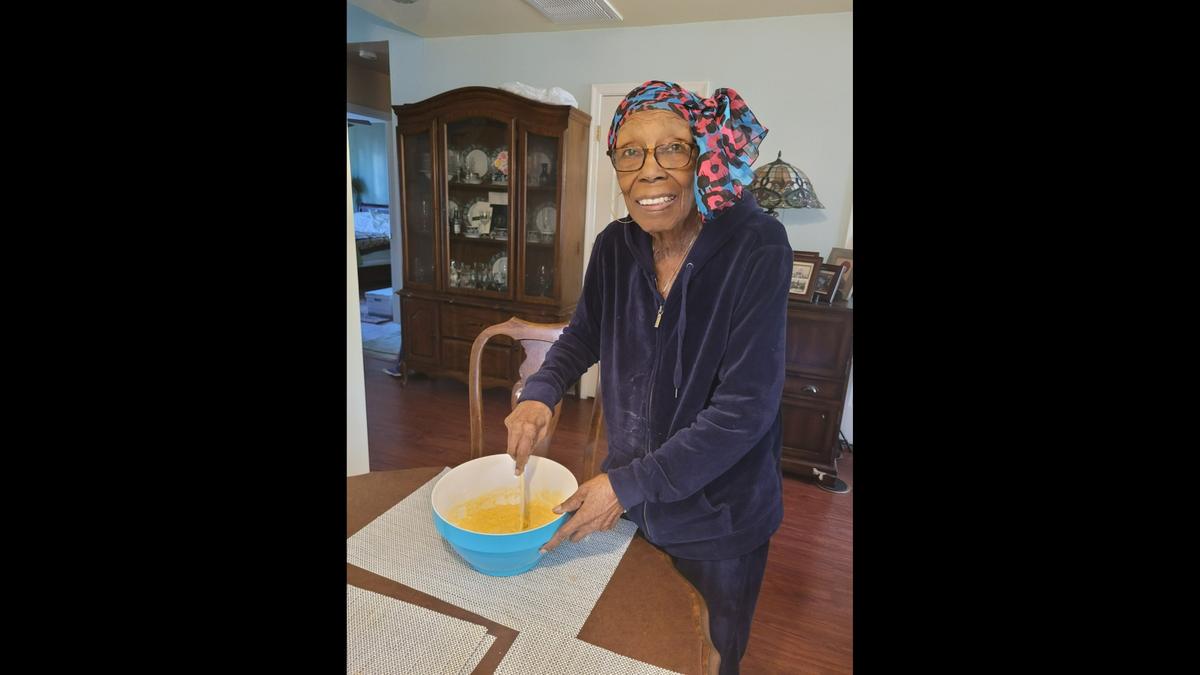
We made my grandmother’s famous cornbread stuffing together, chatting, me mostly chopping vegetables and my mom spinning a yarn about something foolish that someone did years ago, laughing hard. I had everything figured out — so I thought.
What I didn’t plan for was getting sick with stomach troubles, which began brewing late Wednesday evening. I never finished making dinner, and I couldn’t work. It also left my mother wondering where the rest of the meal was.
First it was kind of comical. The turkey breast and stuffing were done.
“Where is the cranberry sauce?”my perplexed mother asked, coming into my room, barely noticing I was curled up in the fetal position. Bespectacled and wrapped in her signature red robe, black support hose and slippers, her brow furrowed and she leaned into me.
“Are you sick?”
My glance replied: You think, Mom?
“It needs the cranberry sauce. The turkey is kind of dry. Can I just make the sauce? Did you make the Brussels sprouts?” she asked.
Caught up in a nausea wave, the pain in my head felt like a drill into my right eye socket. Eyes closed, I was mostly speechless. Finally, looking back at me, a flash of the Mom I remember came alive. She leaned back toward me and stroked my cheek, giving me compassionate eyes and a wry smile.
There was no nausea medication in her bathroom cabinet, of course. No neighbors seemed to be around. She couldn’t drive to a pharmacy. It would be Friday around 4 p.m. before I felt well enough to drive to a pharmacy, still feeling quite ill.
But in the meantime, my mom climbed stairs to bring me chicken broth and crackers. I was grateful. For me, this moment was a triumph. I came to help her, but in the end she helped me. And she finished preparing the sides. Way to go Mom!
Later, when I was feeling much better on Saturday, she came back to my room, where I was resting but alert.
Glad I was feeling better, she also knew that meant one thing — I would be leaving soon. Sunday, in fact, a day later than planned. Her face twisted up in disappointment, in a way I’ve never seen before.
“I don’t want you to go,” she said. Trying to make light of the situation, I laughed saying I was laid up like “cock robin,” (one of her favorite expressions) for two days. I wasn’t very sociable.
“I just like having you here,” she said.
Yeah, I miss you too, Mom. But I’m only five hours away and Christmas is coming.
This story was originally published November 30, 2022 at 6:00 AM.