Area towns are rewriting rules on e-bikes. Charlotte may be next.
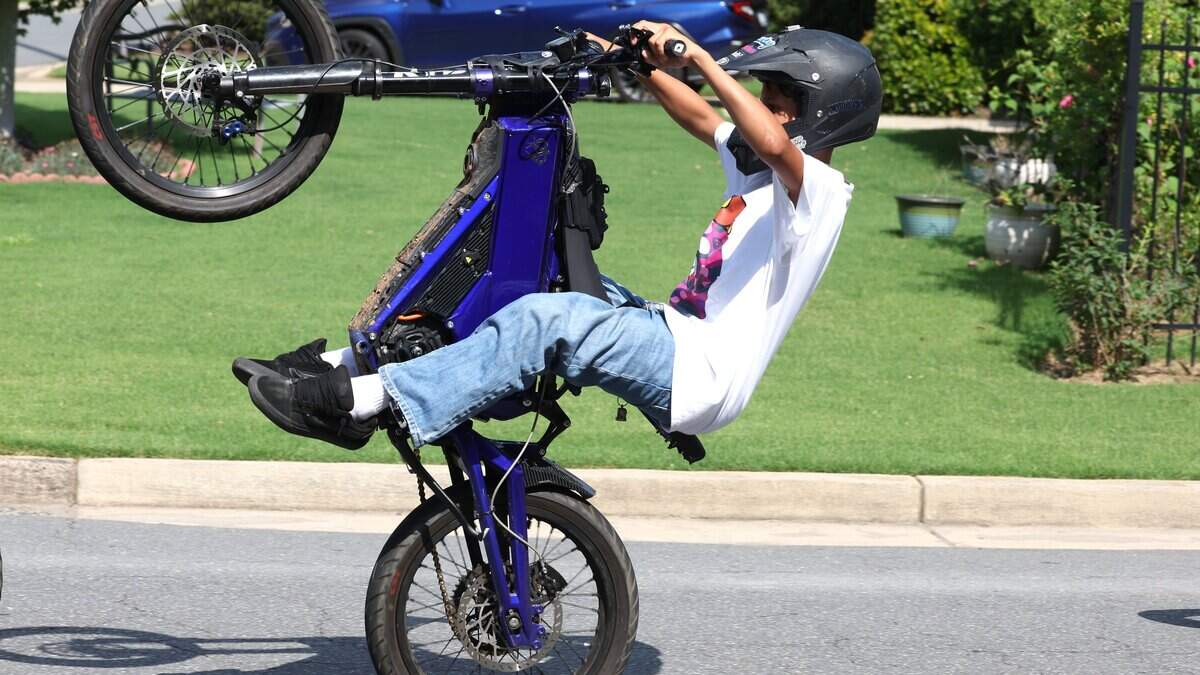
Up until recently, complaints about kids riding electric-powered bikes largely lived where so many neighborhood disputes do: on Facebook, Nextdoor and HOA message boards.
Residents complained about teenagers popping wheelies through shopping centers, blowing stop signs, weaving around pedestrians and treating greenways like race courses. Parents, meanwhile, defended the bikes as a way to get children outside and less dependent on rides from Mom and Dad.
But the problem has nothing to do with most e-bikes. Officials say the real challenge is increasingly powerful electric vehicles operating in spaces designed for pedestrians — and widespread confusion about what many parents think they’re buying.
That confusion has prompted a wave of ordinance changes across the region, and in Charlotte, a City Council member is leading an effort to take a new look at e-bike rules.
‘There is a difference between them’
Much of that confusion stems from the fact that people use the term “e-bike” to describe a wide range of very different vehicles.
Many products marketed online as “e-bikes” do not meet North Carolina’s legal definition of an electric-assisted bicycle. State law defines an electric-assisted bicycle as a bicycle with two or three wheels, fully operable pedals, a seat or saddle, an electric motor of no more than 750 watts and a top speed of no more than 20 mph on motor power alone.
Vehicles that exceed those limits may fall into other categories, including mopeds, motorcycles or motor-driven bicycles, depending on their specifications.
“Residents who call in generally refer to everything as e-bikes,” said David Baucom, police chief in the Town of Cornelius, the first Charlotte-area town to overhaul its ordinance in response to the rise of e-bikes and other electric-powered vehicles. “Because many people still do not know there is a difference between them.”
Driving much of the surge in revised local ordinances like Cornelius’s is how quickly the technology has changed.
Pedal-assist bicycles have been around for years, but officials say a wave of heavier, faster electric-powered vehicles — some capable of highway speeds while still resembling bicycles to many consumers — has blurred the line between bicycles and motorcycles, forcing local governments to revisit rules that no longer fit the marketplace.
The region’s early adopters
Nationally, these debates aren’t new.
Local governments in places like New York City, San Diego, Santa Monica and others have been wrestling with e-bike and e-mobility regulations for years. Likewise, states such as California and Colorado have developed more mature legal frameworks.
But efforts in the greater Charlotte area have been snowballing since last fall, with Cornelius overhauling its ordinance in November and Waxhaw and Davidson following suit in February.
The new rules vary somewhat by municipality, but they share the same basic goal: separating traditional electric-assist bicycles from faster, more powerful electric motorcycles while giving pedestrians priority on sidewalks and greenways.
All three towns require riders to yield to pedestrians, restrict where higher-powered electric vehicles may operate, and authorize officers to issue citations.
The differences are in the finer details.
Cornelius focused most heavily on distinguishing legal pedal-assist e-bikes from the increasingly popular e-motos that can weigh nearly 100 pounds, reach 40 mph or more and are often marketed online as “e-bikes.” Police there also can cite parents or legal guardians when juvenile riders repeatedly violate the ordinance. E-motos are not allowed on greenways, and there’s a 20 mph speed limit on greenways for e-bikes.
Waxhaw’s new ordinance also drew distinctions between vehicle types, but its public messaging has been less focused on reclassification and more on where various devices may legally operate; the rules it adopted bar e-bikes, e-scooters and other motorized recreational devices from sidewalks (while continuing to allow traditional bicycles in many cases). The town capped speeds on greenways and multi-use paths at 15 mph.
Davidson, meanwhile, has banned e-motos from sidewalks but allows true e-bikes on them. The same rules apply for greenways, although it did not explicitly set a speed limit for them. It’s instead distinguished their ordinance by placing an emphasis on an aggressive public education campaign aimed at helping families understand what their children are actually riding.
“I’ve said to parents a couple times (at informational meetings), ‘There’s no one in this room that would buy their child a motorcycle,’ and they’re like, ‘Of course not, that would be dangerous,’” said Davidson Police Chief Philip Geiger. “I’m like, ‘Well, that’s what a lot of us have done, is you’ve unknowingly bought your child a motorcycle — and now we’re hopeful that nothing bad is going to happen.”
“So ... we want people to just understand the public safety risk and comply,” he continued. “We don’t really want to do the enforcement. But if we need to, we will.”
Yet there’s a challenge for everyone involved: Parents often unknowingly buy vehicles marketed as e-bikes that are legally e-motorcycles, leaving officers to determine exactly what a child is riding before they can decide which laws apply.
Even in Cornelius, police say they’ve issued fewer than 10 citations under the ordinance.
Will the City of Charlotte be next?
That same challenge has now reached Charlotte City Hall.
Charlotte City Council member Kimberly Owens said complaints about high-speed electric vehicles were among the issues she heard repeatedly while campaigning for office last year: “When I started to run for office and people talked to me about the things that really gave them anxiety, it continued to come up.”
And since taking office in December, Owens has emerged as the first Charlotte elected official to publicly champion the issue, pushing it onto the agenda of the council’s Safety Committee as the city considers whether its ordinances have kept pace with technology.
Like officials in Cornelius, Waxhaw and Davidson, Owens said one of the biggest challenges isn’t writing new rules — it’s helping residents understand the differences between the increasingly diverse electric-powered vehicles now on the market.
“I do think it’s important to draw the distinctions, because I think it all gets lumped in together and sort of demonized together,” she said. At the same time, she added, “I want to be very clear that we are not talking about banning anything. We’re talking about really understanding, as a city, and then communicating to the folks out in our community what the distinctions are.”
Owens hopes the Safety Committee will begin discussing the issue later this summer, with proposed ordinance changes potentially reaching the full council before the end of the year.
The conversation isn’t stopping at the local level, either.
Rep. Beth Helfrich, a Davidson Democrat whose district includes much of northern Mecklenburg County, is working with police chiefs, cycling advocates and other stakeholders on legislation she hopes will bring greater clarity to North Carolina law.
“It’s tricky, because so many young people are on electric bicycles, or on vehicles that even can go faster than what we would consider legally defined electric bicycle,” Helfrich said. But she said better laws alone won’t solve the problem. “It is really an educational campaign that needs to happen in terms of trying to create policy that clarifies ... what it actually is that you’re purchasing.”
The issue has reached Congress as well. A bipartisan group of lawmakers has introduced the Safe SPEEDS Act, which would require clearer national classifications and labeling standards for e-bikes and similar electric-powered vehicles.
‘We really want kids on bikes’
If all of this sounds like a backlash against e-bikes, the officials driving these ordinance changes insist that’s exactly what they’re trying to avoid.
“We really want kids on bikes,” Helfrich said. “We want people to be able to move around on our greenways and on our sidewalks and on our streets in ways that don’t necessarily require a car.”
Owens, the Charlotte City Council member, said she actually has multiple e-bikes sitting in her online shopping cart.
“I’m trying to figure out the perfect e-bike for me,” she said. “I’m at an age where that little bit of an additional boost, particularly as I try to commute more in ways other than car.”
She said she understands why parents buy them, too — and that they give teenagers independence while relieving those parents from constantly serving as chauffeurs. The goal of any changes in the city ordinance, she said, is preserving that freedom while ensuring riders, pedestrians and drivers can safely share Charlotte’s streets, sidewalks and greenways.
“So I’m gonna see what staff comes up with,” Owens said.
“I’m gonna be curious and open-minded, and hopeful that we can all come to something where we all just, you know, live a little bit more easily together.”