Barbara Ryan awoke on Feb. 4, 2019, in a $650,000 house at the mouth of a sloping south Charlotte cul-de-sac — a home she believed she still owned. By early afternoon, Ryan, who is legally blind and paralyzed from the waist down, was homeless — “a refugee in her own city,” as one of her attorneys puts it. Court records claim Ryan lost her home due to years of back taxes she unknowingly owed to Mecklenburg County. But that’s only part of the story.
Barbara Ryan awoke on Feb. 4, 2019, in a $650,000 house at the mouth of a sloping south Charlotte cul-de-sac — a home she believed she still owned.
By early afternoon, Ryan, who is legally blind and paralyzed from the waist down, was homeless — “a refugee in her own city,” as one of her attorneys puts it.
Armed with a court order, a team of Mecklenburg County sheriff’s deputies forcibly removed Ryan, 57, from her longtime residence at 4810 Drakestone Court, then petitioned a magistrate to have her involuntarily committed to a psychiatric unit.
Three days later — and with no home to return to for the first time in her life — Ryan was living on the streets of uptown Charlotte, sleeping in the elevator of a Fourth Street parking deck to escape the wet and freezing cold of late winter. She had no money or credit cards, no identification, no phone, no socks or shoes, no food.
All of those everyday essentials were back at the house. The same house that, according to the deputies, now belonged to someone else.
Court records indicate Ryan lost her home due to years of back taxes she unknowingly owed to Mecklenburg County. But that’s only part of the story.
Two different courts have since ruled that Ryan paid what the county said she owed days before her house went on the auction block in September 2018, a payment that, under North Carolina law, should have kept the house in her hands.
Instead, the foreclosure sale — and Ryan’s removal from her home five months later — capped off a period in which every legal safeguard designed to protect homeowners’ rights in such cases quietly collapsed around her, putting her out on the streets in her wheelchair for two weeks, leaving her to roll herself through the frigid and darkened city each night to an elevator car in which she feared she might die.
Every year, thousands of Mecklenburg County property owners default on their taxes and risk losing their homes. The details in Ryan’s case, which are spelled out in hundreds of pages of court documents, set her story apart.
Veteran Charlotte attorney Harrison Lord says he had trouble believing Ryan’s experiences when he first heard them. Now he describes her treatment as one of worst injustices he has ever seen.
“I’ve been practicing law for a very long time. I’m not one for hyperbole,” he says, slowly choosing his words. “But this is the most atrocious and horrible case I’ve ever been a part of.”
Ryan puts it this way:
“It’s trying to make sense out of something that doesn’t make sense.”
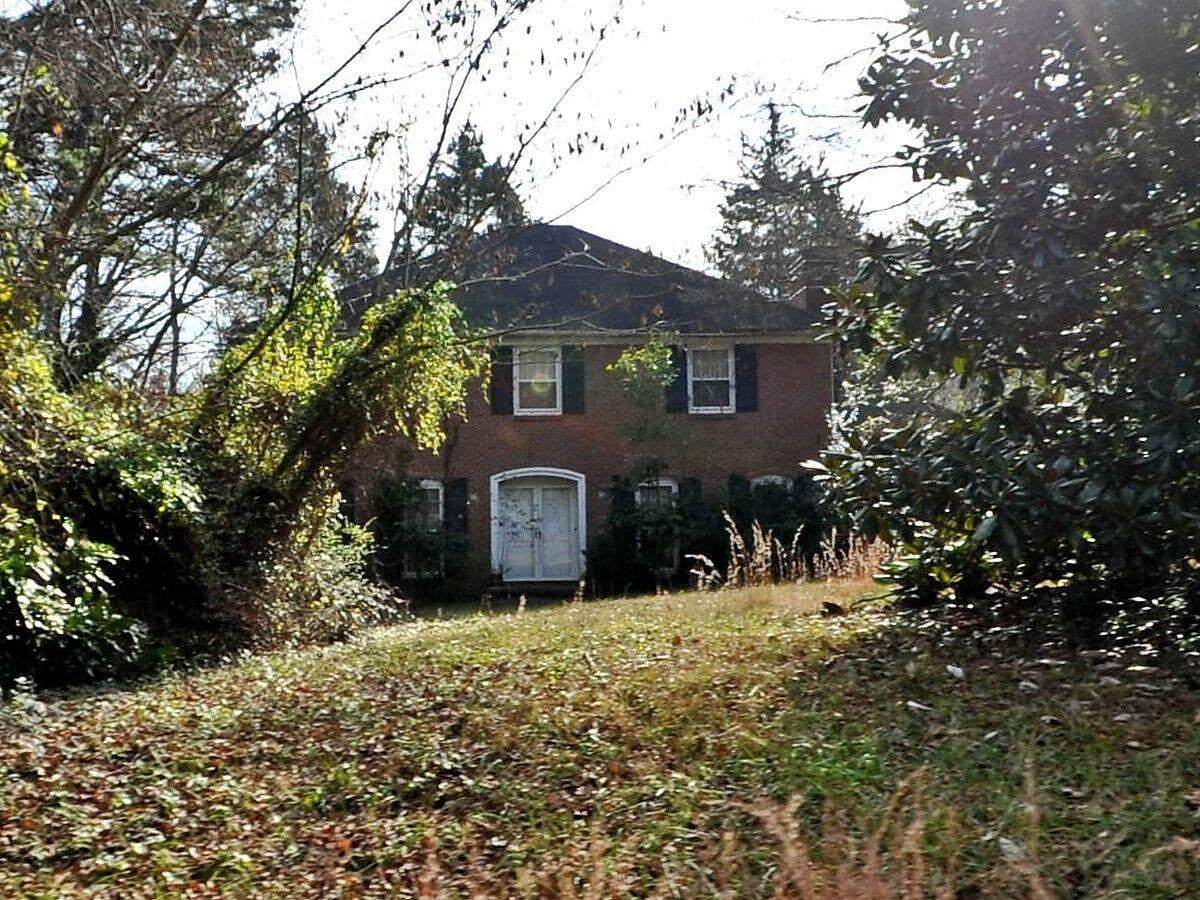
Barbara Ryan of Charlotte lost her home at 4810 Drakestone Court in 2019 for back taxes she already paid, according to court documents. Mecklenburg County
Back taxes
Ryan first walked into the two-story brick traditional on Drakestone Court as a 10-year-old in the 1970s when her parents, John and Barbara, moved to Charlotte from Wales.
It was a house that the family couldn’t really afford, Ryan says, but it was the home they truly wanted.
In 1987, Ryan was peddling her bike back to her south Charlotte neighborhood after classes at Central Piedmont Community College when she was struck by a car, leaving her with spinal injuries that put her in a wheelchair two years later. She became legally blind in 1992.
John Ryan collapsed and died inside the house a decade later. Ryan’s mother died in 2010. Barbara, who lived alone for the next nine years, made her parents’ ashes the centerpiece of a small shrine on the family’s antique sideboard.
Her attorneys describe Ryan as a private person who keeps to herself, but who also shows extraordinary loyalty to those who earn her friendship and trust. About a year ago when Casey Simmons, one of Ryan’s attorneys, lost her grandmother, Ryan wheeled herself some 12 miles from Matthews to Cotswold so Simmons did not have to grieve alone.
As a disabled woman living by herself, Simmons and others say, Ryan routinely did not answer the doorbell or the phone. In time, her property became overgrown, and her 2,800-square foot house fell into some disrepair.
According to court documents, Ryan first fell behind on her Mecklenburg taxes in 2014. More nonpayments followed for the next three years. By August 2018, her debt to the county had reached more than $20,000.
The county’s tax office filed a civil action against Ryan in January 2018. That August — and without Ryan’s knowledge — a judge approved the county’s motion to find her in default. To recoup the back taxes, the office later filed notice that it intended to foreclose on Ryan’s house and auction it off on Sept. 18, 2018.
What the court documents do not tell you is this: Ryan’s tax problems appear to be largely of the county’s own making.
After her mother’s death, the estate paid the property taxes on the Drakestone home, Ryan’s attorneys say. In time, the $300,000 in the account reverted to the state treasury. But the process, in theory, worked the same way. The tax office would tally what Ryan owed, then request the amount through the clerk of court’s office from the state-held account.
For 2011-13 , for example, the county requested and received almost $24,500 to cover Ryan’s taxes for Drakestone and a rental home in Matthews that she also owned, according to records shared with The Charlotte Observer.
In 2014, the system broke down. That year, according to records, the tax collector’s office requested $5,571.85 for Ryan’s tax bill for the Drakestone house. After the money arrived, and for reasons that still aren’t clear, the office only applied slightly more than $3,300 to the amount she owed, records show.
The county later used the difference to pay the 2015 taxes for Ryan’s rental home in Matthews, records show. But that meant Ryan’s tax account for Drakestone was suddenly delinquent by $2,266.66.
From there, Ryan’s debt steadily deepened. For the 2015, 2016 and 2017 tax years, according to Simmons, the court file for the state-controlled estate of Ryan’s mother showed no requests for money to pay the taxes on Drakestone.
What went wrong is unclear. The Observer emailed Tax Collector Neal Dixon requesting an interview for this story. A spokeswoman for Mecklenburg County replied in his place, saying in an email that the county does not comment on pending legal matters.
However it happened, by the summer of 2018, Ryan was more than three years behind in taxes and interest for Drakestone Court, which had been scheduled for auction to recoup the debt.
Worse still, she says, she had no clue any of this was happening.
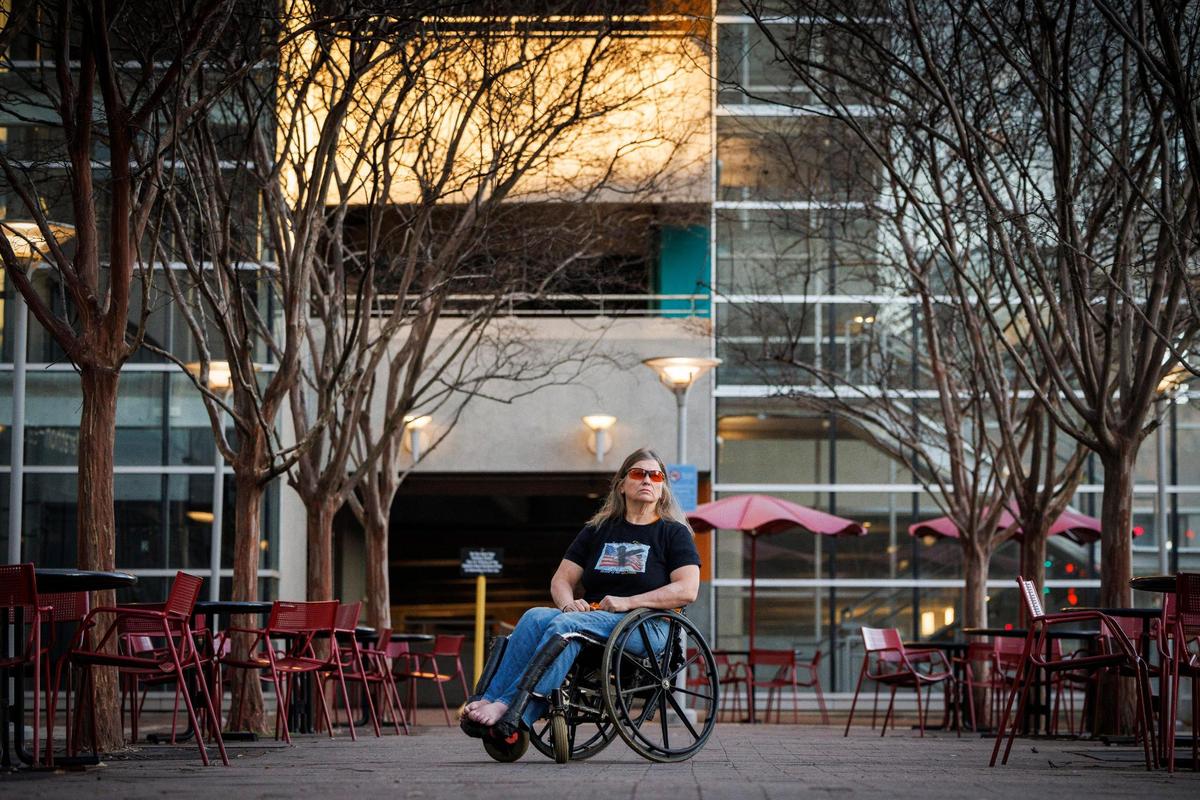
Barbara Ryan crosses East Fourth Street in uptown Charlotte on March 1, near the parking deck elevator where she was forced to sleep after losing her home in February 2019. Ryan, who is paralyzed from the waist down and legally blind, was forcibly evicted for back taxes that two courts have found that she already paid. Alex Slitz alslitz@charlotteobserver.com
The auction
In a sworn affidavit she gave three weeks after being forced from her home, Ryan says she first learned of her overdue taxes on her home less than a week before the auction.
In February of this year, a ruling by the N.C. Court of Appeals included a possible explanation why. Because of her paralysis and blindness, Ryan has difficulty collecting and reading traditional mail. So, following an unrelated tax matter in 2014, she asked the tax collector’s office to use email if it needed to reach her.
From November 2015 to September 2017, according to court documents, the county phoned Ryan 14 times. She never answered. County personnel also made at least two trips to Drakestone and posted tax delinquency notices at the house. They also paid for seven ads in the Observer and posted two more delinquency notices online. Ryan never responded. On Aug. 1., 2018, a court found Ryan in default.
In all that time, however, the county, according to the Court of Appeals, did not send a single email, even though it had Ryan’s address on file and knew that she had expressly told the tax office that emails were the best way to reach her.
As a result, the Court of Appeals reversed a Mecklenburg judge and ruled that Dixon and his staff failed to perform due diligence in attempting to notify Ryan before publishing a series of newspaper notices that May about her overdue taxes — a legal process known as “service by publication.”
Ryan first learned of her tax predicament on Sept. 12, 2018, when she says she discovered a note outside her home. It had been left by the wife of Charlotte developer Jacob “Jake” Belk, who offered to buy the house rather than see Ryan lose it in a foreclosure auction, Ryan says.
According to court documents, Ryan emailed Dixon three times over the next two days to discuss her taxes but did not get a response.
So she called the tax collector’s office on Sept. 14. The employee who answered told Ryan she owed $21,438.25 for the 2014-17 tax years, documents show. Ryan paid the amount over the phone using a debit card. The money was removed from her bank account that day and was posted as received on Sept. 17.
On Sept. 18, the house was auctioned anyway. Ryan and her attorneys say they still don’t know why.
On Oct. 15, 2018, Jake Belk, the president of a Charlotte construction company, submitted the final winning bid for the Drakestone property of $407,925.
Out at the house, Ryan says she knew none of this, thinking instead that she had “dodged a bullet.”
“Because I paid the taxes, I thought, ‘That takes care of that,’” Ryan told the Observer. “... Because you can’t sell a house for taxes if there are no taxes owed.”
Instead, on Halloween 2018, Belk knocked on Ryan’s front door. Ryan did not answer, documents show, so Belk stood on the porch and told her through the door that he now owned the house.
Confused, Ryan posted a note on the porch that she had paid her taxes and that the house remained hers, she says. When Ryan later talked with Belk, she says, he assured her that he would “back away” if she had indeed settled her tax debt with the county.
Ryan next tried to contact the Asheville law firm of Richard Kania, who had handled the county’s foreclosure auction, to say once again that she had paid her taxes and intended to keep her house.
Under N.C. law, homeowners in tax foreclosure have the right to “redeem” their property up until the day a judge enters an order confirming the sale to a new owner. In Ryan’s case, that did not happen until Dec. 6, 2018. On Nov. 28, however, a member of Kania’s staff sent her an email — incorrectly stating that Ryan’s right of redemption “no longer existed.”
Something else happened on Nov. 28: Belk made his payment to buy Ryan’s home. In all, Kania’s firm earned almost $28,000 off Drakestone’s foreclosure and sale.
A portion of Belk’s payment also went to the county to cover Ryan’s back taxes. On Jan. 3, 2019, documents show, Dixon’s office refunded Ryan’s $21,438.25 payment from September.
The county would later argue before the Court of Appeals that Ryan had not redeemed her property because the county had refunded Ryan’s tax payment. The three-judge panel did not agree.
“Put plainly,” the judges wrote, “Ryan called the (tax office), inquired about the debt owed, and paid the outstanding debt four days prior to the foreclosure sale.”
Charlotte attorney Claudia Clontz, Ryan’s first lawyer in the case, puts it more succinctly.
“She was screwed twice,” Clontz says. “The first time she paid her overdue taxes and they proceeded with the auction anyway. The second time was when (the county and its attorney) denied her right to redeem.”
Kania did not respond to two Observer phone calls seeking comment. Reached by phone, Belk twice declined to be interviewed. His attorney, Amy Hunt, did not respond to email requests for comment.
Though Ryan says Belk promised to step away if she paid her taxes, the Charlotte developer instead took steps to take over the property, documents show. After the courts approved his purchase in early December, he mailed notices to Ryan ordering her to leave the house. He posted a copy of the notice on her front door. He put another copy in her mailbox, documents show.
On Jan. 24, 2019, a Mecklenburg judge gave Belk an order of possession to take over the home where Ryan still lived. Ten days later, he joined a team of sheriff’s deputies outside of the big brick house on the corner lot of Drakestone Court.
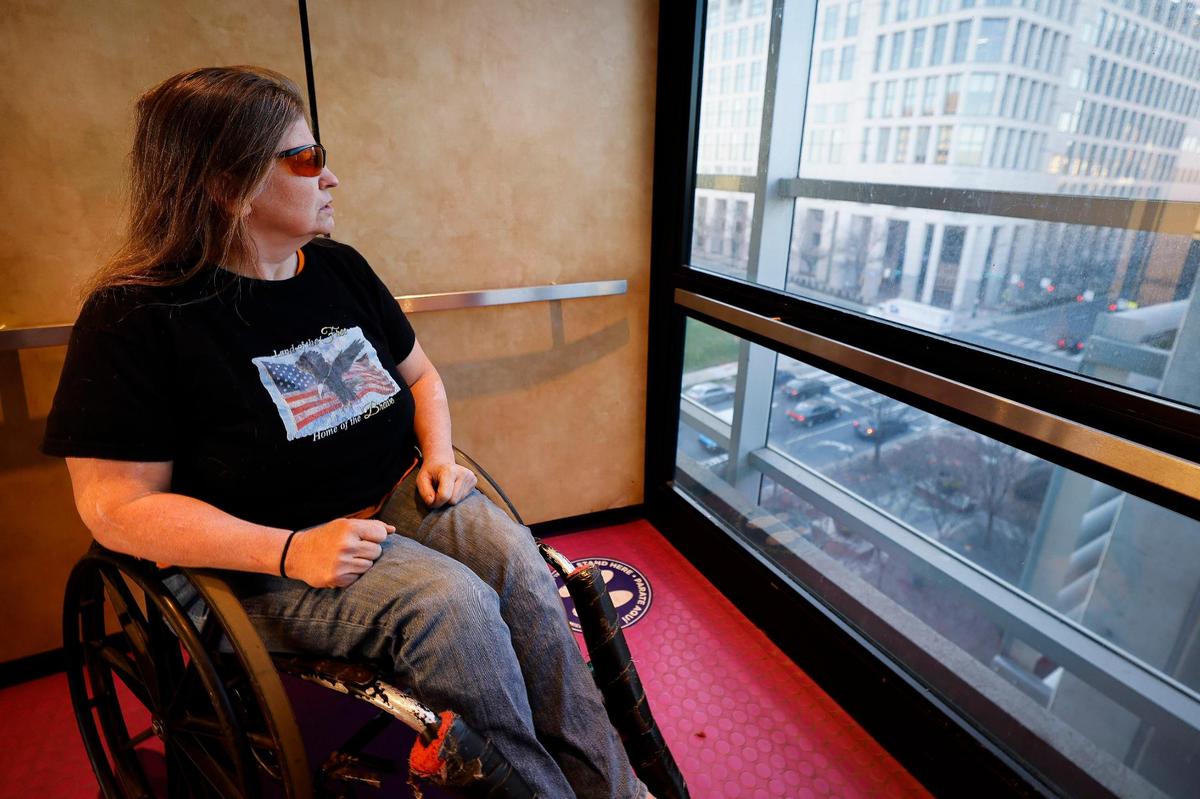
Barbara Ryan looks out of an elevator car in a parking garage in uptown where she slept while temporarily homeless on Tuesday, March 1, 2022. Alex Slitz alslitz@charlotteobserver.com
‘Those or nothing’
At 11 a.m. on Feb. 4, Ryan says she heard a pounding on the front door and the shouts of a Mecklenburg deputy.
She says she wasn’t fully dressed when she wheeled herself to the door. In the tension of the moment, she says, she struggled to unlock it.
She says she had just begun telling the four deputies to meet her in the back of the house when one of the officers broke out a back window and unlocked the door. Two deputies came inside. They stayed for about four hours. They told Ryan she had to leave.
At one point, a female deputy tossed her a pair of pants that belonged to a cousin and were several sizes too small.
“Those or nothing,” the deputy said, according to Ryan’s affidavit.
Ryan argued that there must have been a mistake and that she presented proof to the officers that she had paid her taxes, according to court documents. She was wheeled to an outdoor porch anyway.
Documents describe Ryan at this point as being “extremely upset and uncooperative.” Based on her sworn statement three weeks later, it’s easy to understand why. She says the deputies refused to allow her to gather her phone, her IDs or any credit cards and money.
On her way out the door, Ryan says she snatched a thin, fleece coat. There was a $10 bill in one of the pockets. That was it. The rest of her belongings, including the ashes of her parents, remained behind.
She says she phoned at least four times for a taxi to take her to the courthouse in hopes of finding someone who could set things right, only for the deputies to wave the cabs away. When she tried to pack up a desktop computer, a female officer told her, “You won’t need that where you’re going,” according to Ryan’s affidavit.
Ryan eventually was loaded into an ambulance. She says she heard a deputy say something about an “IVC,” short for an involuntary commitment. A medic did some routine tests, then asked her which hospital she preferred. She told him she needed to get to the courthouse, not a hospital, to stop what was happening.
By then, Belk already was boarding up the house and cutting down trees, Ryan’s affidavit says.
Under N.C. law, if judges deem that people pose a danger to themselves or others, they can be involuntarily committed for up to 90 days, with the possibility of a renewal order of up to 180 days more.
Contacted Thursday by the Observer, a spokeswoman for the Mecklenburg County Sheriff’s Office said it does not comment on pending legal matters.
Ryan’s commitment file in the courthouse is sealed. Looking back on the morning she was forced to leave her home, Ryan says she was angry, confused and afraid but not erratic or threatening. Deputies, Ryan says, later told a magistrate that she had told them that “people from Ireland were coming to get me,” and that she had dangerously wheeled herself into traffic on Drakestone.
Three years later Ryan still scoffs at the allegations. “Drakestone is a really small street. There are only eight houses. It was the middle of the day,” she says. “There is no traffic.”
Ryan says she spent three days in the locked psychiatric unit at Novant Health Presbyterian Medical Center. She spent almost all of the time on her back, she says, unable to move and in increasing pain.
She was released on Feb. 6, the same day the window to appeal Belk’s order of possession from the courts had closed. She filed for a temporary restraining order, but her request was denied without a hearing.
She says she repeatedly emailed Belk, asking to be allowed into the house only long enough to collect her parents’ remains and some other essentials.
“I do not beg easy, but I did everything but beg that guy to let me go and collect them,” Ryan told the Observer. “I was frightened. Angry. Confused. Wanting to get back to my property. Wanting to get back to my parents. Wondering how in the hell it all happened.”
She says Belk never responded.
Within days — she doesn’t know precisely when — Ryan claims her parents’ ashes “were shoveled out like trash” and dumped in a landfill with most of her other personal belongings.
Ryan had promised her mother to take her parents’ ashes back across the Atlantic to spread them in Wales. Now she struggles to speak when she recalls a vow she can no longer keep. She blames Belk.
“They don’t have a resting place. I’ll never forgive him for that,” she said in a tearful whisper. “I’ll never forgive myself that it happened. It will haunt me for the rest of my life.”
The elevator
In February 2019, according to National Weather Service records, a cold rain fell in Charlotte for nine straight days. Ryan was living on the streets for half of them.
The rental home she owned in Matthews was of little value since it was not wheelchair-accessible. It would be months before she regained access to her bank accounts, two full years before she received a replacement state ID. It would also take months for her attorneys to piece her legal case together.
Cut off from Drakestone, her computer, her phone and her personal papers, she might as well have been invisible.
“It was almost as if she didn’t exist,” Simmons says.
While homeless, Ryan spent the daylight hours inside the Mecklenburg courthouse searching for help. When the building closed at 5 p.m., she wheeled herself up the slopes of uptown to the main library on North Tryon Street.
At 8 p.m., when the library locked its doors, Ryan would make her way back east. For a time she tried sleeping under a heating duct at the Transportation Center but never felt safe. Eventually she settled on the Fourth Street parking deck near the courthouse. There, Ryan says, she would ride the elevator to the seventh floor, gaze out over the lights of the Charlotte skyline, and contemplate if she would awaken the next day.
“The worst part was always coming along and wondering whether I was going to die. At some points I did worry because I was so cold,” Ryan recalls. “At nights the numbness in my feet began moving up my body. There was rain and freezing temperatures. It was not nice weather.”
Ryan says she called two legal firms. Both declined to take her case.
Then she reached out to the law office of Claudia and Ralph Clontz. On the first phone call she talked to Simmons, who passed her on to Claudia Clontz. When Clontz and Simmons finally met with Ryan in the courthouse, they say they were stunned by what they saw and heard, and horrified at the condition of Ryan’s cut and swollen bare feet.
“She looked terrible. She had no money. She wasn’t eating. She was certainly dehydrated,” says Clontz, whose office is across the street from the courthouse. “She would have died. Absolutely she would have died. She would have died from exposure to the cold. From the lack of food or water. From a broken heart. From the lack of anyone helping her.
“Everybody in the courtroom knew about her. But nobody wanted to do anything for her because they looked at her like she was a crazy person. It’s like something you would see in a movie.”
Barbara Ryan, of Charlotte, near in the uptown parking garage where she slept in while briefly homeless in 2019. Ryan, who is paralyzed from the waist down and legally blind, was forcibly evicted from her home in 2019. Alex Slitz alslitz@charlotteobserver.com
The courts
Ryan fought for years to reclaim her home.
She believes she’s not the first Mecklenburg resident to have unfairly lost a house. But unlike others, she says, she had the money to do something about it.
In December 2019, she filed a motion calling on the Mecklenburg courts to overturn both the tax default judgment against her and the confirmation of the sale of her home to Jake Belk.
On Oct. 20, 2020, District Court Judge Paulina Havelka handed down what might be described as a split decision. She ruled that Ryan had legally redeemed her property, and the judge set aside the Dec. 6 confirmation of the sale of the house to Belk.
But while Havelka said Ryan was entitled to restitution, she did not return her property, ruling instead that Belk had been a “good faith purchaser.”
Both the county and Ryan appealed.
In February, the three-judge panel of the Court of Appeals unanimously agreed that the house belonged to Belk. Despite Harrison Lord’s arguments that Belk could not be a good faith buyer because Ryan had told him before the sale that she had paid her taxes, the judges ruled Belk had the right to rely on the county’s claim that the Drakestone house was being properly auctioned.
Late last year, Ryan filed two lawsuits — one against the county and the Kania law firm alleging fraud, negligence, misrepresentation and negligent infliction of emotional distress; and a second against Belk and his wife, Robin, which accuses the couple of disposing of Ryan’s belongings, including her parents’ remains, before the mandatory 10-day waiting period had expired.
How much Ryan will receive in restitution from Mecklenburg County — if any — will be determined in a future court hearing. Her attorneys acknowledge that any court victories Ryan earns from this point on will be bittersweet.
“No, she’ll never be made whole,” says Clontz. “Losing her possessions, losing her parents’ ashes, it’s like losing them all over again. I’m sorry about getting emotional, but this is such a horrible thing.”
On April 28, Mecklenburg County added a new legal wrinkle — filing a 450-page motion petitioning the N.C. Supreme Court to hear the case and overrule the Court of Appeals’ decision granting Ryan restitution.
The county’s arguments include the claims that it had taken exhaustive steps by phone, mail and in person to notify Ryan of her tax situation, and that “the new duty to email” property owners will be overly burdensome, especially for tax collectors.
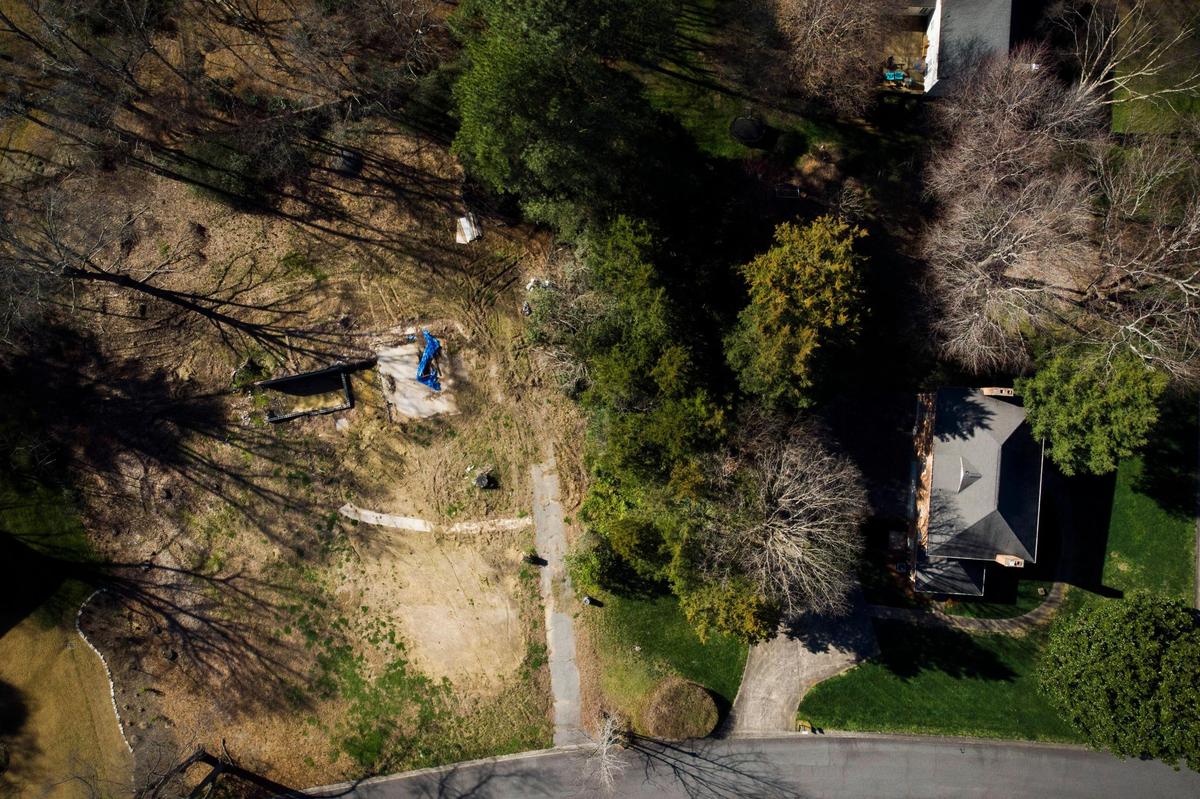
An empty lot sits at 4810 Drakestone Ct. where Barbara Ryan’s home stood in Charlotte, Tuesday, March 1, 2022. Alex Slitz alslitz@charlotteobserver.com
Drakestone
When Ryan was a girl, Drakestone Court was an outpost of emerging south Charlotte suburbia surrounded by deep Carolina woods.
She says she remembers a cedar tree out on the big front lawn where she used to bring her grandfather his beer. She recalls the basement where she and her father indulged a shared passion of working with wood, the kitchen where she and her mother would bake, and the visits by Welsh kin when her family would join voices and sing “tribal” songs.
Today, all of it is gone. On Feb. 13, 2020, Belk received a county permit to tear down the house. The project was considered complete last September. The date of the actual razing is unknown. All that’s left is the foundation, a few rows of dark bricks and a line of plastic garbage bins flanking the property line.
The south Charlotte home that Barbara Ryan lived in since childhood was torn down at an unknown date in 2020-21. All that’s left at 4810 Drakestone Court is the foundation and some debris. Alex Slitz alslitz@charlotteobserver.com
Near the street, a small sign bearing the name of Belk’s home-building company promises a new custom-built residence to take over the space. Given that the property is at the center of three active court cases, it’s unclear when the infill work will begin.
More than three years removed from the loss of Ryan’s home, her attorneys say they still do not have a full explanation of why this all occurred.
“The county and its attorneys had every opportunity to keep this from happening,” Harrison Lord says. “The system is set up. The statutes were in place. The problem is that at every stage, the safeguards failed.”
For now, Ryan is renting a place and saving her money to pay legal fees that long ago crested six figures and which could spike again given the county’s latest appeal. All the while, she continues to grieve over what she has lost.
“It was my family home,” she says. “It was the absolutely last connection to my parents, and that land means something to me. ... Now the home is gone. The only fight is about restitution, and that’s wrong.”
Clontz recalls a conversation she had with Ryan about all the ways people can lose their homes — from fires, floods and storms.
“But those are God-made. This was man-made. It should not have happened,” Clontz says.
“Things just started to snowball, and they never stopped.”
This story was originally published May 8, 2022 at 6:00 AM.
Michael Gordon has been the Observer’s legal affairs writer since 2013. He has been an editor and reporter at the paper since 1992, occasionally writing about schools, religion, politics and sports. He spent two summers as “Bikin Mike,” filing stories as he pedaled across the Carolinas.