Police deadly force justified in Galway Drive shooting, DA Merriweather says in new report
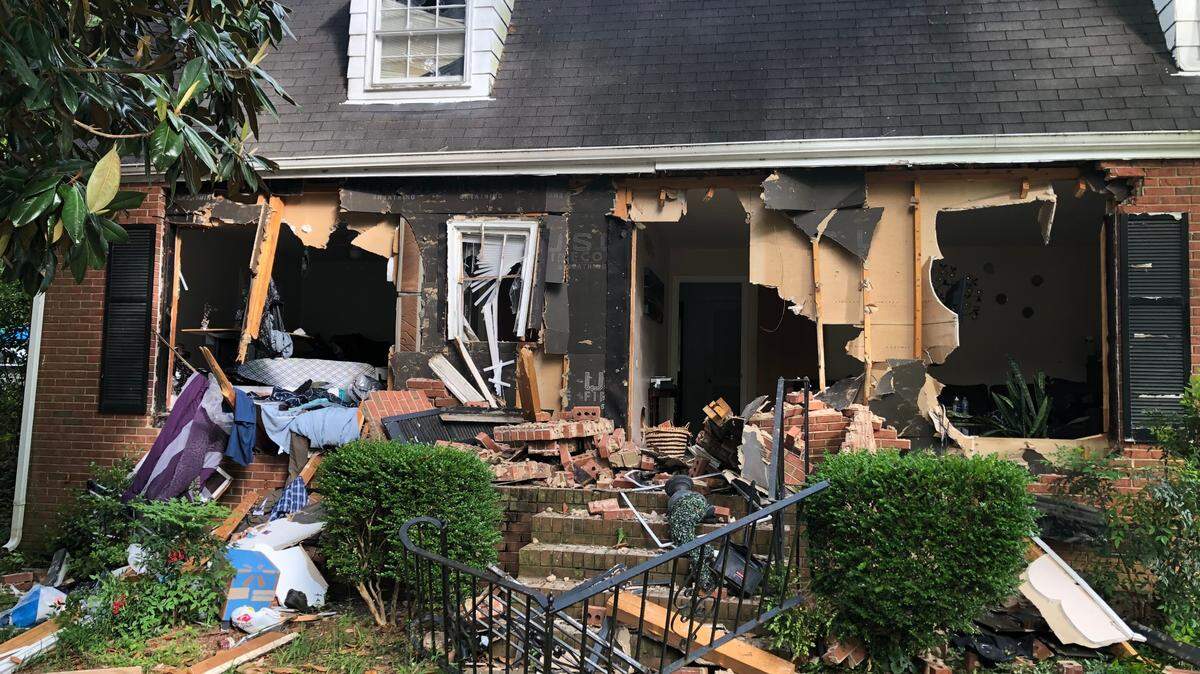
Mecklenburg District Attorney Spencer Merriweather on Thursday released his review of the investigation into the April 29 Galway Drive shooting, finding 23 officers were justified in the use of deadly force on a gunman who had ambushed a federal task force.
The task force came under gunfire and a shootout ensued. Charlotte-Mecklenburg police swarmed to the scene to help. Police fatally shot Terry Clark Hughes, Jr., who had shot and killed four officers after the task force tried to serve him a warrant. Four more officers were shot and injured by Hughes.
“This incident signifies the single deadliest assault on law enforcement in our community’s history,” Merriweather’s review said. “If law enforcement officers had not responded to an imminently deadly threat with lethal force, as difficult as it is to imagine, the outcome could have been even more catastrophic.”
Merriweather sent his letter to Charlotte-Mecklenburg Police Chief Johnny Jennings, whose agency investigated the shootout.
Officers recount April 29
The review was based largely on officers’ accounts of the fatal day, given through interviews with CMPD. There was no body-camera footage of officers approaching Hughes or of Hughes opening fire, Merriweather said.
A lone CMPD officer on the task force had a body-camera, according to the letter, but he was on the street in front of the house when Hughes started firing from a back window. It is unclear if the camera was recording. When Hughes later jumped out of a front, second-story window, the officer’s camera was blocked by the car being used as cover.
The Observer previously reported that the marshals planned to implement body cameras in North Carolina by the end of June. But they’ve declined to say whether or not they’ve done that.
“Three task force officers declined to be interviewed but submitted written statements,” the review said. “Two other task force officers declined to be interviewed or offer a written statement.”
Barry Lane, a spokesperson for the Marshals Service, declined to comment on the marshals who fired their weapons at Galway Drive would not speak with CMPD detectives.
The Carolinas Regional Fugitive Task force of the U.S. Marshals Service — which includes federal, state and local law-enforcement — had arrived at the house to try to convince Hughes to turn himself in on felony fugitive warrants for eluding police in a January chase in Lincoln County and felonious possession of a firearm, officials have said.
Three task force members were killed: State Department of Adult Correction Officers William “Alden” Elliott and Sam Poloche, and Deputy U.S. Marshal Thomas M. “Tommy” Weeks Jr. CMPD Officer Joshua Eyer, who was among officers who responded to the shooting after it started, also was killed.
The shooting captured the attention of national media, as well as U.S. Attorney General Merrick Garland and President Joe Biden, who both visited Charlotte shortly after.
CMPD asked to interview all officers who shot at Hughes that day. Four officers working for the United States Marshals Service who fired weapons — Senior Inspector Eric Tillman, Senior Inspector Austin Acheson, Senior Inspector Derek Miller and Deputy Marshal Joshua Shuffler — declined to be interviewed as a part of CMPD’s investigation.
Tillman, Acheson, and federal ATF officer Arthur Philson, who also declined to be interviewed, gave written statements.
Miller and Shuffler also declined to give any statement.
The letter clarified when the four fallen officers were struck.
Timeline of April 29 events
By 1:35 p.m., the first of “hundreds” of Charlotte-Mecklenburg police officers arrived to the scene to “assist and extract the fallen officers,” Merriweather’s letter says.
Eyer and other CMPD officers approached the house’s rear through a nearby home’s backyard. They were looking for a safe route to three downed officers.
Eyer and others made their way to a tree where Weeks had been shot.
Hughes struck Weeks first, as he took cover behind a backyard tree with Poloche. Then Hughes shot Elliott and another task force officer, who were at a fence on the side of the home.
Eyer, when he arrived to help at 1:35 p.m., went to the tree. Then Hughes shot him and Poloche as they took cover behind the tree.
Weeks, Poloche, Eyer and Elliott never fired their guns, Merriweather wrote. The 23 officers who did fired a total of 340 rounds at the home and Hughes.
At 2:39 p.m., Hughes’ girlfriend called 911 and told dispatch that she was hiding in a closet with her 17-year-old daughter. There was no evidence that either the girlfriend or the daughter — or anyone else — ever fired from 5525 Galway Drive, Merriweather concluded.
CMPD ruled out a second shooter in May, saying Hughes acted alone.
Hughes had a Radical Arms RF-15 rifle, and police found 29 spent rounds from it inside the house, mostly upstairs and near the side windows he’d been shooting from.
For 17 minutes, CMPD has previously said, officers exchanged gunfire with Hughes, before he jumped from a window at the front of the home and was fatally shot by police.
Deadly force justified
Merriweather wrote that he, as district attorney, doesn’t charge people with crimes. He simply decides whether or not to prosecute a charged crime.
“Generally, the DA does not review police decisions not to charge an individual with a crime,” he wrote. “However, in officer-involved shooting cases, the DA reviews the complete investigative file of the investigating agency. The DA then decides whether he agrees or disagrees with the charging decision made by the investigating agency.”
Merriweather’s report provided more context on why some officers at the scene believed there was more than one shooter inside.
“Some of those present believed there to have been an additional shooter who fired on officers from the residence after the decedent was killed in front of his residence,” it says. It’s not a surprising misunderstanding, Merriweather wrote, “given the confusion present on scene.”
But it’s contradicted by the evidence: radio traffic that announced Hughes was down and body camera footage that captured a shot fired by an officer who thought he saw movement in a window shortly after Hughes went down.
There’s “no question” that the 23 officers who returned fire on Hughes “did so in defense of themselves and of their fellow officers,” Merriweather concluded.
This story was originally published August 1, 2024 at 11:58 AM.