Charlotte dad who used COVID money for vacation, Jeep, school fees is sentenced

A Charlotte father of three who made his living reselling tickets escaped prison time for misusing more than $200,000 in pandemic relief funds on a beach house vacation, a Jeep Wrangler and children’s sports fees.
Federal prosecutors recommended Shawn O’Donnell, who was represented by a top Charlotte lawyer and had support of the head of Charlotte Christian School, be sentenced to at least 15 months in prison for one count of wire fraud. U.S. District Judge Kenneth Bell sentenced him to 10 months of “prison at home” and two years of probation.
The sentencing, which keeps O’Donnell strictly at home unless for a religious event or pre-approved appointment, came after O’Donnell tearfully read a lengthy statement apologizing for the fraud and the effect it had on his family and community. He feared how his actions would reflect on his wife and children.
His ticket resale company, Event Witness, provided for his three children — who all attend the private Charlotte Christian School with straight A’s and eyes set on Ivy League schools, he said in the U.S. District Court for the Western District of North Carolina on Tuesday afternoon.
O’Donnell — who was represented by Noell Tin, founding partner of Charlotte law firm Tin Fulton Walker & Owen — said he panicked when the pandemic hit. Venues shuttered. Close quarters were banned. Ticket sales for live events plummeted to $0.
O’Donnell four times filed falsified Paycheck Protection Program loan applications, prosecutors with U.S. Attorney Russ Ferguson’s office said in court documents. In total, he applied for more than $340,000 and obtained about $220,000, according to court documents.
Some of the money was used to put a down payment on a Jeep Wrangler the family got when they traded in an old Volkswagen with 200,000 miles on it. They used the new car to get to his son’s baseball games, according to court documents.
Other unauthorized personal expenses, including a beach vacation, were used “to resurrect the children’s pre-pandemic life and offer them familiar healthy outlets,” O’Donnell’s lawyers wrote.
Tin and attorney Emily Gladden in court documents said that O’Donnell’s business was “hit first, hardest, and was among the last to come back” and that PPP loans guidance was “confusing and rapidly changing” as it was rolled out.
Fraudulent loan applications
In the applications, O’Donnell said Event Witness had three employees, but there were no employees. Court documents show that his wife and brother-in-law did work with the business, but they were not W-2 employees covered by PPP loans. O’Donnell also filed fabricated loan forms for a dormant cellphone repair company that dissolved in 2017. He paid back a $157,000 loan for the cellphone company before it could be forgiven. One of the loans was denied.
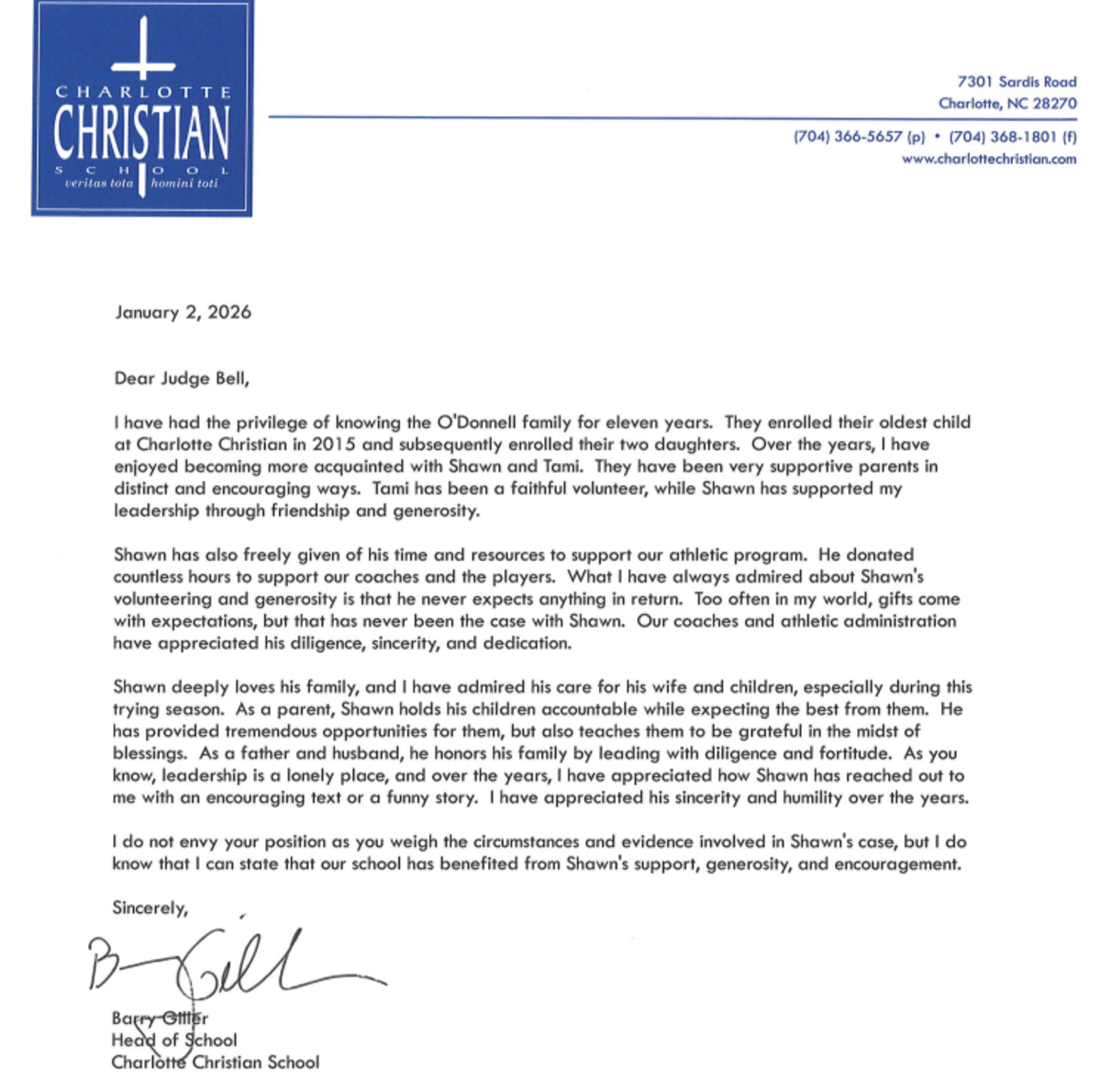
In court filings on O’Donnell’s behalf, Tin included a dozen letters hailing him as an upstanding father and role model for the baseball teams he has coached and the children he has mentored. The head of Charlotte Christian School and attorneys who met O’Donnell when he attended Wake Forest Law School wrote in support of him, court records show.
“What I have always admired about Shawn’s volunteering and generosity is that he never expects anything in return,” Head of School Barry Giller wrote. “Too often in my world, gifts come with expectations, but that has never been the case with Shawn ... Shawn deeply loves his family, and I have admired his care for his wife and children, especially during this trying season.“
O’Donnell, “in desperation… tried everything he could think of to make ends meet and support his family,” Tin and Gladden wrote. They sold possessions and applied for unemployment, Medicaid and food stamps. They sold masks and hand sanitizer on Etsy. O’Donnell “swallowed his pride and met with the principal of his children’s school and begged for leniency on tuition,” court documents say.
On top of his house arrest and probation, Bell ordered O’Donnell stop taking CBD gummies that returned positive THC readings on his required drug tests. Assistant U.S. Attorney Caryn Finley said probation officers asked him to stop taking them at least three times.
Bell also required him to complete 120 hours of community service, saying it couldn’t be “school sports, since that’s what you want to do and do already.”
It had to be a service focused around helping the homeless or those in the food bank, Bell ordered.
“I want you to see what people who are really desperate look like,” he said. “And most of them are not committing crimes.”