At end of emotional rollercoaster of a career, UNCC’s Phil Dubois shares touching tribute
Phil Dubois turned his head to the side and leaned far enough to the right that his face was no longer in view of his computer’s camera, and when he came back into frame after a long pause, tears were rolling over his cheeks.
It was the middle of an emotional day for the 69-year-old outgoing chancellor of UNC Charlotte, who just before this interview recorded a graduation message for the spring class of 2020 in his commencement regalia but had changed into a 49ers football jersey because he had a farewell video call with the school’s alumni board right after.
It has also, of course, been an emotional year for Dubois, who’s found himself leading faculty, staff and students through the aftermath of the most devastating event in the history of the university as well as the worst pandemic the world has seen in more than a century.
And if you know much about his resume, you may know this: In his previous job, as president of the University of Wyoming, he saw the campus through some of its darkest days in the wake of multiple student deaths that garnered national headlines.
So, in fact, it’s safe to say that it has been a pretty emotional career for Dubois, who will retire this summer — about two weeks shy of 15 years at the helm of UNC Charlotte.
At that particular moment, however, Dubois’ rush of tears had nothing to do with tragedy and nothing to do with sentimental feelings related to the day’s obligations.
He was weeping over the memory of something that happened at his installation as president at Wyoming in 1997.
‘It all goes up in flames’
Dubois’ last day as chancellor will be June 30, and he plans to cram into his final seven weeks as much planning as possible for what could be a very tricky fall semester in the time of the coronavirus.
He won’t be doing that work from Charlotte, though.
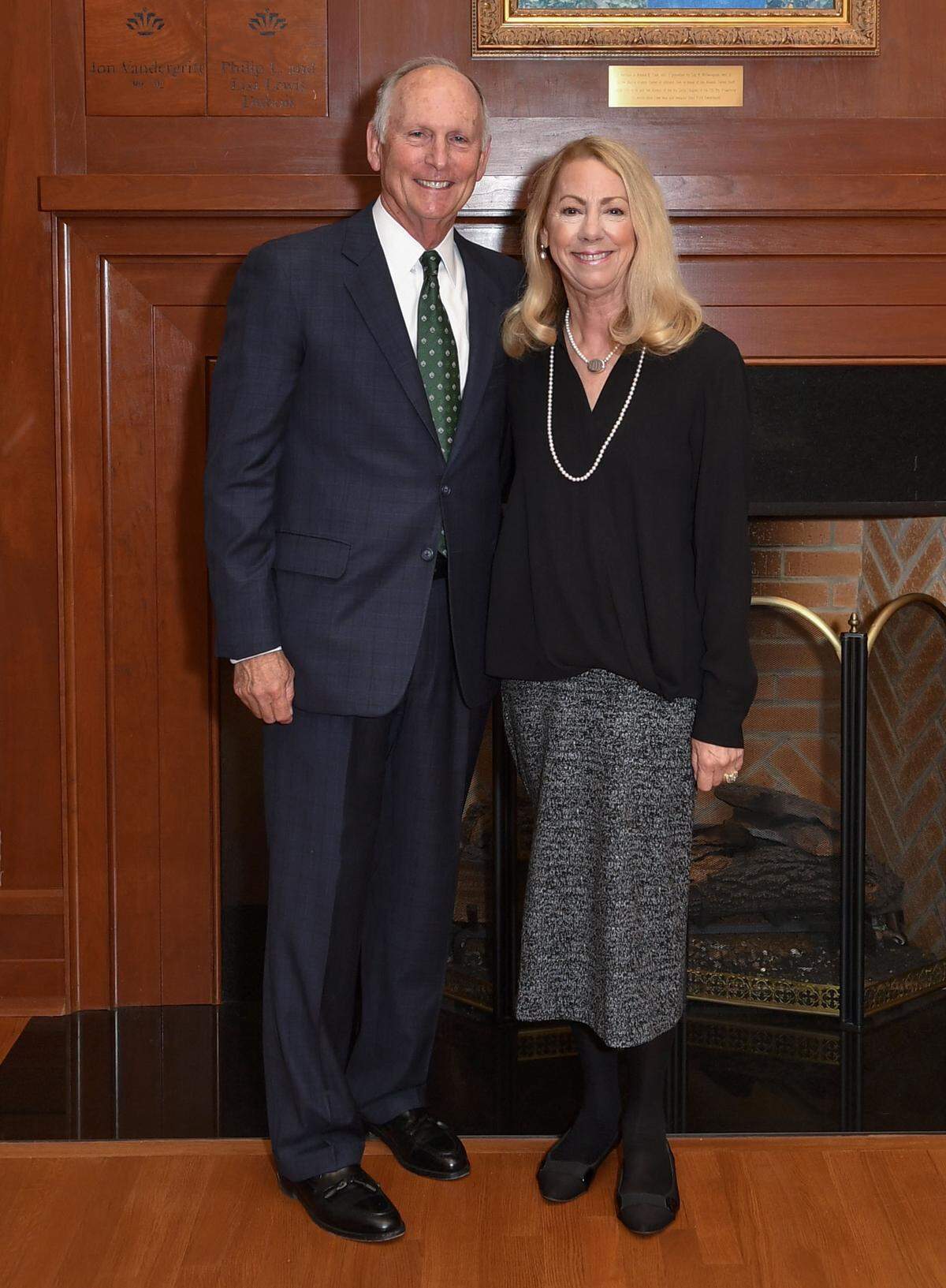
“The moving van is at the house right now,” he said during a 70-minute interview last Friday morning, adding that the goal was to hit the road and head south with his wife, Lisa, the middle of this week.
From that point on, he’ll be completing his tenure remotely from their new home on Lake Oconee, about 75 miles east of Atlanta (which is where his twin 14-month-old grandchildren are situated). Dubois (pronounced Doo-BWAH) hopes to return to UNC Charlotte in June to say goodbye to the staff, but says such a visit will hinge on whether it’s safe and appropriate at that time.
Obviously, there are no guarantees.
Just a few months ago, he and Lisa had a glorious homestretch to look forward to. Not just the special events that were planned in his honor — including a celebration to mark the renaming of UNC Charlotte’s Center City Building as The Dubois Center — but also some highly anticipated father-son experiences: great seats for him and his sons Logan and Taylor to see the Final Four in Atlanta, and tickets to the Masters golf tournament he’d scored for him and Logan, his eldest.
“I started to try to find a humorous way to describe my last year,” Dubois said, “and I decided it was like being in a fiery crash on the third turn of Charlotte Motor Speedway — you’re so close to the finish, but then it all goes up in flames. And it was sad. It was very hard on my wife, honestly, because she really wanted that for me.”
On top of that, the pandemic forced UNC Charlotte to dramatically scale back plans for public events on April 30 that would have marked the one-year anniversary of the campus shooting that killed Riley Howell and Reed Parlier and injured four other students.
Though it’s possible that it worked out better for everyone that way.
Or, at least, that it worked out less painfully.
‘Even chancellors get traumatized’
Natalie Henry-Howell, for example, had planned to let her husband, Thomas, attend UNC Charlotte’s Day of Remembrance events in April without her; Riley Howell’s mother just feared it would be too difficult emotionally to be there.
And while Dubois would never begin to try to compare his anguish to hers, it’s still there.
“Even chancellors get traumatized,” he said.
In the immediate aftermath of the shooting, he established himself as the primary point of contact between the university and the Parlier and Howell families, as well as with injured student Emily Houpt.
He felt a strong sense of obligation to be there for the victims’ families, and in the months that followed, he has “stayed in relatively constant contact” and has intervened in impactful ways — including personally inviting Reed Parlier’s uncle, David Reed, to be on the board of the remembrance commission, and playing a key role in helping Houpt land a job at Bank of America.
Dubois also said that when Thomas Howell recently told him the anniversary video UNC Charlotte put out on April 30 “hit the mark spot on ... that was the best feeling for me.”
But Dubois remains haunted by the deaths of the two young men, and by the nightmarish vision of a gunman filling a classroom in the Kennedy Building with bullets, and the crushing grief felt by the campus community.
“I would have waves of sadness come over me for all of last year,” he said. “In my rational mind, I know I couldn’t have prevented it, but —” here his voice started to quaver “— it happened on my watch. And that has — it’s bothered me. ... That, shoot, you know? These are things you read about at other places. They don’t happen at your place.”
Yet he’d been through enormous tragedy before.
In fact, his experiences at the University of Wyoming probably made him better prepared to lead UNC Charlotte through this than others might have been.
‘I can’t hide my emotions’
Dubois was just 46 and only 18 months into his presidency at the University of Wyoming in 1998 when it too drew national attention for the murder of Matthew Shepard at the hands of two men who beat and tortured the gay student before leaving him to die near Laramie. It was widely denounced as a hate crime.
Emotionally, it had a profound impact on Dubois. His father had died in 1996 of lung cancer, but his mother was still living at that point and he had never experienced such a shocking tragedy.
In February of 2000, just months after his mother was killed in a car accident, Dubois gave a talk reflecting on the Matthew Shepard murder at the annual conference of the UC-wide Lesbian, Gay, Bisexual and Transgender Association, held at his alma mater, the University of California, Davis. During it, he said: “Other than the death of my parents, I cannot recall anything that made me as sad as this for such a long period of time.”
He would go on to deliver the same speech several more times (including in 2001 at UNC Charlotte, where he previously had worked as provost and vice chancellor for academic affairs), until his wife put a stop to it.
“It was taking an emotional toll on me over and over and over,” he said, “and so she told me she would not let me do it anymore.”
Then the week after 9/11, eight University of Wyoming students were killed in an early-morning car wreck. A ninth student was driving the truck that hit their SUV. (He eventually went to prison, and remains there to this day.)
By the time Dubois was done navigating the school through that, he was an expert in crisis management.
And in 2005, not long before he moved back to Charlotte, he wrote an article titled “Presidential Leadership in Time of Crisis,” in which he wrote: “During times of crisis, the President may be not only the chief executive officer, but also mourner-in-chief.”
“You’re responsible for capturing the collective emotion and sadness of your community, and finding a way to express it,” he said last Friday. “And that happened here, when I had to do the (vigil the night after the shooting). ... I was just a basket case. I can’t hide my emotions in those circumstances. And it’s not because I think I need to show emotion, I just do.”
“I don’t think there’s anything called closure,” he added. “I mean, I don’t think that ever happens. It’s not gonna happen to me.”
‘I was trying to thank my father’
Of course, his time in Charlotte has also been marked by events that have given Dubois immense joy.
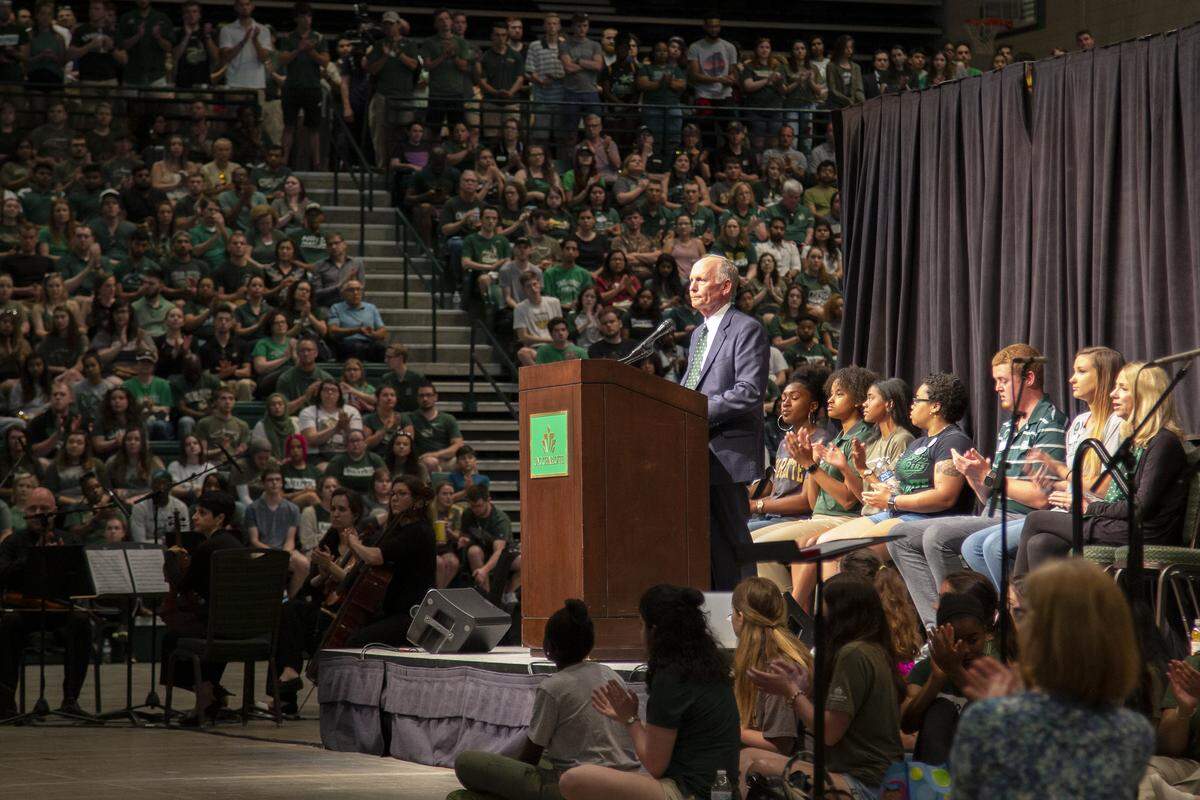
Asked during a press conference last Wednesday what he was most proud of, he replied that it’s the fact that he’s been able to graduate more than 96,000 students at the undergraduate and graduate levels with degrees and certificates. “I always think about that as like a small city of people who are gonna enjoy better lives, more prosperous lives, healthier lives, more productive lives, because they got their degree from UNC Charlotte.”
Asked during Friday’s interview with the Observer to get more specific — to pinpoint a moment when he’s gotten emotional while serving as chancellor — he picked two.
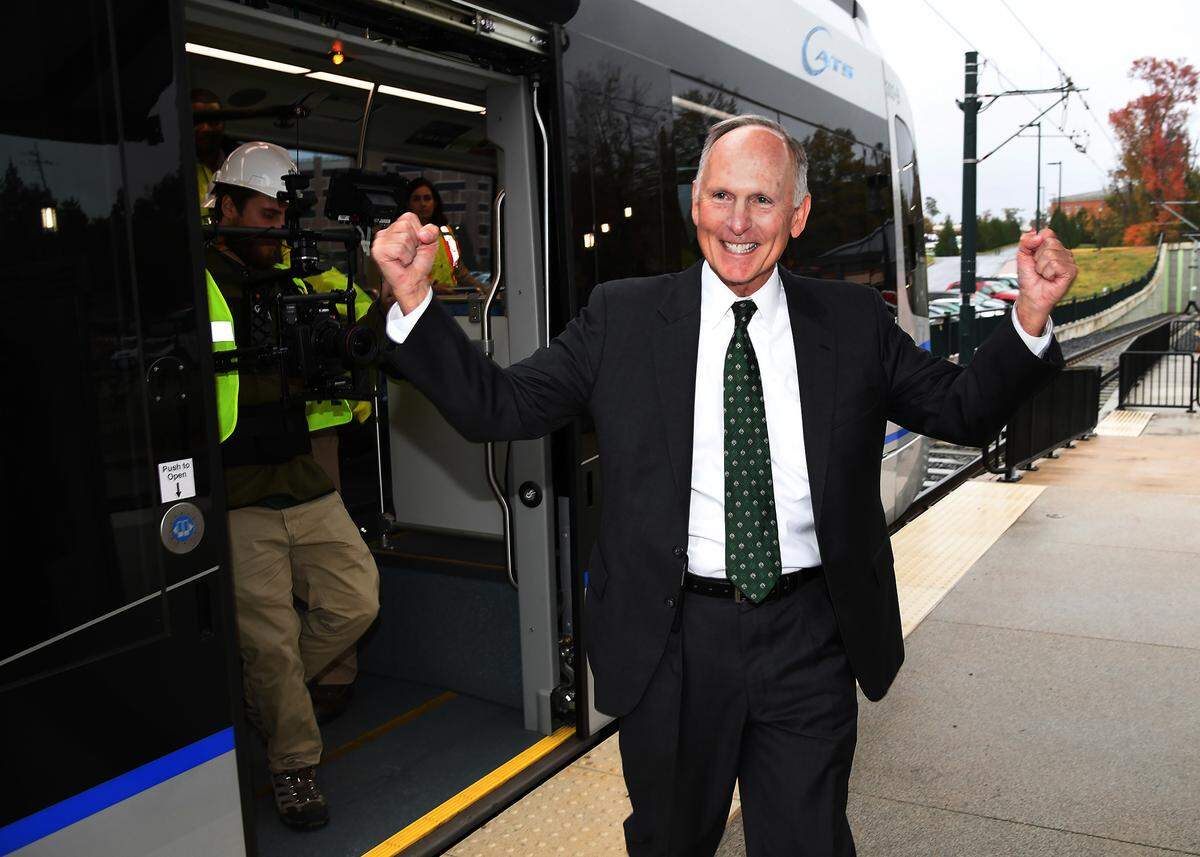
1. Nov. 8, 2017, the day he joined others for a preview ride from the campus to uptown Charlotte on the LYNX Blue Line Extension. “I just about bawled my eyes out because I was so happy to see it done. I mean, 13 years. Holy cow. Usually if you work on something for 13 years, it doesn’t come out right,” he said, laughing.
2. Aug. 13, 2013, when an American flag covered the field prior to UNC Charlotte’s inaugural football game against Campbell at Jerry Richardson Stadium. “As a form of entertainment, football’s not my deal. But I knew what it meant to the campus — especially to the alumni and to the students — and to see that place filled up with so many smiles on their faces, I really thought that was a great moment.” (The 49ers also won the game, 52-7.)
And asked how much it pains him that his parents didn’t live long enough to see all that he accomplished and all he overcame as a college president and chancellor, he answers with a story that he suggests he’s rarely told, if ever.
“No one would know this, other than my colleagues at Wyoming. ... But my mom came to my installation at Wyoming in 1997. She was in the audience sitting next to the governor of the state of Wyoming (Jim Geringer). I got up to speak — and this is two years before my mother died, but a year after my dad had died — and I had a little emotional moment when I was trying to speak to all the people who had made it possible for me to become a university president. I was trying to thank my father.”
Dubois took a long pause to collect himself.
“So I did what I’m doing right now. Anyway, my mother stood up in the middle of 450 people —” Dubois paused again.
His face disappeared from view for a few seconds, and when it came back into view, there were tears streaming down it.
But at the same time, he was smiling.
“And she yelled, ‘Oh, Phil,’” he said, his voice breaking into pieces as he remembered her words:
“‘Your father would have been so proud of you.’”
-
-
3 burning questions for Phil Dubois
Q. What’s the biggest thing at UNC Charlotte that needs to be tackled going forward?
Well, we’ve got both near-term challenges and then long-term challenges, obviously. In the near-term I’m dealing with, What does life with the virus look like until a vaccine is developed? ... The big challenge, of course, is gonna be in the classroom. ... We think we’ll have to have not only a lot more online delivery, but a lot more hybrid delivery, which is where a student goes to a class for one of the days of the week in person and then does the other day remotely. ...
Long-term, I think the issues for (Sharon Gaber, his successor) are gonna be many of the issues that I’ve had related to growth. How do you manage the growth? ...
She’ll need additional academic facilities down the road, and she’ll need some funding to renovate the ones we have. ...
Dr. Gaber is also going to have to wrestle with that question of how big is big enough? And how do you accommodate it? The UNC Charlotte main campus we think can handle about 40,000 students. But it’s already pretty crowded up here, and I’m thinking they’re going to need additional remote locations, probably in Center City close to what we already have down there. Light rail’s going to help a lot.
Q. You have said that the changing nature of the UNC Board of Governors didn’t play into your decision to retire. But what are your thoughts on the board as you leave?
The Board of Governors has been very good to UNC Charlotte. There should be no mistaking that. ... To some extent, it’s because we’re a little bit under the radar. We’re well-managed. ... We never attracted the kind of attention that the Board of Governors felt that they needed to do anything about. ...
But regarding the board generally, I’ve always felt that they’re well-intentioned people, but too involved in the transactional business of the campuses. For instance, we would have to take a construction project not only through our board, but through the big board. And when you consider the fact that there are 17 campuses taking projects through this one board, they got mired down a lot in the detail rather than in the policies that would govern construction and renovation.
So I’ve always been one to urge them to get out of the weeds of the campuses and focus more on the things that would help the entire system.
Q. Will you maintain your ties to Charlotte in any significant way?
Well, one of the reasons I am moving to Georgia is to actually get out of Dr. Gaber’s way. I have a lot of connections in the city, as you might imagine, and I want her to have the opportunity to establish her own presence and reputation with the leadership in the city, and not to have me around. ... Unlike my predecessor, Jim Woodward — who did stay in Charlotte and has been a visible presence at the university — I’m not able to hold my opinion to myself, so (it would be bad to have me) around a new chancellor.
But I do plan to come back to Charlotte now and again, of course, if she invites me to events I will consider those. I also have two grown children here. ... So we’ll maintain a connection to Charlotte, and I’m sure I’ll maintain a connection with many of the people I’ve worked with. But not in an active way. I think they need to bond with the new chancellor, and I’m going to give them every opportunity to do that.
And, of course, if anybody invites me back to Charlotte to play golf at Quail Hollow after I’ve improved my golf game, I might accept that invitation.
This story was originally published May 11, 2020 at 5:15 PM.