In Charlotte schools, student diversity isn’t seen in the staff. How can that change?
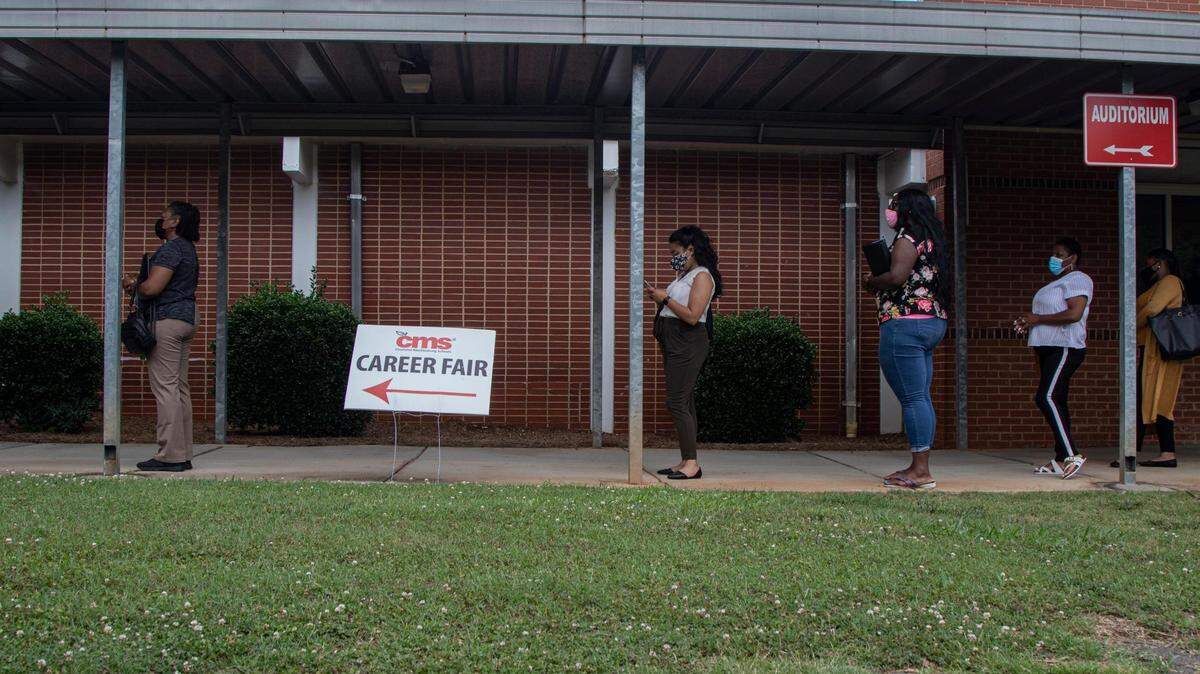
Most students in Charlotte-Mecklenburg Schools — 62.5% — are Black or Latino, yet the district’s teachers and leadership are predominantly white.
Superintendent Earnest Winston told county commissioners earlier this month the district has been strategically recruiting educators of color in an effort to improve student outcomes. But their own numbers show there’s been little progress made in that area across the last three years.
Across the city, school staff still hardly reflects student body populations.
Experts say it’s a problem.
“It is important for school districts like Charlotte-Mecklenburg to ensure that their staff reflects their student body population,” said Marcus Pollard, of the Southern Coalition for Social Justice based in Durham. “A learning environment that prioritizes diversity and inclusion goes further than the teaching material but extends to those teaching it.
“For example, a study out of John Hopkins University showed that Black students who had at least one Black teacher in elementary school were significantly more likely to graduate high school and consider going to college.”
According to the latest data the district shared this week, 29.1% of teachers in CMS are Black and 63.3% are white, as of April 30. The number of Black teachers has dipped slightly since the 2018-19 school year.
Latino teachers make up 2.3%, and 2.9% of teachers are multi-racial — both basically unchanged, even dipping slightly, since the 2018-19 school year.
According to the 2020-21 Charlotte-Mecklenburg Schools Diversity Report, 36.7% of students are Black; 27.2% are Hispanic; 25.8% are white and 7.3% are Asian.
“Does it concern me?” school board member Sean Strain said. “I’d say it is one of many opportunities we are pursuing to improve our effectiveness and ultimately student results.
“There is no question that the research/data is clear, i.e., that having an educational environment to which a student can relate and find inspirational, a culture that embraces, supports, challenges and empowers students, drives effectiveness of the teaching and learning,” Strain said. “While it is not absolutely essential that the racial, ethnic and gender diversity of the student body be reflected in the school-based staff, it is certainly tremendously beneficial to do so.”
Progress is slightly better when looking at the demographics of educators who are leaders like principals or assistant principals.
From the 2018-19 school year to 2019-20, the district had a 2.6% increase in the number of Black principals, and an overall increase of 2.9% from 2018-19 to this past school year.
In the district, 39.2% of principals are Black, and 0.6% are Latino. But the gaps are closer within the assistant principal ranks: 49.4% of assistant principals are white, 45.8% are Black.
Recruitment and retention
Christine Pejot, the district’s chief human resources officer, said the department has hosted dozens of recruitment events, including at Black colleges and universities and worked with organizations like Profound Gentlemen, a national organization founded in Charlotte that is building a community of male educators of color.
“It’s really important how we recruit,” Pejot told the board Tuesday night. She said they’re bringing in mentors to specifically mentor and coach Black male teachers who are new to CMS.
According to the district, 120 soon-to-be CMS teachers who are completing classroom training identify as teachers of color.
And CMS is making a concentrated push to recruit more Latino educators. Officials have participated in virtual recruiting events to try and draw international teachers, as well.
“It’s important to have a diverse teacher base and school leadership because it shows students that they are valued and that this world is full of many different types of people that can, and do, make a difference,” Ron Brown, a former teacher who now works for Profound Gentlemen, said. “Being able to culturally identify with your teacher or school leadership can open doors with a student and their family.”
CMS teacher retention in 2019-20 was 89.9%, which was higher than the national average of 84% and state average of 87.53%. That translates to nearly 9 out of every 10 teachers are returning for the next school year.
Black teacher retention is 86.7%; white teacher retention is at 87.2%; Hispanic teacher retention is 89% and multi-racial teacher retention is 90.6%. All groups have slightly decreased year-over-year, Pejot said.
“Our programming focuses on keeping male educators of color in education through community building and social emotional learning,” Brown said. “We’ve seen our gentlemen are more likely to stay in the classroom or seek a leadership position when they are supported by a community and valued.”
‘We must be serious’
Equity is a hot-button issue causing division between CMS and Mecklenburg County commissioners. County leaders are withholding $56 million from the district until it provides specific plans on how it will fix failing schools that most Black and brown students attend.
While diversifying teachers will certainly help, educators lament that it’s not easy.
“We’re having more and more problems getting Black students into education,” school board member Ruby M. Jones said.
CMS isn’t alone.
In a DRIVE Task Force (Developing a Representative and Inclusive Vision for Education) report presented to Gov. Roy Cooper, 79% of the teachers throughout North Carolina identified as white, while 47% of the students identified as white.
“If we are truly focused on liberating the education environment and increasing the chances of success for Black and brown students, we must be serious about increasing diversity for faculty and staff,” Pollard said.
Breana Fowler, the student advisor to the CMS board, said the district should think about how to get students engaged and excited about education.
“Could we create a program for our students to say, shadow a teacher over the summer or shadow a teacher in the classroom,” she told school board members.
“My father’s a teacher, so that’s how I kind of understand what all the teachers have to go through during the summer. But I have friends that are interested in being teachers. In CMS, we could use the resources.”
Amanda Thompson-Rice, the president-elect of the Charlotte Mecklenburg Association of Educators, said the CMAE gives scholarships to individuals pursuing education degrees — but it’s hard to find recipients.
“We also have to consider how the role of teacher has been painted for decades,” Brown said. “If a student isn’t viewing the field of education as appealing, we have to ask why that is and how the field has (or hasn’t) changed in decades.
“Maybe the question isn’t why is it hard to get male educators of color, but instead, why are males of color not pursuing the education field as a career track? Is the pipeline appealing?”
This story was originally published June 11, 2021 at 12:12 PM.