Some students are more than a year behind. What’s CMS doing about COVID learning loss?
Charlotte tutor Leslie Scott was ready to help children read at the beginning of this school year, something she’s done for decades.
The veteran mentor also was prepared for what she knew would be a challenge: far-reaching COVID disruptions over the prior two years have slowed learning progress across the state in all grades and subjects.
Scott, 62, works with third- through fifth-grade students at Reid Park Academy. And although she was ready, she was shocked by what she found.
“The kids couldn’t write sentences,” Scott said. “They didn’t know punctuation. They didn’t know when to use an exclamation mark. I’m thinking, ‘How am I going to teach them reading? How am I going to get these kids up to par, when they can’t write?’ ”
Scott’s students are not alone in their struggles.
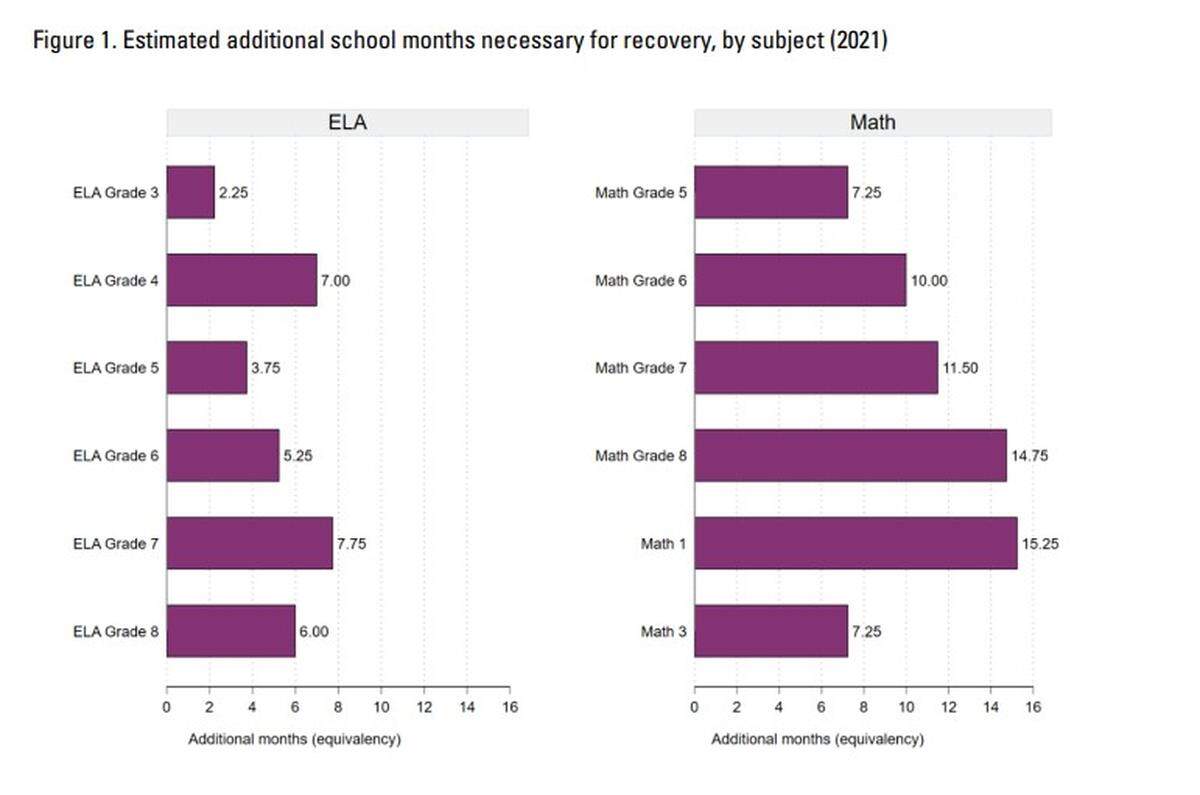
Statewide data released last week covering the last school year shows math students in North Carolina middle and high schools are more than a year behind where they should be. Student losses in reading are anywhere between two and seven months behind.
In Charlotte-Mecklenburg Schools, less than 15% of all third-graders are expected to be on track in reading. And less than 10% of Black or Hispanic third-graders are expected to be on track in reading.
State data released in September show 44.6% of students in all subjects passed exams, and a low number of the district’s students are college or career ready in key subjects such as math and English. For example, this fall saw only 4.5% of CMS high school students scoring high enough on exams to be considered performing at the college or career level in math skills.
.png "image (4).png")
How will CMS help?
CMS’ solution for the lingering problem is bolstering summer programs and “high-dosage tutoring,” an intervention the North Carolina Department of Public Instruction supports.
“While students have made much progress during this school year, some students still have learning needs,” said Nancy Brightwell, CMS’ chief academic officer. “Summer programs will help students continue that learning in a fun, engaging way so that they are prepared to start the ‘22-23 school year ready to learn grade level work.”
Scott said learning loss, whether from a pandemic or summer breaks, is systematic and failures can be prevented once there’s awareness and people start having dialogues.
“You can’t fire superintendents and say it’s their fault,” Scott said, referring to the firing of former Superintendent Earnest Winston last month. “You can’t blame it all on a pandemic. I tutored before the pandemic and after. It’s really something parents should be expecting.
“If your children were having problems before, they’re going to have problems after.”
Learning losses deepened
Learning losses deepened from 2018 to 2021 in grades three through high school, according to data the state’s Office of Learning Recovery and Acceleration released last week. Those losses were in reading, English and math.
Students in seventh grade English language arts, for example, are nearly eight months behind where they should be, according to the data. Officials based results on a nine-month school year instead of a 12-month calendar.
Students in Math 1 are nearly 16 months behind schedule.
“As a school district, we are focusing on literacy proficiency by the end of third grade, math and algebraic proficiency at the end of Grade 9, so students are college- and career-ready when they graduate,” said Mark Bosco, the former Myers Park High School principal who is now the CMS senior administrator of expanded learning. “As a result, all content areas and grade levels have a part to play in this preparation.”
Bosco expects about 10,000 students to participate in summer programs, most of which begin in June and are meant to help students stay on top of their subjects, catch up or both.
Last year, 30,000 students were enrolled in summer programs, and average attendance was around 16,000. Attendance was not mandatory.
Brightwell said any second- or third-grade students needing support in reading can attend the Summer Reading Camp, and enrollment is taking place now. Other summer programs that include language help and transition help for incoming ninth-graders, among others, serve targeted populations based on student needs.
Last summer when the state required all districts to offer 150 hours of summer school, more than 95% of elementary and middle school students who participated were promoted, according to a state DPI report. Nearly 80% of high school students were promoted.
The success rate for seniors who needed credits to graduate was 97%, according to the report.
’What the teacher brings’
Leslie Neilsen teaches world history and global studies at Community House Middle and taught at Camp CMS last summer. Neilsen said she hasn’t seen learning loss as much as she’s seen children struggling with the stamina to keep at a task when it gets difficult.
“During remote learning, they could pick and choose when to work on something. In the classroom, I am there to sit with them and help them through a struggle and hold them accountable and encourage them,” Neilsen said.
“That is what they lost in the past two years more than anything,” she said. “It’s what the teacher brings to the learning experience for them. It was difficult to recognize the cues we are used to using when a student is struggling when you were teaching 35 little black boxes.”
Neilsen said children who invested in summer learning made gains. But it also became important for educators to build relationships and foster trust.
“When students don’t feel successful and are hearing all the time they have ‘learning loss’ what kind of message does that send to them?” she said. “This isn’t going to be solved in one summer or one school year.
“But the kids will be able to successfully make gains if we stop putting the emphasis on test scores,” Neilsen said, “and start putting it back on the soft skills and critical thinking skills they need to succeed. Not just in school, but in life.”
A push for more tutoring
During the 2021-22 school year, thousands of students were tutored in the areas of reading and math, CMS Interim Superintendent Hugh Hattabaugh told school board members May 10.
In the current school year, he said, more than 32,000 students received high-dosage, or high-impact, math tutoring sessions, and more than 7,000 students were receiving fluency tutoring. High-dosage tutoring is a form of teaching in one-on-one or small group settings.
Gia Page, senior project director for Helps Education Fund programming in Charlotte, said such tutoring helps students in several ways.
The frequency of sessions, for example, means students get regular and consistent practice. Helps Education Fund is a nonprofit based in Raleigh and one of CMS’ tutoring partners along with Heart Math Tutoring and the Augustine Literacy Project.
“Sessions can be individualized to meet the unique needs of each student,” Page said. “We often forget the value of the 1:1 attention that each student receives from their tutors. During the sessions, students receive high praise, encouragement, and the opportunity to develop strong bonds with their tutors.”
In the fall, CMS announced it was launching a tutoring initiative that aims to support students whose learning was significantly disrupted during the pandemic.
At the time of the announcement, then-Superintendent Winston said district educators had to intervene “now to improve outcomes for many of our students, especially those from traditionally under-served racial and socioeconomic backgrounds.”
Winston continued: “Gaps in student achievement that existed before the pandemic have grown wider, and they will not narrow without expanding learning opportunities and support beyond the time students are with our teachers and staff in classrooms during the school week.”
Bosco, the senior administrator of expanded learning, said CMS has approved 30 vendors, and the district is investing upwards of $50 million from federal COVID relief money in the tutoring initiative.
Virtual and in-person tutoring will begin this summer. CMS is registering students now from the 42 schools the state has designated as low-performing.
“Students come to us with various challenges,” Page said. “So there is not a specific number of sessions that will address all needs.”
For example, Page said, if a student is struggling due to a lack of confidence it’s possible that just a few sessions will empower them to show progress. But if a student is an English language learner, or English is not their first language, they may need more time.
“At least 60% of students who receive Helps tutoring will meet or exceed expected growth,” Page said.
Enter the corps
In May, Gov. Roy Cooper visited South Johnson Elementary School in Scotland County to meet with members of the North Carolina Education Corps program.
The NC Education Corps serve as high-impact literacy tutors who help K-3 students with reading skills and help them recover from the learning disruptions they experienced over the course of the pandemic.
Cooper encouraged people to apply to be a tutor for the 2022-23 school year.
According to school officials, 100% of students being served through literacy tutoring demonstrated growth in reading, and 10% of them moved from below grade level at the beginning of the 2021-22 school year to at grade level by mid-year.
“We are calling on more North Carolina residents to step up and serve as high-dosage tutors in the coming school year,” NC Education Corps Executive Director John-Paul Smith in a news release.
In CMS, Bosco said there are 3,200 tutoring slots for the summer, and the actual number of tutors will depend on the individual vendor.
‘Learning is a trajectory’
Neilsen is 53 and is in her 12th year teaching in CMS. The Community House educator said teachers don’t define learning loss.
“You lose your hearing, your vision, but learning is a trajectory. So it may have been slowed down by the pandemic, but it was never lost, and students can and are making gains,” Neilsen said. “Teachers have always had students who have delays or deficits for a myriad of reasons, and we know how to mitigate them.”
She said parents and educators can help children by letting “kids be kids” and limiting screen time.
“They also need to read on their own and feel encouraged,” Neilsen said. “They are resilient and do not have any reason to feel like they are ‘less than’ because of a global pandemic. We have to stop selling the narrative that our kids are broken.”
Children need to stop feeling like the only measure of success is test scores and grades, she said — even though that’s how CMS and the state DPI are measuring learning loss.
“Let me tell you that the pride I feel with my students is what they write in an essay on climate change, or show concern for teachers with COVID by helping donate items for care packages, or how they all rallied together to raise money for Ukrainian refugees,” Neilsen said. “I’d say that is not a loss at all. I’d say that is a huge gain.”
As for Scott, the veteran tutor at Reid Park Academy said she worked part-time and saw upward of 25 students a day in groups of about five students over several months. She was able to teach them the context of sentences — and reading.
“We got the little problem fixed,” Scott said. “It was doable, in a short amount of time. The kids were getting it and loving it.”
This story was originally published May 29, 2022 at 6:00 AM.