UNC defends race-conscious admissions in arguments at the Supreme Court
READ MORE
Supreme Court cases on affirmative action
A UNC admissions case made it all the way to the Supreme Court. How will the Supreme Court rule? How do decisions on other cases throughout history inform this one? And could this SCOTUS ruling change college admissions in the future?
Expand All

How will college admissions adapt after the Supreme Court rules in UNC case?
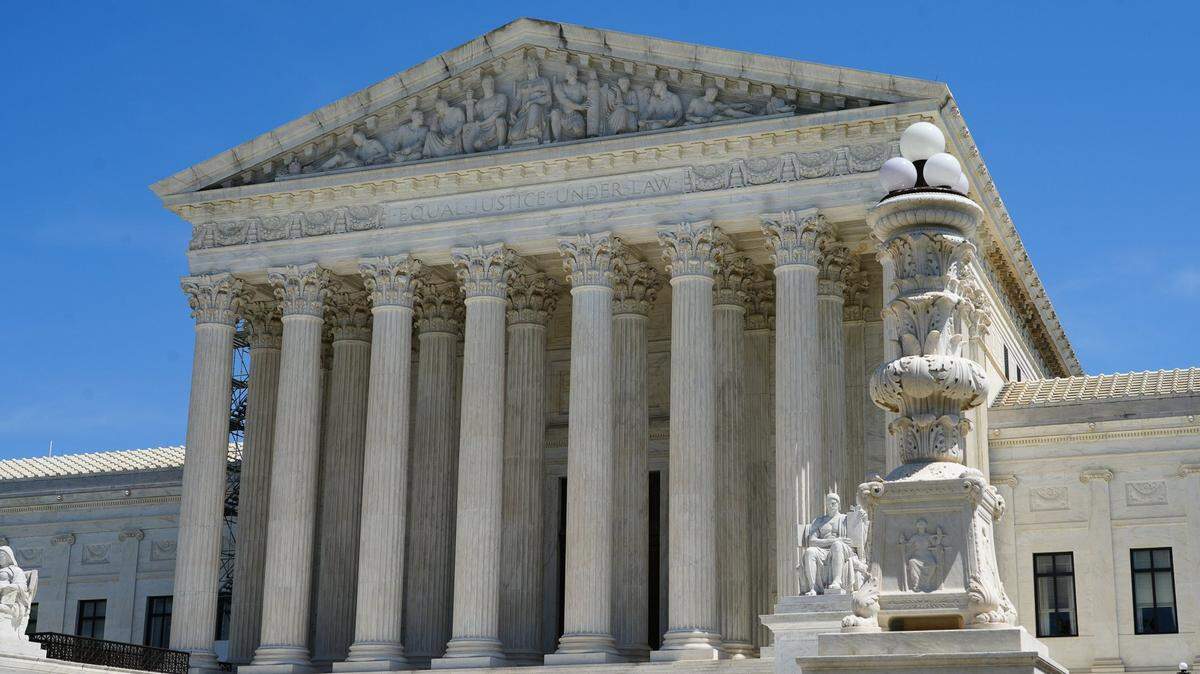
How has U.S. Supreme Court ruled on affirmative action? Here’s a timeline of cases.
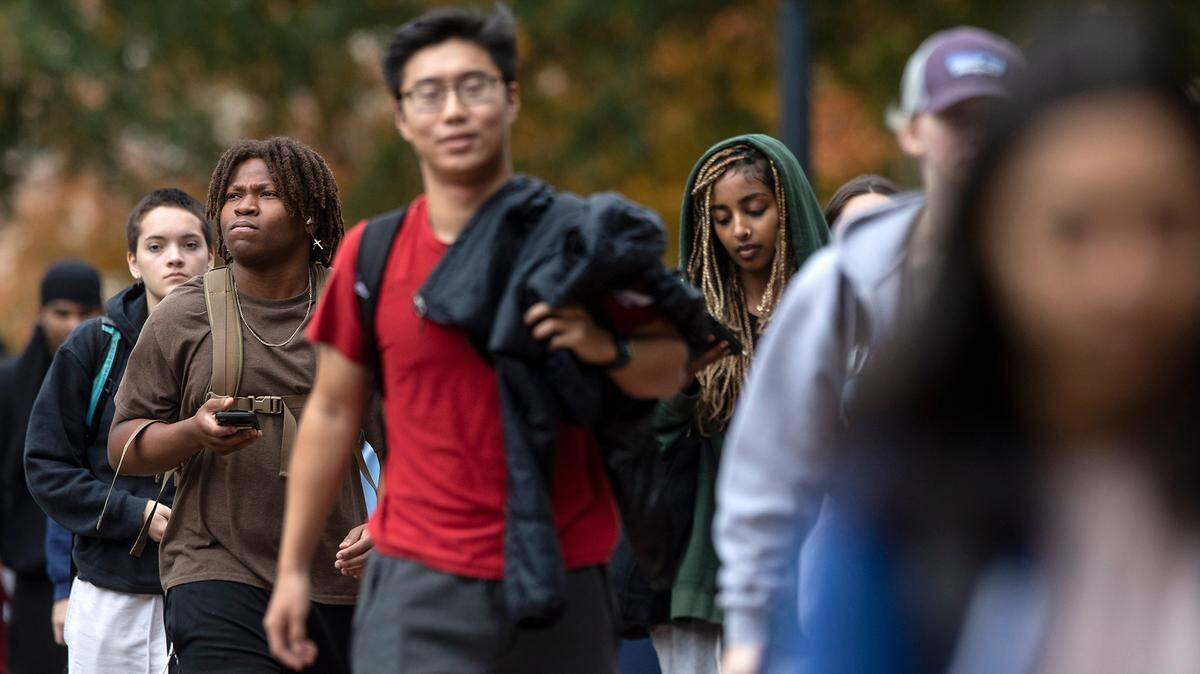
How did UNC admissions case get to the U.S. Supreme Court? Here’s a timeline.

UNC’s affirmative action case explained: What was the complaint and what happens next?
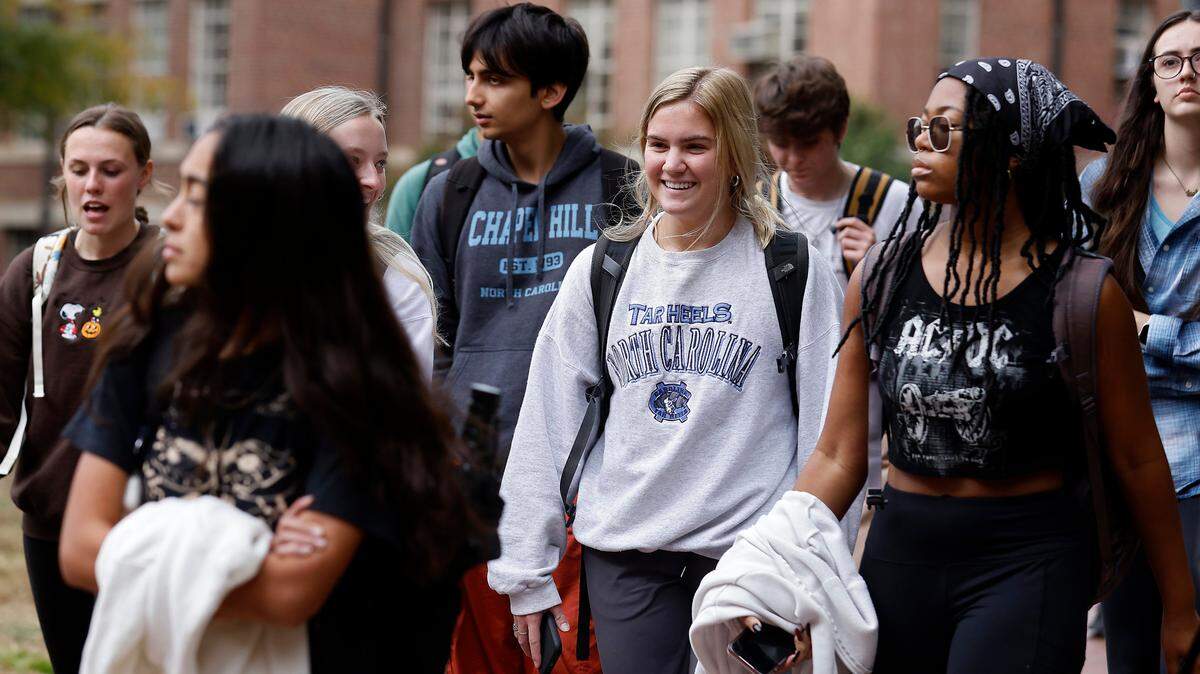
UNC defends race-conscious admissions in arguments at the Supreme Court
The U.S. Supreme Court heard arguments Monday in two cases concerning the use of race in higher education admissions practices, including one involving UNC-Chapel Hill.
In Students for Fair Admissions v. University of North Carolina, the court will consider whether institutions of higher education can use race in their admissions decisions, and whether UNC’s practices violate the 14th Amendment to the U.S. Constitution, which provides equal protection under the law.
The case stems from a 2014 lawsuit brought by Students for Fair Admissions (SFFA), an anti-affirmative action group made up of thousands of rejected applicants, prospective students and parents.
That group is behind the other case heard by the court Monday, which considers Harvard University’s use of race in its own admissions process and whether it violates Title VI of the Civil Rights Act of 1964, which prohibits racial discrimination by institutions that receive federal funding.
SFFA is led by Edward Blum, a conservative legal activist who previously led a successful effort to dismantle part of the Voting Rights Act of 1965 in Shelby v. Holder, a 2013 Supreme Court case. The group was represented in the UNC case Monday by Patrick Strawbridge, a Boston attorney.
UNC was represented by North Carolina Solicitor General Ryan Park. A group of students from the university was represented by David Hinojosa of the Lawyers’ Committee on Civil Rights Under Law. U.S. Solicitor General Elizabeth Prelogar also argued on behalf of the federal government in support of UNC and its policies.
The court, which tilts conservative and has shown a willingness to overrule precedent, is expected to hand down opinions in the cases next year. Depending on how the court rules, the decisions could significantly alter, or even bring an end to, race-conscious admissions processes, also referred to as affirmative action, in higher education.
Crowds of attorneys and activists gathered outside the Supreme Court building Monday morning, waiting for the courthouse to open and for the justices to hear arguments.
A crowd of young people wearing Carolina blue crowded together and shouted “defend diversity” while holding signs and advocating the importance of diversity and inclusion in education.
Originally set for 90 minutes of oral arguments divided evenly among both sides, Monday’s proceedings in the UNC case lasted almost three hours, with the nine Supreme Court justices asking several questions.
SFFA argument says precedent is ‘grievously wrong’
Strawbridge, representing SFFA, opened the day’s proceedings at about 10 a.m., saying in his opening statement that “racial classifications are wrong” and urging the court to overturn precedent set out in Grutter v. Bollinger, a ruling on affirmative action from 2003.
That case, from the University of Michigan Law School, allows what is referred to as “narrowly tailored” uses of race in “highly individualized” admissions decisions “to further a compelling interest in obtaining the educational benefits that flow from a diverse student body.” It has been largely upheld in subsequent rulings by the court, as recently as 2016.
“Grutter is grievously wrong,” Strawbridge told the court in his opening statement, saying that such racial classifications used in admissions processes under that ruling are in violation of the 14th Amendment.
Strawbridge also said that “there is no evidence that, after two decades, Grutter has somehow reduced the role of race on campus” — and, that although the Grutter opinion posited that race-based admissions should diminish over time, UNC has not made it clear when the university might reach a scenario when that is the case and the university’s diversity goals have been achieved.
The Supreme Court justices then launched into more than 50 minutes of questions for Strawbridge on SFFA’s position and arguments, beginning with a question from Justice Clarence Thomas on whether not being able to consider race in admissions prohibits universities from considering “the whole person in the admissions process.”
Strawbridge responded by saying that the court “has always said that racial classifications are necessarily invidious.”
“And certainly, it is possible that an applicant, for example, could write something in which race provides a context for their experience,” Strawbridge said. “But just considering a race, and a race alone, is not consistent with the Constitution.”
Some justices, including Ketanji Brown Jackson and Sonia Sotomayor, pushed back against that reasoning throughout their questioning of Strawbridge, noting that, under precedent in Grutter, race can be considered not as the sole feature of a student’s application, but instead as part of a holistic review process that considers several additional factors.
“Race is never the determinative factor. That was the finding by the district court,” Sotomayor said, referencing the 2021 decision in the previous federal trial on the issue, when a judge ruled in favor of UNC’s practices. “Race alone doesn’t account for why someone’s admitted or not admitted. There’s always a confluence of reasons.”
SFFA says UNC should use race-neutral alternatives
Other questions from the justices to Strawbridge focused on race-neutral alternatives in admissions, which SFFA suggests could be used instead of the university’s current practices. In those alternatives, factors such as socioeconomic status would be used instead of race to create a diverse student body.
“We do not think the university has made a commitment to race-neutral alternatives,” Strawbridge said of UNC’s policies, responding to a question on the topic from Chief Justice John Roberts.
In the previous federal trial on the issue, Judge Loretta Biggs said the university had considered race-neutral strategies, including new methods of recruiting, more financial aid and admitting more transfer students, and that there was “no non-racial approach that would promote such benefits about as well as its race-conscious approach.”
Justice Brett Kavanaugh questioned Strawbridge over whether specific factors or information in an application, such as whether a student is descended from enslaved people or from immigrants, could be considered race-neutral. Strawbridge said he was unsure of whether it would be permissible to consider a student’s relation to enslaved people, because that could be a “proxy” for race, but a student’s relation to immigrants “is probably closer to being OK.”
Jackson later pressed Strawbridge on his response to that question, exploring possible violations of the Equal Protection Clause when the experiences — particularly when it comes to family relations and experiences — of some students would able to be considered in race-neutral alternatives, while others would not.
In a hypothetical example, Jackson presented to Strawbridge two imaginary students who applied to the university for admission — both of whose families have lived in North Carolina for generations, but one whose family has attended UNC for generations and another whose family descended from enslaved people, whose story and background are closely tied to race.
Jackson said the applicants “would have a dramatically different opportunity to tell their family stories and have them count” in the university’s admissions decisions.
“The first applicant would be able to have his family background considered and valued by the institution as part of its consideration of whether or not to admit him, while the second one wouldn’t be able to, because his story is, in many ways, bound up with his race and with the race of his ancestors,” she said.
In response, Strawbridge said there is nothing to stop UNC “from honoring those who have overcome slavery, or recognizing its past contribution to racial segregation.”
“But the question is, is that a basis to make decisions about admission of students who are born in 2003?” he said. “And I don’t think that it necessarily is. I don’t think that the Equal Protection Clause suggests that it is.”
UNC says race is individualized, used as one of many factors
Park, Hinojosa and Prelogar separately filled more than 90 minutes of argument in favor of UNC and race-conscious admissions practices.
Park began his opening statement by saying that “diversity is our nation’s greatest source of strength,” and positing that, through its race-conscious admissions process, UNC has followed, in “scrupulous compliance,” court precedent from Brown v. Board of Education in creating diverse student bodies.
“It was Brown’s vision that education could be the engine of our democracy, a place where students can prepare for the rights and obligations of citizenship in a diverse and inclusive setting,” Park said.
“The University of North Carolina at Chapel Hill seeks to fulfill Brown’s vision by assembling a student body that is diverse along the many dimensions that matter in American life, including race, but also social class, geography, military status, intellectual views and much more.”
Much of the Supreme Court justices’ questions for Park focused on race-neutral alternatives and whether UNC would ever reach a point — as suggested by the majority opinion in Grutter — at which the use of race in admissions was no longer necessary, because the university had met a threshold or goal of diversity.
“We enthusiastically embrace the durational requirement, and we have tried to do everything possible to adopt race-neutral alternatives, from the time of Grutter to today, to minimize our consideration of race,” Park said in response to a question from Justice Amy Coney Barrett about the “sunset” of the university’s use of race.
Other questions from the justices, including Jackson, focused on whether students “check a box” for demographic identifiers on their applications, including race, and how that information is used by admissions officials.
Park said the university’s application has a box students can check to indicate their race, but it is voluntary for students to fill out and is self-reported by students. He said that information is used on an individualized basis when the applications are reviewed.
“We think that it can, in context, on a individualized basis, perhaps not in every case, but in some cases, give important information about where that person is coming from, what their experiences have been,” Park said.
Sotomayor asked whether a student “checking a box” for any demographic identifier on their application gives the student “an automatic plus,” or benefit to the application. Park said that is not the case, and Hinojosa, representing the group of UNC students, echoed the sentiment in his arguments.
“There is zero evidence of race playing a decisive factor for any applicant,” Hinojosa said in response to a question from Sotomayor. “There is zero evidence of any student who was accepted under the race-conscious admissions plan — regardless of race —there is zero evidence of any student being penalized for their race.”
Following Hinojosa, Prelogar argued about the far-reaching implications overturning Grutter could have beyond traditional higher education, including military academies and ROTC programs and, eventually, branches of the military and its leadership.
“Our armed forces know from hard experience that when we do not have a diverse officer corps that is broadly reflective of a diverse fighting force, our strength and cohesion and military readiness suffer,” Prelogar said. “So it is a critical national security imperative to attain diversity within the officer corps, and at present, it’s not possible to achieve that diversity without race-conscious admissions, including at the nation’s service academies.”
The court took a recess at about 12:45 p.m., and returned later in the afternoon to hear the Harvard case. Justice Ketanji Brown Jackson recused herself from that case because she previously served on the Harvard Board of Overseers.
UNC chancellor, alumni react to arguments
In a virtual press conference Monday afternoon, UNC Chancellor Kevin Guskiewicz said the university is “proud” of its holistic admissions process and the diversity it brings to campus.
“But we also today made a strong case, I believe, for the values of a public institution like the University of North Carolina, in that we recognize one of the fundamental values of our institution is diversity,” Guskiewicz said.
Guskiewicz said he felt good about the arguments Park made to the court Monday, and the work by the rest of UNC’s legal team.
Guskiewicz, who has been on the faculty at UNC for almost 30 years and became chancellor in 2019, said he has “been on the front row in seeing the educational benefits” of a diverse campus. He said he has heard from students on campus, as well as some at the court Monday, about the benefits they see in having peers with “different lived experiences” at the university.
Cecilia Polanco, an alumni of UNC-Chapel Hill, attended Monday’s arguments in support of affirmative-action admission practices and said they help create equitable and diverse campuses.
“If we had a more equitable society, maybe we wouldn’t need a policy like affirmative action,” Polanco said.
Polanco is Latina and said she’s been told by peers she’s there to fill a quota or to meet diversity needs.
“You know, it takes away from my merit and my accomplishments and who I am holistically as a person,” Polanco said. “But I’ve been able to flip the narrative and say my Latina heritage is something that I want to celebrate, it’s something that contributes to who I am.”
Polanco became involved in the case defending UNC while she was a student at the university. She was asked to share her experiences and what it was like being a student. That led to her testifying in federal court in Winston-Salem.
Two years after her initial testimony, she sat in the Supreme Court listening to the arguments again.
“It was an incredible experience to be there, to witness the arguments and to see the questions that the justices asked,” Polanco said. “When I got involved with this, I didn’t imagine it would come this far, but it just goes to show where we are in society and how we’re grappling with this and what it means for us and the differing opinions we all have about this, too.”
Polanco said she’s optimistic and, even if she doesn’t get the outcome she hoped for, she will continue to fight for equitable outcomes for people.
Asked by multiple reporters if the university is preparing for a scenario in which race is no longer allowed to be considered in admissions, Guskiewicz said he did not want to “speculate on the outcome of this case.”
This story was originally published October 31, 2022 at 2:58 PM with the headline "UNC defends race-conscious admissions in arguments at the Supreme Court."