
Teeth in walls of Kentucky cave belong to sharks that lurked 325 million years ago
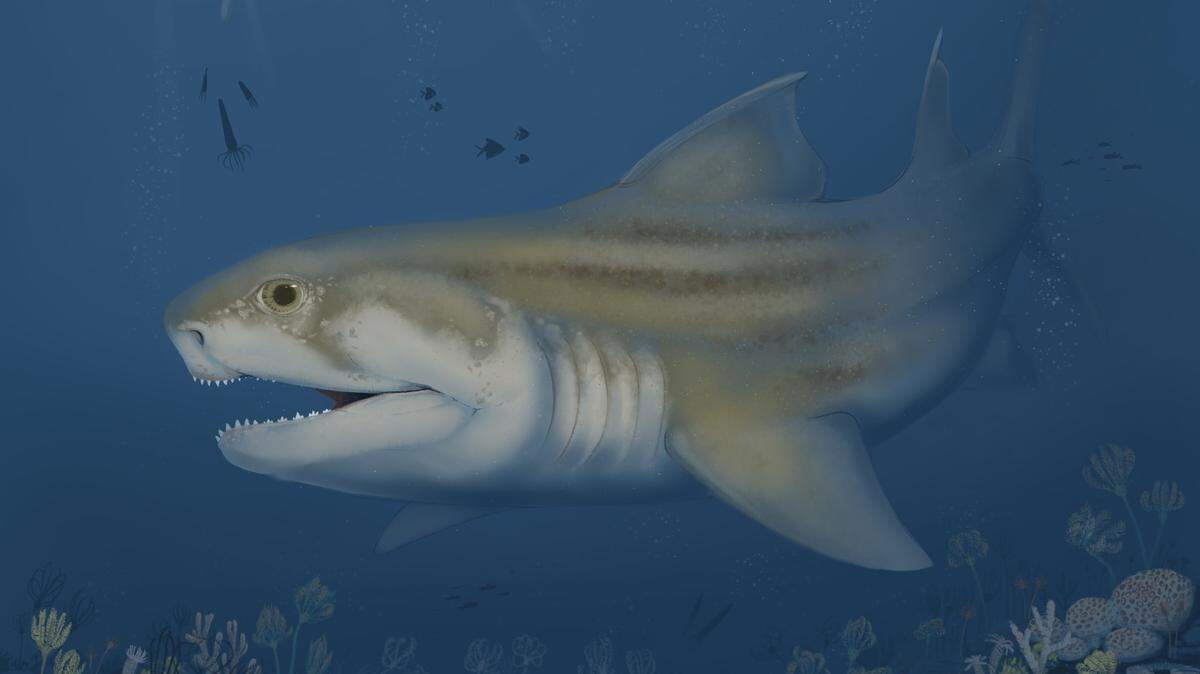
As researchers continue to learn more about sharks that lurked in Kentucky seas hundreds of millions of years ago, two new species have now been identified.
The two new species of ctenacanth shark fossils — Troglocladodus trimblei and Glikmanius careforum — were identified during the yearslong Paleontological Resources Inventory at Mammoth Cave National Park, according to a Feb. 1 news release from the National Park Service.
Researchers made the identifications through teeth found in formations at the Mammoth Cave, as well as the Bangor Formation in northern Alabama, researchers said.
Troglocladodus trimblei was named in honor of park superintendent Barclay Trimble, who was the first to find a tooth of the specimen in 2019, according to the park service.
The species was believed to be up to 12 feet long, with researchers comparing it to the size of an oceanic whitetip shark.
The other species, Glikmanius careforum, was a similar length and draws similarities to the modern lemon shark, researchers said. Teeth of the species were found in various areas, with the walls of Mammoth Cave also uncovering “a partial set of jaws and gills of a young Glikmanius.”
It draws its name from the Cave Research Foundation, whose members helped discover the jaws.
“Its jaw shape suggests it had a short head with a powerful bite for hunting smaller sharks, bony fish, and squid-like orthocones,” the park service said.
Both species hunted more than 325 million years ago in what is now Kentucky and Alabama, according to researchers.
The recent identifications are the latest in a wave of discoveries at the cave through the ongoing Paleontological Resources Inventory, which began in 2019.
In October, the park service announced the discovery of a species dubbed Strigilodus tollesonae — a type of shark similar to a ratfish.
The teeth of Strigilodus tollesonae were “spoon-like,” which is considered ideal for crushing, McClatchy News reported.
In 2020, Mammoth Cave announced the discovery of more than 100 shark teeth belonging to at least 10 different species, McClatchy News reported.
JP Hodnett, a paleontologist and program coordinator for Dinosaur Park in Laurel, Maryland, described the findings as one of “the most exciting pieces of paleontology” he has been associated with.
“There was just so much there,” Hodnett told McClatchy in 2020. “I only had three days to do the field work and we just scratched the surface. The process of mapping every single tooth we were finding, it took hours just to move five feet. You see a tooth, mark it, and then there would be another right behind my head. That whole process took five to 10 minutes for each tooth.”
Mammoth Cave, according to the park service, is “the longest known cave in the world,” featuring 426 miles of mapped passageways.
The park is about 100 miles southwest of Lexington.
This story was originally published February 1, 2024 at 1:30 PM with the headline "Teeth in walls of Kentucky cave belong to sharks that lurked 325 million years ago."