North Carolina lawmakers OK new 2020 congressional maps. Now it’s up to the courts.
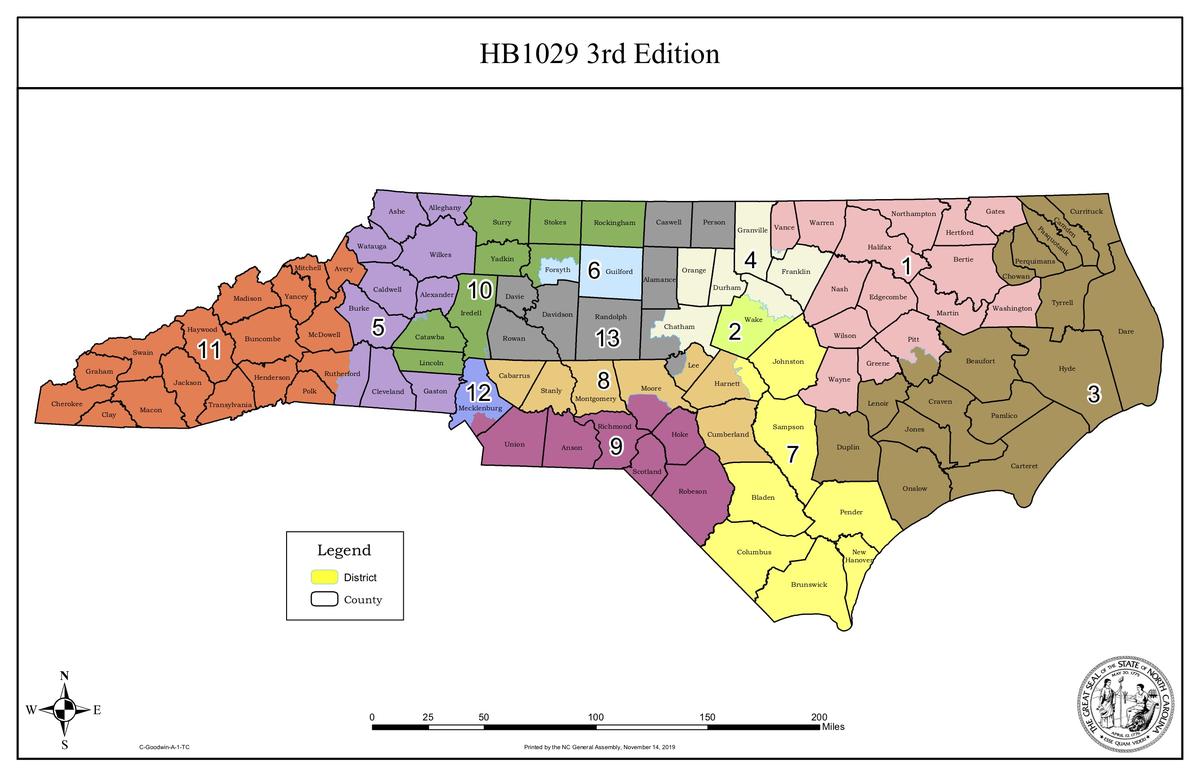
The Republican-led North Carolina Senate approved a new congressional district map Friday to be used in 2020 that is likely to shrink the GOP’s edge in the state’s congressional delegation.
But Democrats plan to challenge the map in court again.
The map passed the N.C. House on Thursday, part of a swift process completed with the Dec. 2 opening of the filing period for congressional candidates in mind. Lawmakers drew the new map after a three-judge panel indicated it was likely to toss the previous map as an unconstitutional partisan gerrymander. The map passed the Senate on a party line vote.
“We did our best,” said Sen. Paul Newton, a Republican who served on the redistricting committee. “We’ll give it to the court and the court will do what the court will do.”
Minutes after the vote, the plaintiffs in the case said they would challenge the map, calling it another extreme partisan gerrymander.
“The congressional map passed by Republicans in the North Carolina legislature simply replaces one partisan gerrymander with a new one. This new map fails to respond to the court’s order by continuing to split communities of interest, packing voters in urban areas, and manipulating the district lines to provide Republicans with an unfair partisan advantage,” said Eric Holder, the former U.S. attorney general whose National Redistricting Foundation is supporting the lawsuit.
There are 10 Republicans and three Democrats in North Carolina’s current congressional delegation. The map passed Friday is likely to produce a delegation with eight Republicans and five Democrats. U.S. Rep. G.K. Butterfield, a Wilson Democrat, said Democrats have little chance of winning a sixth seat with the newly approved map.
“I don’t think anybody can look at this map and believe the results we had two years ago will be the same results we’ll have next year,” said Sen. Harry Brown, a Republican.
Under the map approved by the General Assembly, the two districts that are likely to flip are currently held by Republican Reps. George Holding and Mark Walker. Holding’s 2nd District would be solely contained in Wake County. Walker’s 6th District would now contain all of Guilford County and parts of Forsyth County.
“No one is entitled to a congressional district. This is the people’s House,” Holding said Thursday in Washington. “I’m going to be here and be effective as long as I can be here, but no one is entitled to a congressional district.”
Walker added in a tweet Friday: “We took on Washington and Raleigh when I ran for Congress in 2014 and together we won. We did it with a new district in 2016. We will do it again in 2020. This was only possible by prioritizing people over politics — the exact opposite of what Raleigh is doing today.”
Democrat Kathy Manning, who lost to U.S. Rep. Ted Budd in 2018, said she is considering running in the new-look 6th District, which includes Greensboro, High Point and part of Winston-Salem.
“This is really exciting for North Carolina. We have really struggled with these gerrymandered maps,” Manning said. “I think this moves us in the right direction. I’m not convinced it gets us to where we need to be.”
The districts currently represented by Democrats — Butterfield, David Price and Alma Adams — remain largely unchanged and safe seats. In the map, no current representatives are “double bunked,” or assigned to the same district based on their home addresses.
The map splits 12 of the state’s 100 counties, and no county is in more than two congressional districts, Republican Sen. Ralph Hise told a Senate committee earlier Friday, satisfying the criteria that the redistricting committee had put into place.
“These maps get us into a good place,” Hise said, noting the opening of filing on Dec. 2.
The Senate debate lasted more than an hour with Republican Sen. Jerry Tillman complaining that Republicans were having to redraw the districts in the first place.
“For 140 years, you all drew the maps,” he said toward Democrats. “You drew them for 140 years, we sat there and didn’t like it, but we took it. ... We’re doing exactly what you all did for 140 years and it was constitutionally OK.”
He said the state constitution was clear that it was up to the political party in power to draw the maps.
“It doesn’t say one thing about splitting a county, a precinct,” he said. “It doesn’t say a thing about being fair.”
Judges’ ruling
Judges declared the state’s legislative maps unconstitutional in September. They ruled that the maps increased the power of conservative voters at the expense of liberal voters. Using many of the same arguments, a liberal group sued over the congressional map.
Rather than wait, the General Assembly — which redrew the House legislative map that was accepted by the court — went to work on redrawing the congressional map. But it hasn’t satisfied everyone.
“A map forced through by the majority party on a partisan vote does not instill confidence in the fairness of the new districts. We believe the congressional districts passed by the legislature today remain a partisan gerrymander,” said Bob Phillips, the executive director of Common Cause NC.
If a new map is not in place by Dec. 2, the congressional primaries scheduled for March could be postponed. In 2016, North Carolina held a separate primary for Congress. Turnout in that June election was 7.73%, down from 35.69% in the original primary, which was held in March and included the presidential, senatorial and gubernatorial primaries.
The maps will only be used in 2020 as they will have to be redrawn for the 2022 election using new Census data. That process should start in March 2021.
“This map is a one-time deal,” said Sen. Dan Blue, a Democrat. “Even though people are upset about it, it’s going to be corrected 15-16 months from now.”
North Carolina voters have elected representatives under different maps in 2010, 2012, 2016 and now, likely, 2020. The 2012 maps were ruled an unconstitutional racial gerrymander.
“Eric Holder and (former President) Barack Obama have raised a lot of money for this outcome, and they’ve pursued a really aggressive legal strategy for their partisan outcomes, and right now they’re calling it partisan gerrymandering, but what they’re seeking is partisan gerrymandering for the left,” Rep. Patrick McHenry, a Republican from Denver, said Thursday.
“We basically have a Wild West of redistricting. This will be the fourth map in six cycles, and I think that is so confusing for voters and has a major negative impact on voters.”
For more state government news, listen to Domecast, the politics podcast from The News & Observer and the NC Insider. You can find it on Megaphone, Apple Podcasts, iHeartRadio, Stitcher or wherever you get your podcasts.
This story was originally published November 15, 2019 at 3:45 PM with the headline "North Carolina lawmakers OK new 2020 congressional maps. Now it’s up to the courts.."