Racial bias in courts doesn’t exist, judge says after overturning Black man’s conviction
A judge on North Carolina’s second-highest court used his opinion in a routine Charlotte-area traffic stop case last month to declare that racial bias does not exist in the criminal justice system — an assertion that has drawn unusually harsh criticism from members of the legal community.
One law professor called the comments by N.C. Court of Appeals Judge Jefferson Griffin “a pure fantasy” and a “judicial whitewash.”
The defense attorneys in the traffic case said Griffin risked undercutting public trust in the courts and in his own impartiality by using a court opinion to circulate his personal beliefs.
Griffin, a first-term Republican, also is drawing fire for criticizing former N.C. Supreme Court Chief Justice Cheri Beasley’s comments on bias in the courts following the 2020 police killing of George Floyd in Minnesota.
Griffin declined comment this week.
In a unanimous opinion released Sept. 21, Griffin joined two other appeals court judges to overturn the cocaine-related conviction of Kevin Johnson, ruling that he had been illegally searched by Iredell County sheriff’s Lt. Chris Stone in 2017 after being pulled over for an alleged seat belt violation.
As part of Johnson’s defense, attorney Michele Goldman said race was a factor in the stop, and she presented data showing that Black male drivers across North Carolina are far more likely to be stopped, searched and charged than their white counterparts. Stone is white; Johnson is Black.
Goldman’s legal brief also excerpted a 2020 speech by Beasley in which she blamed racial bias in the courts for African-Americans being “more harshly treated, more severely punished and more likely to be presumed guilty.”
For justice to be served, judges “must openly acknowledge the disparities that exist and are too often perpetuated by our justice system,” Beasley said.
Griffin used his opinion in the case to fire back.
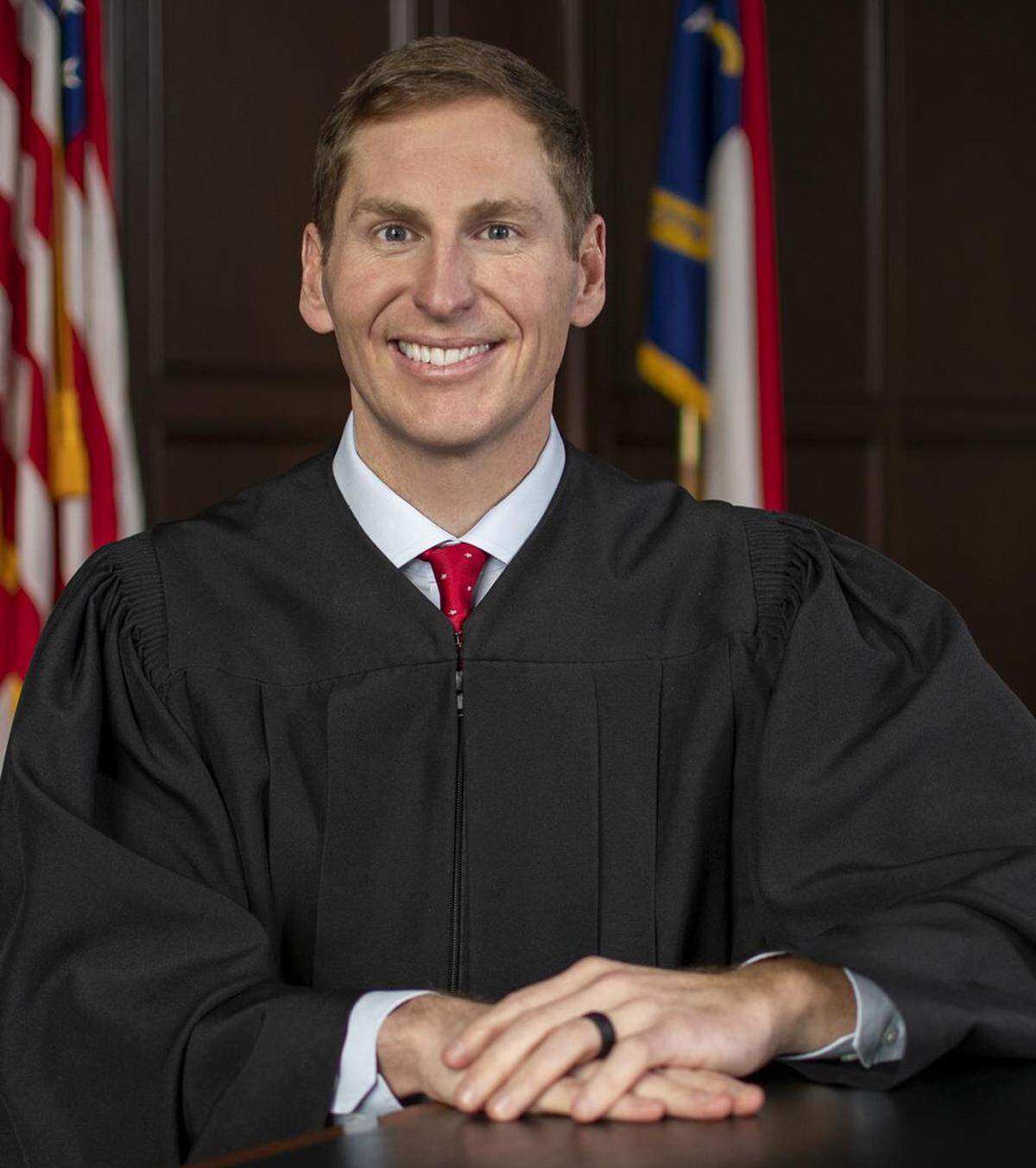
First, he accused Goldman of making “inflammatory and unnecessary” arguments by injecting race into the case where the judge said there was no proof it had influenced Stone’s conduct.
“Defendant’s brief implies that U.S. citizens are treated differently under our laws based on the color of their skin. I reject this argument. The law is color blind and applies equally to every citizen in the United States of America,” the judge wrote.
Griffin then said Beasley bore responsibility for Goldman’s overreach in which the attorney told the three-judge panel that it had the constitutional authority “to carry out our Chief Justice’s pledge.”
Goldman’s statement, according to Griffin, “highlights the problem with the judiciary becoming involved in public policy.”
“The speech by the former Chief Justice states our justice system does not treat people equally based on the color of their skin. It also encourages and charges the courts to become an active body by involving our judicial branch in policy decisions. The judiciary should at all times practice judicial restraint. Here, this Court reaches the correct legal outcome regardless of the color of the defendant.
“We are fortunate to live in the United States of America where the law is applied the same to all citizens.”
Color-blind courts?
Griffin’s written comments were published in the midst of an angry conservative campaign nationwide against so-called Critical Race Theory, which critics say depicts the country as inherently racist.
In 2013, the conservative members of the U.S. Supreme Court overturned protections of minorities included in the Voting Rights Act of 1965 largely on the grounds that they were no longer needed. Chief Justice John Roberts wrote that the law was “based on 40-year-old facts having no logical relationship to the present day.”
In North Carolina, Beasley’s remarks on the existence of racial bias in the criminal justice system have drawn fire from the right before.
Writing for the Civitas Institute in June 2020, former state Republican Party Executive Director Dallas Woodhouse accused Beasley of undermining the integrity of the courts and “impugning the reputation of every judge, prosecutor, clerk, probation officer, magistrate, and law enforcement officer who has dedicated their life to the cause of justice.”
Asked Wednesday if Griffin was justified in what he wrote about Beasley, Woodhouse replied, “Of course, he was.”
“It wasn’t Judge Griffin who politicized the courts with his words. He pointed out the natural consequences of (Beasley’s) actions ... that this would be used by criminal defendants to try to escape responsibility for their crimes,” Woodhouse said.
Griffin’s claim of a color-blind court system, however, contrasts sharply with the 2020 report by Gov. Roy Cooper’s Task Force for Racial Equity in Criminal Justice, which made 125 recommendations to address bias in policing and the courts.
It also called on the state “to re-imagine public safety to provide accountability for victims and safety for communities without the grotesque racial disparities that manifest in so many ways in our criminal justice system.”
In a similar vein, Beasley, a Democrat, created the Commission on Fairness and Equity to address disparate racial impacts in the courts after she lost her re-election bid last year. The commission is co-chaired by Griffin’s appeals court colleague, Valerie Zachary.
Beasley is now running for the U.S. Senate. In a statement to the Observer, she stood by her remarks about race and the justice system, saying that she was the first chief justice in the country to call out bias in the courtroom.
“It was my responsibility as a leader to speak out against injustice and be transparent about the disparities in our courts,” Beasley said. “North Carolinians deserve leaders committed to the pursuit of justice, who will act with courage and integrity — that’s what I’ve done throughout my career.”
Legal analysts react
Under traditional courtroom decorum, it highly unusual for lawyers to publicly criticize the judges in their cases. Yet in an email to the Observer, Goldman and her boss, state Appellate Defender Glenn Gerding, defended their use of racial traffic-stop data in the Iredell case. They also accused Griffin of ignoring judicial restraint when he used the “gravitas of a judicial opinion” to express a personal belief.
“Although judges have a right to free speech like everyone else, we believe judges should not express personal opinions in judicial opinions,” Goldman and Gerding wrote. “Personal commentary in a judicial opinion can undermine the integrity of the courts and public confidence in the impartiality of the judge who wrote it.”
That the back-and-forth involved a traffic stop was not lost on UNC-Chapel Hill political scientist Frank Baumgartner, perhaps the country’s leading expert in racial disparities in how drivers are treated by police, and whose data was used by Goldman in her written argument.
“If we are not willing at least to address relevant facts, it’s hard to avoid wishful thinking on this issue,” Baumgartner told the Observer. “But it’s also possible that the wishful thinking that race does not affect judicial outcomes can become a smokescreen that hides rampant racial discrimination when it is in fact occurring.
“The question is whether our court system will assert its power to stop the police from a system riven with racial disparities. This ruling shows that some judges appear ready to do so and others do not.”
Duke law professor Jim Coleman accused Griffin of using his judicial opinion to launch “a gratuitous political hit” on Beasley. He dismissed the judge’s insistence of a color-blind court system as “a pure fantasy” and “judicial whitewash.”
“His attitude is actually an obstacle to the kind of reform Beasley was talking about,” the Charlotte native said in an email. “Without acknowledging the role that race plays, there is no chance he or the court will address the problem. His opinion is now out there for use against Beasley in the Senate race. It is unlikely that did not occur to him.”
The N.C. Court of Appeals, where Republicans hold 10 of the 15 seats, has disputed the role of race before.
In 2019, a three-judge panel ordered a new first-degree murder trial for Raleigh homeowner Chad Copley after ruling that a Wake County prosecutor had wrongly argued in his closing argument that race was a factor in the fatal shooting of Kouren Thomas, a 20-year-old Black man.
Utilizing the tone Griffin would echo two years later, appellate Judge John Tyson, another Republican, wrote that the prosecutor’s argument that Copley shot Thomas “because he was black” was not supported by the evidence and is “wholly gratuitous and inflammatory.”
The N.C. Supreme Court overturned the decision in 2020 and upheld Copley’s conviction.
In the Iredell case, fellow first-term appellate Judge Jeff Carpenter of Union County joined Griffin in overturning Johnson’s drug conviction while also using his opinion to criticize the defense’s use of race. Carpenter, also a Republican, wrote that discussions of racial bias “overshadow the other important constitutional issues of this case, and is not helpful to maintaining public confidence in the judiciary or the practice of law.”
Wake Forest law professor Kami Chavis, a former assistant U.S. Attorney who heads her school’s Criminal Justice Program, said it’s convenient for the judges in the Iredell case “to pretend racial bias doesn’t exist.”
“By doing so, it forecloses actions they can take in behalf of Black motorists, Black pedestrians and people of color,” she said.
“What’s unbelievable is why wouldn’t they think race plays into this. At every single point in the criminal justice continuum — be it from who are police going to stop, who are they going to search, who they’re going to charge to who will be sentenced to a harsher penalty — at every point and with every actor, we can see that people of color are treated disproportionately.”
Bob Orr, who served as a Republican on both the state Supreme Court and Court of Appeals, said Griffin’s declaration of a bias-free court system is not backed by actual events.
“We’d all say that is the ultimate goal,” Orr said, “but history has shown the law to have been applied unequally in numerous cases, particularly in the context of race.”