
What is the Coalition for Truth and Reconciliation in Charlotte-Mecklenburg?
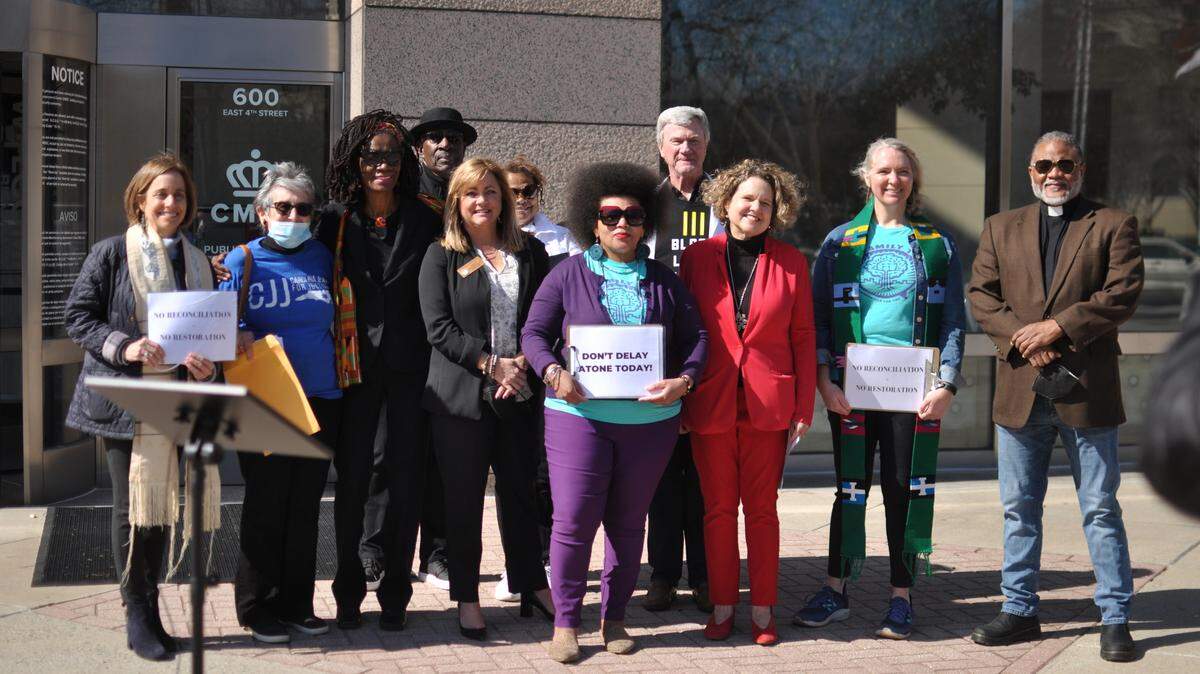
A new report, researched and written by public library staff, lays bare the history of racist policies implemented by the Mecklenburg County government since its founding.
The nonprofit group who organized the report’s publication now want the city of Charlotte to commission a similar undertaking.
The report, finished in September and written by the Charlotte Mecklenburg Library and the Robinson-Spangler Carolina Room, covers more than 150 years of racial injustices, focusing primarily on actions by white government officials and elected members of the Mecklenburg Board of County Commissioners.
But it exposes much more.
The 40-page document tells how racist ideology and discrimination permeated Charlotte society, including in employment, housing, health care, and civic participation. It gives examples of how government policies both directly disenfranchised Black residents and permitted further discrimination in other forms. In some cases, the report cites how non-government actors — like The Charlotte Observer, published under a different name in the late 1800s — used articles and editorials to perpetuate racist ideals and support oppression.
While some of that history has been previously reported, this document stands out in how it came to be. And though the report focuses on past events, the effects of systematic racism, by definition, continue today.
The lead-up goes back years and involves numerous civic activist groups — catching a spark in 2021 when two county commissioners, Laura Meier and Mark Jerrell, called for a formal review of racist policies implemented by the board on which they now serve.
The Coalition for Truth and Reconciliation, a conglomerate of groups pushing for racial equity in Charlotte, organized its development while the library did the research.
Meier, on Friday, said she and Jerrell met with the researchers as the document came together. Every section, she said, was shocking.
“You kind of know your history, but when you see it printed,” she said, “it blows your mind.”
Meier said the document reinforces the need for direct funding to address ongoing racial inequities. She hopes that, in future years, the county will increase its current $2 million allotment dedicated directly to that cause.
Organizers with The Coalition for Truth and Reconciliation, also called for more funding from the county. They also asked for the city to request its own report, and for influence with the $250 million Mayor’s Racial Equity Initiative.
History of the Charlotte coalition
The Coalition for Truth and Reconciliation’s story began in 2019 with listening sessions on affordable housing, said Judith Schindler, a rabbi and the director of the Stan Greenspon Holocaust and Social Justice Education Center at Queens University of Charlotte.
At the time, the coalition was more loosely formed, but was having conversations about housing with people who included former residents of Brooklyn — a Black neighborhood in Charlotte that was demolished during urban renewal in the 1960s. City leaders, with federal government help, declared Brooklyn an unsafe and unclean place to live and used that justification to forcibly remove generations of Black Charlotteans from their homes, churches, businesses and schools.
In 2020, the coalition began direct advocating for racial justice measures within City Hall. That effort led to the creation of a separate, advocacy-focused group called Restorative Justice CLT, and pushed Mayor Vi Lyles to apologize in August 2020 for the grave effects of urban renewal on Black people in Charlotte.
The coalition in 2021 then shifted its focus to the county government. From March to May of that year, coalition members advocated for policies to address issues of racial equity.
Racism in Charlotte media
Among the details published in the report were news articles from outlets, including from The Charlotte Observer and previous iterations of the paper, that were overtly racist.
One editorial, published by the Observer in 1898, advocated against Black people holding public office.
“The negro, like fire and water, is a good servant but an awful master,” the paper wrote.
The Daily Charlotte Observer published articles in 1903 that reminisced “about the days when (white employers) could pay Black laborers 75 cents per day,” as opposed to the $1.50 daily wage that Black workers advocated for at the time.
In 2006, the Observer published a special issue apologizing for its promotion of racist ideologies in the 19th century, including “Social Darwinism” and both its coverage and the role some in the newsroom played in the 1898 coup in Wilmington.
“An apology is inadequate to atone for the Observer’s role in promoting the white supremacist campaign,” the paper wrote at the time. “But an apology is due.”
Next steps
Meier said that, along with increasing funding, the county will continue to discuss and then implement ways to actively address the findings of the report.
The coalition has not yet formally asked the city to create a report of its own, but will consider doing so, Schindler said.
She added that the model of research could be used for a number of Charlotte institutions: the city government, hospitals, law enforcement and more.
On a community-level, Rev. Janet Garner-Mullins, chair of the coalition, encouraged residents to read the report and discuss it. QC Family Tree, an activist organization and coalition member, put together a conversation guide for people to use as they discuss the report in small groups.
“In the words of John Lewis,” Garner-Mullins said, “We want to get into some good trouble.”
This story was originally published February 11, 2022 at 2:38 PM.
.jpg)