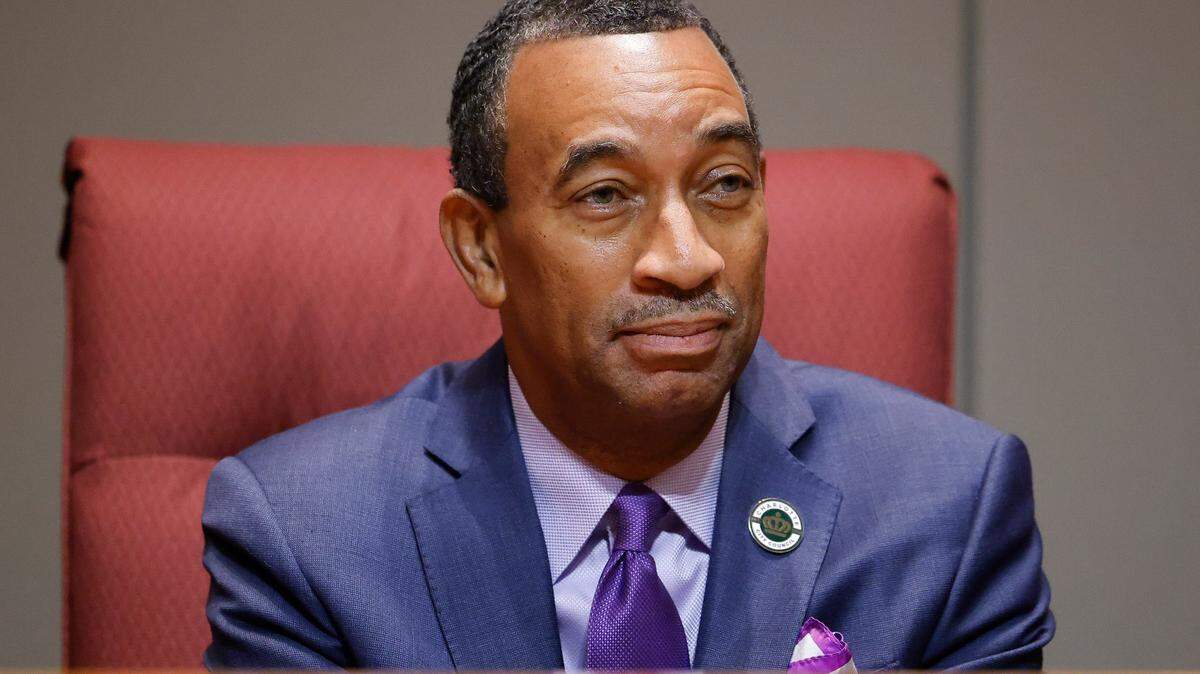
James “Smuggie” Mitchell, At-Large Charlotte City Council member at the Charlotte-Mecklenburg Government Center in Charlotte, N.C., Tuesday, Sept. 6, 2022.
Alex Slitz
Observer file photo
Despite significant evidence to the contrary, Charlotte City Council member James “Smuggie” Mitchell has repeatedly claimed to own a 25% stake in a local construction company, which, if true, would violate state law and has made Mitchell the subject of a state investigation.
The question is why?
Records provided to the city from the company’s lawyers indicate Mitchell has neither the facts nor the law on his side — that Mitchell lost his stake in Bright Hope Construction LLC after he failed to repay a $375,000 company loan, money designed specifically for Mitchell to buy into the company in the first place.
Without offering proof, however, Mitchell has continued to claim he is still a quarter partner — even though that assertion has placed him in potential legal jeopardy.
Under N.C. law, it’s illegal for a city do business with a company if a member of the city’s governing board owns more than 10%.
State Bureau of Investigation probe
In late December 2020, Mitchell became president and CEO of R.J. Leeper Construction, one of Charlotte’s major Black-owned businesses, which Bright Hope now owns and has active contracts with the city for projects at Charlotte Douglas International Airport and the Charlotte Convention Center.
Mitchell left Leeper after six months but said at the time he was retaining his 25% share of Bright Hope.
After Mitchell won an at-large seat in this year’s elections and was sworn in on Sept. 6, Mecklenburg County District Attorney Spencer Merriweather requested a state investigation to determine if Mitchell is violating N.C. law by retaining his stake in Bright Hope. Taxpayers will foot the bill.
James “Smuggie” Mitchell takes the oath office for Charlotte City Council at the Charlotte-Mecklenburg Government Center in Charlotte, N.C., Tuesday, Sept. 6, 2022. Alex Slitz Observer file photo
Mitchell issued statements saying he welcomed the probe by the State Bureau of Investigation and was eager to get on with the city’s business. But largely because of his own comments, the legal issue that drove him from his longtime council seat in January 2021 has marred his return.
“Because there was controversy before he resigned the first time ... why would you think it wouldn’t come around again when he came back to the council?” said Eric Heberlig, a political science professor at UNC Charlotte. “It’s not like it’s going to suddenly disappear.”
Mitchell’s motives remain unclear. According to Bright Hope documents, which The Charlotte Observer obtained under a public records’ request, he’s had no ownership role in the company since late March.
Mitchell could challenge the status of his ownership stake in court. While he alluded to upcoming litigation in an Aug. 30 statement, he and his attorneys have not taken legal action to get the matter before a judge.
Mitchell did not respond to phone and email requests from the Observer last week to discuss his situation. Neither did his attorneys, Bobby Robinson and Jim Smith, both of Charlotte.
Heberlig at UNC Charlotte says he finds the whole saga confusing, starting with Mitchell’s potential self-incrimination.
“Generally, when things don’t add up in obvious ways, there’s something else that we haven’t put together,” he said. “My guess is that there’s something going on behind the scenes, some private information that we don’t know yet.”
In the meantime, here’s what we do know and what we have still to learn.
North Carolina General Statute 14-234 — known as the “criminal self-dealing law” — makes it a misdemeanor for a elected official or government employee who is involved in making or administering a government contract to receive a “direct benefit” from that contract.
A direct benefit is defined as public employees, such as Mitchell, or their spouses receiving income or property from the contract or owning more than 10% of any company doing business under a contract with the relevant government body.
“This is holding our elected officials to a higher standard, and it’s protecting the integrity of the democratic process,” says Kristina Wilson, an assistant professor of public law and government at the UNC Chapel Hill School of Government. “We should be able to assume in good faith that our elected leaders use their offices for the benefit of the public and not for themselves.”
The loan
G.S. 14-234 intersected with Mitchell’s evolving career path on Dec. 29, 2020, when he accepted the job to run Leeper as well as a sizable partnership loan from Bright Hope Construction.
Bright Hope says the loan was intended to cover the upfront costs of Mitchell’s 25% partnership stake. The loan agreement Mitchell signed said the company could demand repayment at any time. Otherwise, Mitchell had until Dec. 31, 2024 to repay the loan in full. If he did not, the company would seize the collateral — which was identified as Mitchell’s “member equity” stake in Bright Hope.
That Mitchell, a sitting council member, accepted the loan money from a company benefiting from city contracts never became an issue. Moreover, despite appearing to violate state law, Mitchell initially intended to keep his new job, the loan and his council seat. He said at the time he would avoid any conflicts by delegating management of Leeper’s city projects, which made up 60% of the company’s portfolio at the time.
Two weeks later, Mitchell resigned from the council, saying it was in the best interests of all involved and that he was not initially aware of the state law limiting a council member’s stake in companies doing city business.
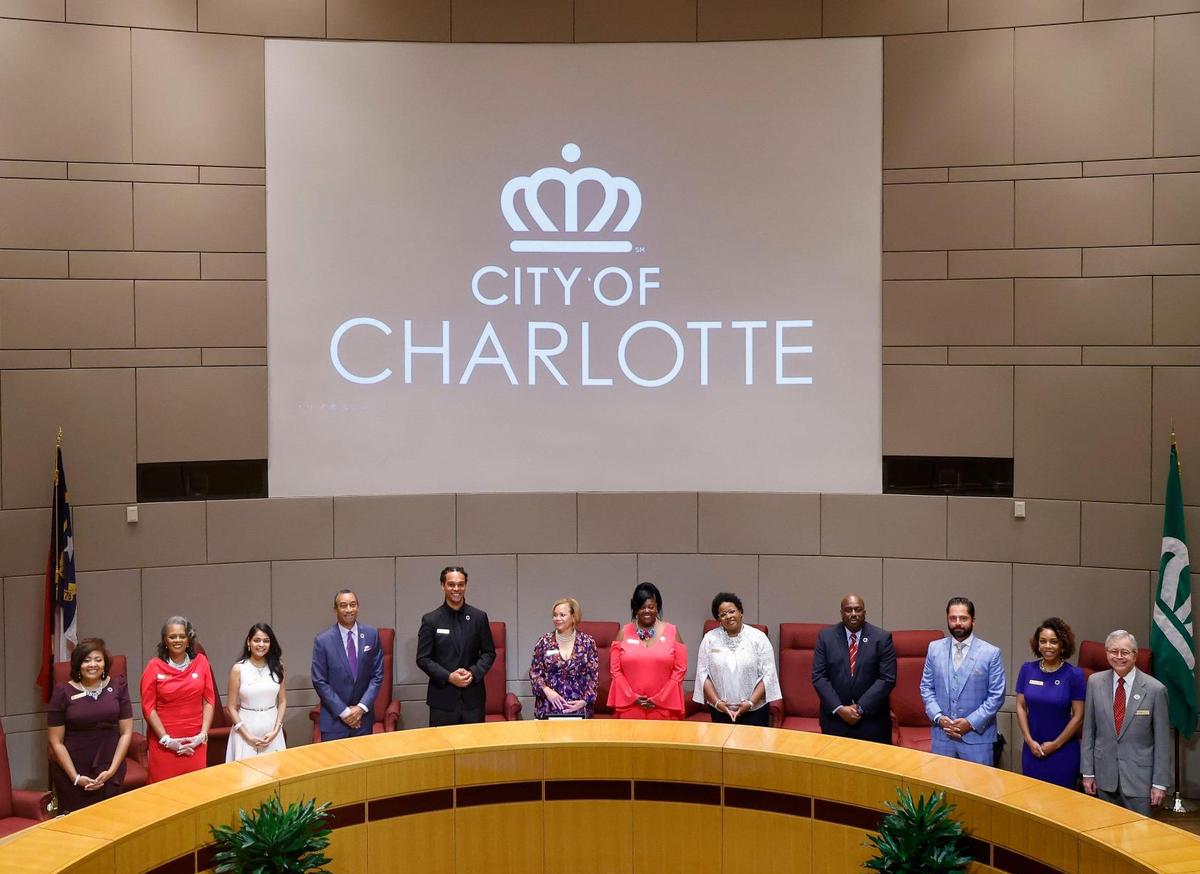
The Charlotte City Council stands after swearing in at the Charlotte-Mecklenburg Government Center in Charlotte, N.C., Tuesday, Sept. 6, 2022. Alex Slitz alslitz@charlotteobserver.com
The loan call
Mitchell’s stay at Leeper lasted only six months.
His departure was announced in July 2021. He told reporters at the time that he would keep his 25% share in the company.
It was not his decision to make. Within nine months, according to Bright Hope documents, Mitchell’s stake was gone.
The foreclosure process opened with a Dec. 22 letter. In it, Bright Hope partner Malcolmb Coley called in Mitchell’s loan plus more than $7,300 in interest. That brought the note to almost $382,400. Coley gave Mitchell five days to pay up, according to the Bright Hope records.
If he didn’t, Coley warned, the company could sue Mitchell or foreclose on his “member equity.”
The foreclosure
Over the next three months, Bright Hope followed a North Carolina law that allows lenders to seize certain types of collateral without going to court.
On Jan. 24, the company’s attorney, Andrew Tarr of Charlotte, wrote another letter, this time informing Mitchell that he was in loan default and had seven days to pay.
Robinson, Mitchell’s attorney, responded with an email, saying that he was working with Mitchell on an “appropriate response.” None came.
On March 1, Tarr wrote back saying Bright Hope intended to seize Mitchell’s ownership stake, and that under the law, Mitchell had 20 days to file any objections. Otherwise, “you will be deemed to have consented to this proposal and will have no further right to object,” Tarr wrote. Once again, no response came.
On March 2, Bright Hope filed a lien against Mitchell with the Secretary of State’s office. Under the heading of collateral, the company wrote: “All of Debtor’s Ownership Interest ... in Bright Hope Construction.”
On March 22, the day after Mitchell’s legal window to object to the foreclosure had closed, Tarr wrote back. Mitchell’s partnership in Bright Hope, the lawyer said, was no more.
In an Aug. 31 statement to the Observer, Mitchell referred to “my pending litigation matter ... as to my ownership state (sic) in RJ Leeper.” Documents, however, indicate the disputed stake was in Bright Hope, not Leeper.
“I remain focused on upholding my oath to those that elected me and will allow my legal team to handle the matter in the proper forum, as I want nothing more than for this to be behind me,” he said. “As of today, there has not been a judicial determination as to my ownership and I look forward to having a judge render a decision in the near future.”
Under N.C. law and the Uniform Commercial Code, a set of laws that govern all commercial transactions around the country, Bright Hope did not need a judge to foreclose. If Mitchell wants to get his grievance into a courtroom, he will have to sue. So far he hasn’t.
Meanwhile, the criminal probe by the State Bureau of Investigation continues.
In an Aug. 30 memo to the City Council that identified Mitchell only as an “incoming councilmember” City Attorney Patrick Baker tried not take sides, but said any criminal violations arising from the matter “attaches to the applicable council member rather than the city.”
He also called the dispute “unprecedented in my 26 years” of practicing municipal law.
This story was originally published September 19, 2022 at 6:00 AM.
Michael Gordon has been the Observer’s legal affairs writer since 2013. He has been an editor and reporter at the paper since 1992, occasionally writing about schools, religion, politics and sports. He spent two summers as “Bikin Mike,” filing stories as he pedaled across the Carolinas.