NC Senate budget would set future tax cuts, cut state positions, raise teacher pay
North Carolina Senate Republicans said they would raise teacher pay by a few percentage points over two years, with smaller raises for most state employees, and replenish the state’s rainy day fund in the budget bill they unveiled Monday evening.
Republican leaders spoke to reporters about the budget Monday evening ahead of the legislation being made public, and about 10 minutes after announcing highlights via an emailed news release. Budget documents were posted online after the news conference ended.
Senate leader Phil Berger told reporters that the budget will take on “obsolete programs” and “bloated bureaucracy.”
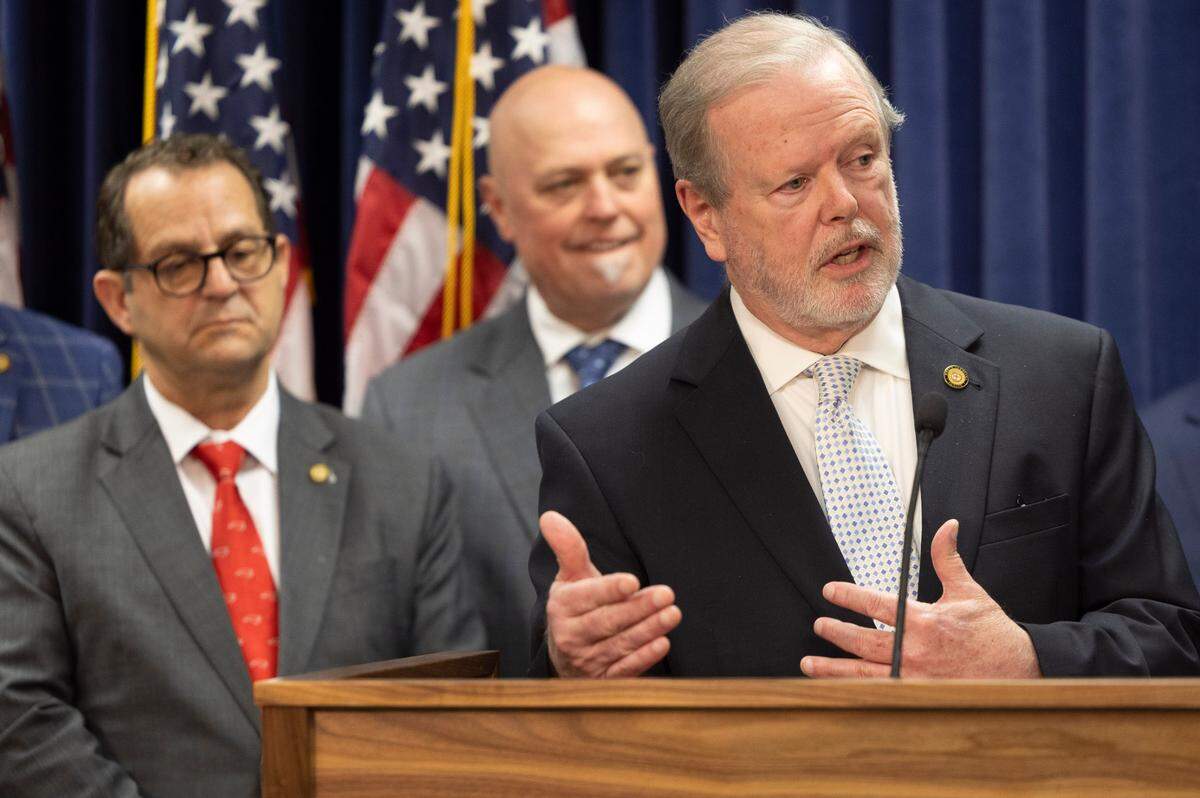
Republicans did not offer specifics beyond Berger saying there will be some consolidation within community college programs. But the budget would eliminate a slew of positions and programs, like an agency that helps businesses owned by minorities, women and people with disabilities, and one that focuses on environmental education.
Senate Republicans want to spend about $32.6 billion in the first year, and about $33.3 billion the second year. Republicans also said that they would raise the amount of money in the state’s rainy day fund to $4.75 billion, the amount where it stood before Helene hit Western North Carolina.
That’s an increase of about $800 million from this year, Berger said, and about $700 million more in the second year.
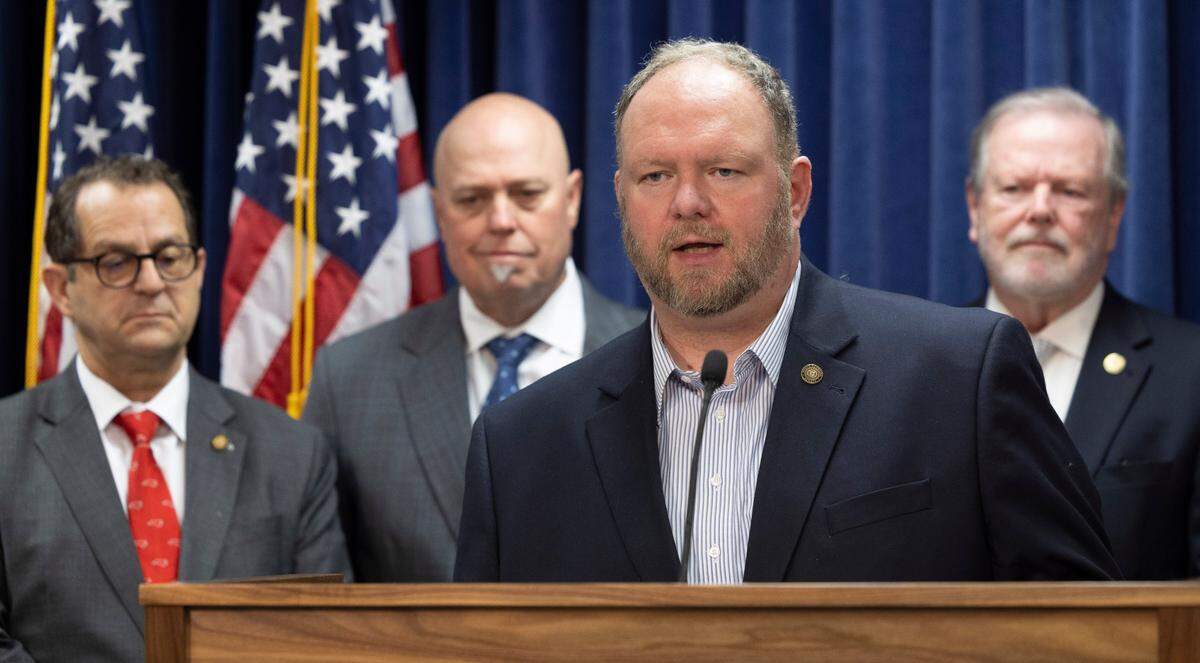
Also, the Senate proposal adds another $700 million to the Helene reserve fund, Sen. Ralph Hise said. Hise is a Republican from Spruce Pine, in the area hit by Helene.
“We must prepare to fend for ourselves,” Hise said, even though they “remain hopeful that the federal government will provide increased and expedited reimbursements” for Helene recovery.
Raises for state workers and teachers
Teachers would get 2.3% the first year on average, and 3.3% average over the two years, along with a $3,000 bonus, legislative leaders said.
The budget would give most state employees a 1.25% raise and a $3,000 bonus over two years, they said, with law enforcement and corrections officers set to receive higher raises.
Correctional officers would get an additional 5.25% raise, which combined with step increases would total 8.9%, while probation and parole officers would get additional raises of 2%.
State law enforcement officers, including officers with the State Capitol Police and sworn officers of the State Highway Patrol, State Bureau of Investigation, and Alcohol Law Enforcement would also get an additional 5.25% raise.
Highway Patrol, SBI and ALE officers, meanwhile, would also be included again in the experience-based salary schedule for law enforcement. Highway Patrol officers moving back into the step schedule would get an average raise of 9.2% while SBI and ALE officers would get average raises of 14.4%.
The budget would give local law enforcement officers a $3,000 bonus over two years as well, Berger said, “to show our appreciation for the hard-working men and women that put their lives on the line every day to protect us.”
Senate Democratic Leader Sydney Batch, of Wake County, called the Senate’s budget bill “a blueprint for neglect and cowardice. Instead of investing in the people who make this state work, Republicans are continuing to hoard taxpayer dollars in a Rainy Day Fund — undermining critical agencies and ducking their responsibility by kicking tough decisions over to the House of Representatives.”
In a statement, Batch went on to call the proposed raises for public servants “pathetic” and said her Republican colleagues, with the budget, care about “protecting the wealthy, ignoring working families, and leaving workers behind.”
State projects
The plan would add $3.5 billion over two years to the State Capital Infrastructure Fund, which pays for construction projects at universities, Sen. Brent Jackson, a top budget writer, said.
The budget ramps up investment in North Carolina Children’s, a pediatric hospital network being developed by Duke Health and UNC Health. After lawmakers allocated $320 million to the project, the Senate budget proposes another $638.5 million. A children’s hospital is expected to open in the early 2030s.
Tax cuts and gambling revenue
Under previous budgets, the individual income tax rate dropped to 4.5% for the 2024 tax year, then dropped in 2025 down to 4.25%. The rate was set to drop after that to 3.99%. The Senate budget would cut the rate to 3.49% in 2027 and 2.99% in 2028 and eliminate previous “triggers” that determined the rate. It could be lowered further in subsequent years if triggers are met.
At the same time, Senate Republicans want to increase how much sports betting operators pay the state in tax to be in line with rates adopted in other states. The Senate’s budget proposal would double the tax paid by sports betting operators from the current rate of 18% to 36%.
Berger noted that several other states tax at that rate or even higher, and said the higher taxes would be paid “from the profits made by sports wagering companies, and is not an increased assessment on North Carolina citizens or North Carolina businesses.”
The doubled tax rate would generate more than $130 million in additional revenue for the state over two years, according to budget documents.
Senate budget creates a DOGE-like DAVE office
Berger told reporters last week that the budget bill would include policy from a bill the Senate passed expanding the office of Republican State Auditor Dave Boliek. Republicans said Monday evening that the budget appropriates $6 million to Boliek’s office to establish a Division of Accountability, Value and Efficiency. However, it won’t be like President Donald Trump’s Department of Government Efficiency, led by billionaire Elon Musk, which has made sweeping cuts and layoffs at federal agencies.
Berger said Monday that new division “will be charged with the responsibility of looking for state programs, state agencies, and coming back to the legislature. Where it is different is that, unlike the DOGE effort at the federal level, where the executive branch actually purports to eliminate programs and pull money back, the auditor will not have that authority. That authority will continue to be with the General Assembly.”
Vacant jobs could be eliminated
The budget also requires state agencies to eliminate some long-vacant positions to achieve budget reductions, and to issue a report by Oct. 1 this year and again in 2026. With a state agency vacancy rate of 20%, that could mean many positions eliminated.
Extra teacher pay, cellphone policy in budget
Senate Republicans want to expand funding for a program that provides teachers additional pay of up to $10,000 a year if they take on extra leadership duties, such as mentoring other educators.
The budget would give an additional $16.2 million this year and $20.1 million next year to the Advanced Teaching Roles program. The budget also would provide an additional $6.5 million in grant funding so more school districts can apply for the program.
“Advanced Teaching Roles changes the outdated organizational structure of our schools, one developed during the Industrial Era, to provide career advancement and leadership opportunities – along with meaningful pay increases – to our most effective educators and embed real-time classroom support for developing teachers,” Brenda Berg, CEO of the business-backed BEST NC, said in a news release.
In other education items, the budget would:
▪ Require K-12 schools to adopt policies restricting the use of cellphones in class. The Senate already passed this bill, but it’s awaiting a vote in the House.
▪ Eliminate funding for the Plasma Games grant that few schools have used. Since 2020, lawmakers had approved grant funding for the science-based video game company, which has ties to Republican state Supreme Court Justice Paul Newby.
▪ Limit eligibility to a program where the state has paid the costs for high school students to take Advanced Placement, International Baccalaureate and Cambridge Advanced International Certificate of Education exams. It would now be restricted to economically disadvantaged families
▪ Provide science of reading literacy training to language arts teachers in low-performing middle schools.
▪ Make permanent a pilot program in which schools can apply for funding to purchase feminine hygiene products for students.
▪ Prohibit schools from serving a different meal to students who have unpaid school meal debt. All students would get the same meal to avoid public shaming.
Unemployment insurance increase; child care aid
The Senate’s budget bill would also raise the unemployment insurance benefit to $400 a week. The state currently pays a maximum benefit of $350 a week, and a House bill would raise that to $450. That would start July 6, if the budget provision becomes law.
The bill would also provide $80 million to increase child care subsidies.
Veterans Cemetery Trust Fund created after years of complaints
A new fund to oversee operations and maintenance of the state’s four veterans’ cemeteries would be created in the Senate budget. The special fund would be within the Department of Military and Veterans Affairs. This comes after years of complaints of cemeteries not being maintained well, The N&O previously reported.
Health care policy changes
A big chunk of spending in the budget proposal is allocated to health care, as is typical — but it also includes policy changes that could spark debate. The budget would:
▪ Repeal North Carolina’s Certificate of Need (CON) law, which controls where health care facilities can open or expand. Supporters, like the state’s hospital association, contend that it curbs costs by preventing redundant services. Critics say it limits access and inflates prices. The Senate’s effort to repeal the law, advanced through a bill this year and partially achieved in the 2023 Medicaid expansion law that lifted rules for behavioral health beds and more, sparked conflict with the House during debates over Medicaid expansion.
▪ Incorporate what appears to be the full text of a Senate-passed bill aimed at increasing transparency in health care billing, reducing costs, and accelerating prior authorization for medical services. That bill has not yet received a hearing in the House, which introduced its bill more narrowly focused on expediting the process of prior authorization.
Should the federal government allow work requirements for the Medicaid program – which provides health insurance to low-income people — the budget instructs the state’s Department of Health and Human Services to develop a plan for those work requirements and to obtain federal approval of that plan.
Changes to the state treasurer’s office
The state treasurer’s job could change under the Senate’s budget. It would end the state’s “sole trustee” model, removing the treasurer’s sole investment authority — a change Republican Treasurer Brad Briner campaigned on and has requested. It establishes the North Carolina Investment Authority to independently manage state investments, such as pensions and highway funds.
In a news release, Briner said the budget proposal would boost the State Health Plan by 5% over last year’s contribution, surpassing the recent 3.3% annual average, and would provide funding to reinstate GLP-1 weight loss drug coverage.
Gov. Stein’s budget proposal
The Senate and House take turns over which chamber goes first. Once the Senate takes final votes on its budget, about a month later, the House will pass its own budget bill. Then the two chambers will negotiate a final budget bill to send to Democratic Gov. Josh Stein. Stein will have 10 days to sign, veto or let it become law without his signature.
Stein has already warned that it should be a tight spending year.
Stein’s budget proposal includes raises of 2% for most state employees, an average 10.6% raise for teachers, a moratorium on private school vouchers and a freeze on the cuts to the individual and corporate income tax rates. Stein’s proposal would spend $33.6 billion in the first year of the two-year plan and $34.3 billion in the second.
Stein wants to raise starting teachers’ base pay to $44,500 a year starting in July, and to $51,200 for the following fiscal year, 2026-27. The current base pay set by the state for a starting teacher is $41,000. The state provides supplements to rural school districts, and metro counties have their own supplements. Including supplements, starting teacher pay for 2025 in North Carolina is $42,804, and Stein’s proposal would raise that to $53,000 in 2027.
What’s next for budget
Budget negotiations between the governor and General Assembly have dragged out for months in recent years, under Stein’s predecessor, former Democratic Gov. Roy Cooper. Some delays also happen because even though the Senate and House are both controlled by Republicans, they often have a hard time finding agreement on a final budget bill. For example, the two chambers fought over legalizing more casinos; that effort stalled during the last budget battle. For Cooper and Republicans, it was over Medicaid expansion, tax cuts and teacher pay.
The House is expected to release its own budget bill in late May. Already, House Speaker Destin Hall told reporters that he thinks they’ll propose higher raises for state employees than Stein’s 2% pitch.
This story was originally published April 14, 2025 at 5:15 PM with the headline "NC Senate budget would set future tax cuts, cut state positions, raise teacher pay."
.jpg)