NC’s auditor is typically a quiet role. Under Dave Boliek, that’s changing
AI-generated summary reviewed by our newsroom.
- Boliek gained election board control, ending over a century of gubernatorial power.
- HB 549 expanded auditor data access and exempted the office from tech procurement rules.
- New DAVE division will recommend job or agency cuts by year’s end.
It’s been eight months since Dave Boliek took office as North Carolina’s first Republican state auditor in 16 years.
His ascent to the typically quiet role has attracted the attention of state lawmakers, who have steadily allocated a variety of additional powers and resources to his office since his election in November. Because of Republican-sponsored legislation, Boliek now appoints election board members, has expanded access to state databases and leads an entirely new DOGE-like division (named after himself) tasked with recommending job cuts.
Critics decry the power shifts as a way to subvert November’s election results, in which Democrats won the governorship and four more of the state’s 10 seats on the executive Council of State.
But Boliek, a lawyer who previously served as chair of the UNC-Chapel Hill Board of Trustees, says the new responsibilities are a result of the “energy and mission” he’s brought to the role.
Shortly after taking office this year, he described his agency as a “sleeping giant.”
In a wide-ranging interview with The News and Observer last week, Boliek amended that statement.
“I believe that giant’s waking up,” he said.
Audits of universities, Medicaid and DMV make headlines
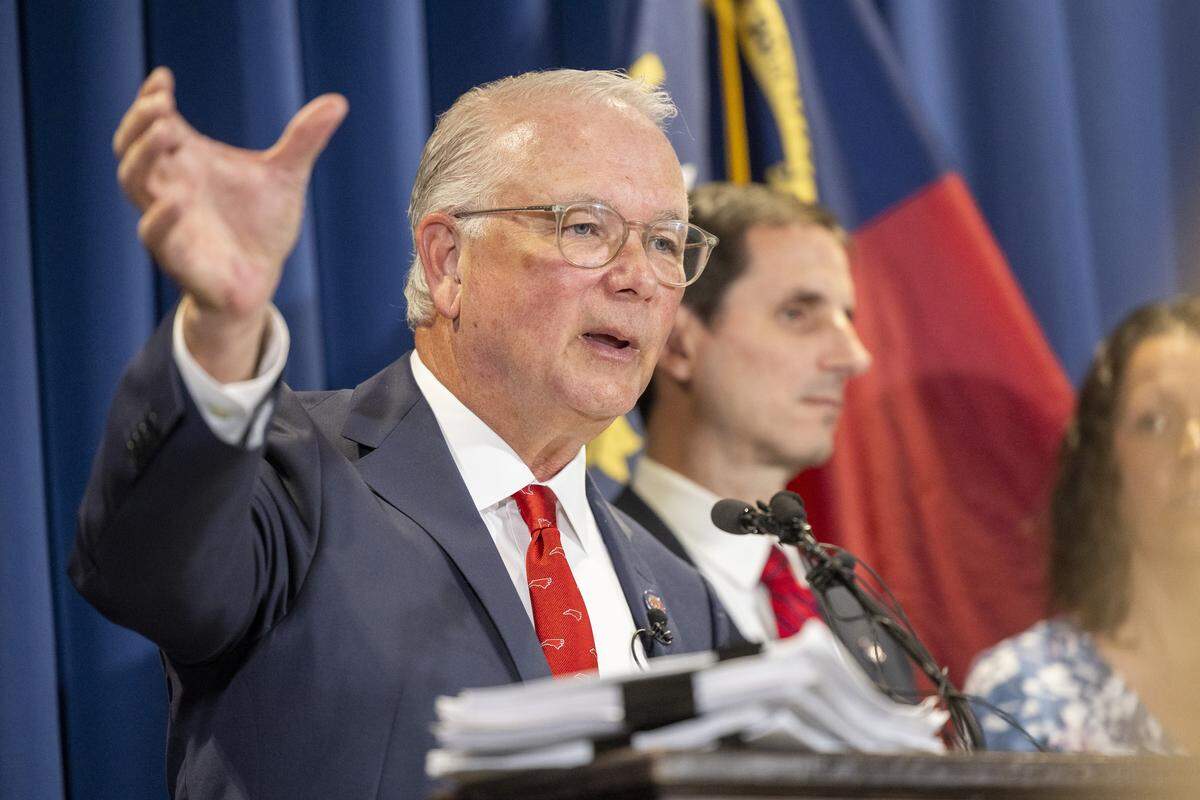
Even if not for the newfound attention the General Assembly has paid to Boliek’s office, the agency has already made headlines for producing a steady stream of noteworthy audits and investigative reports.
In March, an audit of NC Central University found $45 million in reporting errors.
A July audit of the state’s Medicaid program found several health care providers with active suspensions still providing services.
And just last month, Boliek’s office released two special reports: one showing alleged fraudulent activity in the town of Mount Olive and another analyzing a $46 million budget deficit in Winston-Salem/Forsyth County Schools.
But Boliek’s true white whale is the Division of Motor Vehicles, an agency beleaguered by years of complaints, gridlock and allegations of mismanagement.
He campaigned on fixing the DMV, promising a “top to bottom” audit with concrete recommendations for improvement.
Last month, Boliek released that audit, a 435-page report examining staffing shortages, wait times and low morale among employees.
The problems he identified were familiar, but one of his recommendations was less so. He proposed making the DMV a separate agency, removing it from the oversight of the Department of Transportation.
While DOT agreed with many of Boliek’s recommendations, the agency opposed removing DMV from its purview, saying it would be too difficult and costly to split them apart.
Boliek’s suggestions aren’t binding, and some would require action from the legislature to take effect.
“We’re going to stay on the DMV until that situation is fixed,” he said. “With the State Auditor’s Office putting an emphasis on that particular area, that hopefully will keep it front and center in policymakers’ minds till we do get a solution.”
‘The auditor is now the governor'
Lawmakers have greater aspirations for Boliek’s office than just audits, though.
Since his election, legislators have filed dozens of bills in some way dealing with the Office of the State Auditor.
Some sought to give Boliek the power to review health care prices. Others wanted him to audit crisis pregnancy centers. And others still simply proposed giving his office more money.
But three notable pieces of legislation beefing up Boliek’s powers have become law since he took office. All three proposals, which dealt with elections, data access and recommending job cuts, faced widespread opposition from Democrats.
“People thought they were electing Gov. Stein,” House Democratic Leader Robert Reives told reporters earlier this year. “What they’ve now found out is that he’s not the governor. The auditor is the governor.”
Boliek appoints GOP majorities to election boards
The first bill was enacted before Boliek even took office.
Senate Bill 382, which Republicans passed in the final days of their veto-proof supermajority in the General Assembly, gave Boliek the coveted power over appointments to state and local election boards.
For over a century, that power resided with the governor, allowing them to appoint a majority of their own party to the powerful boards. But since Democratic Gov. Roy Cooper’s 2016 election, Republican lawmakers have sought to strip that power from the governor’s office.
They found a successful method of doing so by transferring the power to the auditor’s office, making Boliek the only auditor in the country with election oversight authority.
After the state’s Republican-dominated appellate courts allowed the law to take effect, Boliek appointed Republican majorities to the State Board of Elections and all 100 county election boards.
Boliek said his vision was to have “responsible and experienced people who could bring integrity to the system.”
Beth Wood, a Democrat who served as state auditor for over a decade and endorsed Boliek’s campaign, said the appointments power could threaten the office’s nonpartisan reputation.
“We are there to audit and investigate,” she told The News and Observer. “And that has nothing to do with it.”
The partisan shift has already produced notable changes.
In May, just after taking office, the state election board’s new Republican majority voted to oust its longtime director, Karen Brinson Bell. They replaced her with Sam Hayes, a lawyer who worked for the state’s top Republican lawmakers.
The board also launched an ambitious, bipartisan plan to update the registration records of over 100,000 voters who the agency says lacks required identification information in its databases. That plan comes as part of a settlement with the Trump administration, which sued over the missing records earlier this year.
And recently, the new board shed light on how it may handle a frequent point of partisan contention surrounding elections: Sunday voting.
County election boards determine their own schedules for early voting. But when they disagree, the matter goes to the state. Two counties which couldn’t come to an agreement on Sunday voting for the upcoming municipal elections brought the issue to the board last week.
In a 3-2 vote, the new Republican majority decided on plans that would not include Sunday voting, prompting Democratic member Jeff Carmon to say that the board was “going down a dark path.”
One of the county election chairs Boliek appointed also made headlines last week.
James Yokeley Jr., the Republican chair of the Surry County Board of Elections, resigned after facing criminal charges for allegedly putting drugs into his granddaughters’ ice cream.
Boliek demanded his resignation shortly after the news broke.
“We found nothing in his background that would suggest this at all,” Boliek said. “It is, clearly to me, disappointing, but when you get appointed to a board … there’s an understanding that you’re going to be held to a high standard.”
Bill expands auditor’s data access, exempts from technology rules
This summer, lawmakers enacted another bill dealing with Boliek’s office: House Bill 549, entitled “Clarify Powers of State Auditor.”
Boliek contends the bill mostly does just that: clarify powers he already has.
“The language did not, in any real specific way, give us additional powers and authorities,” he said.
However, Democratic Gov. Josh Stein, who vetoed the bill, said it grants Boliek “intrusive power” that could put personal taxpayer data “at heightened risk of a breach.”
Republican lawmakers, with the help of Democratic Rep. Shelly Willingham, overrode Stein’s veto, enacting the bill in July.
Much of the bill focuses on the auditor’s ability to investigate non-state entities (like nonprofits, businesses and churches) that receive public funds.
Boliek and previous auditors agree that this was already within the purview of his office, but Wood said the updated language could address issues she had in her term, when sheriffs’ offices claimed they didn’t have to be audited.
“(It’s) making sure that it’s clear that any organization — not-for-profits, sheriffs’ offices, other elected officials — that yes, we do have jurisdiction,” she said.
Jessica Holmes, however, who replaced Wood as auditor in 2023 after she resigned following a hit-and-run charge, said the clarification is “largely redundant.”
HB 549 doesn’t only focus on auditing non-state entities, though. It gives Boliek’s office far more autonomy over technology and greatly expands his access to government data.
The bill exempts the auditor’s office from technology procurement rules laid out by the Department of Information Technology, which are intended to protect the state’s cybersecurity.
Boliek said it could take up to 17 months to get software approved under these rules, a pace that doesn’t match his goals or his interest in artificial intelligence.
“We intend to pour jet fuel — responsibly — but pour jet fuel on new technology so that we can leverage it to be more efficient ourselves and provide more productivity out of this office,” he said.
HB 549 also requires state agencies to hand over “databases, datasets, and digital records necessary for any purpose within the authority of the auditor,” upon Boliek’s demand.
Democrats warned that data could be wielded improperly if somebody had “an ax to grind.”
“That’s a lot of sensitive information that is suddenly available that has never been available before to anybody at any time under these type of circumstances,” Reives said earlier this year when debating HB 549. “And that really makes me uncomfortable.”
Boliek, however, said his office has no specific targets in mind.
“Our goal is to hold accountable the use of public funds,” he said. “... If you’re using state funds, I think the taxpayers expect to be able to find out exactly what those dollars are being used for.”
Lawmakers establish DAVE to recommend job cuts
The most recent expansion to Boliek’s powers came somewhat last-minute, as lawmakers slipped the provision into a “mini-budget” amid an ongoing budget stalemate between the House and Senate.
That provision — which had already been introduced earlier as its own separate bill — creates a Division of Accountability, Value and Efficiency, or “DAVE” in the auditor’s office.
DAVE, which was allocated $6 million to hire up to 45 employees, is tasked with assessing the “continued need for each state agency and the vacant positions within each agency.”
By the end of the year, the division must submit a report to the General Assembly outlining its recommendations for any jobs or agencies that it thinks should be eliminated. The bill also specifies that DAVE may use AI to inform its recommendations.
The new division has drawn comparisons to DOGE, the new U.S. agency formerly led by billionaire Elon Musk that oversaw chaotic and sweeping cuts to the federal bureaucracy.
Boliek notes, however, that DAVE has no powers of its own to fire people or gut state agencies.
“Will that mean that there may be recommendations to cut programs and agencies? Yes, we’re not going to be afraid to make those recommendations,” he said. “It could (also) mean that we would recommend additional resources be put into certain aspects of government across the state.”
The DAVE Act has one other notable component: the division dissolves on the last day of Boliek’s term as auditor.
Boliek said he interprets that provision as creating a “time sensitive mission.”
“We need deadlines, right?” he said. “We need to be able to be accountable to the public, too. And I think that helps to hold our office accountable.”
This story was originally published September 4, 2025 at 7:00 AM with the headline "NC’s auditor is typically a quiet role. Under Dave Boliek, that’s changing."