Could Charlotte transportation referendum price people out of their houses?
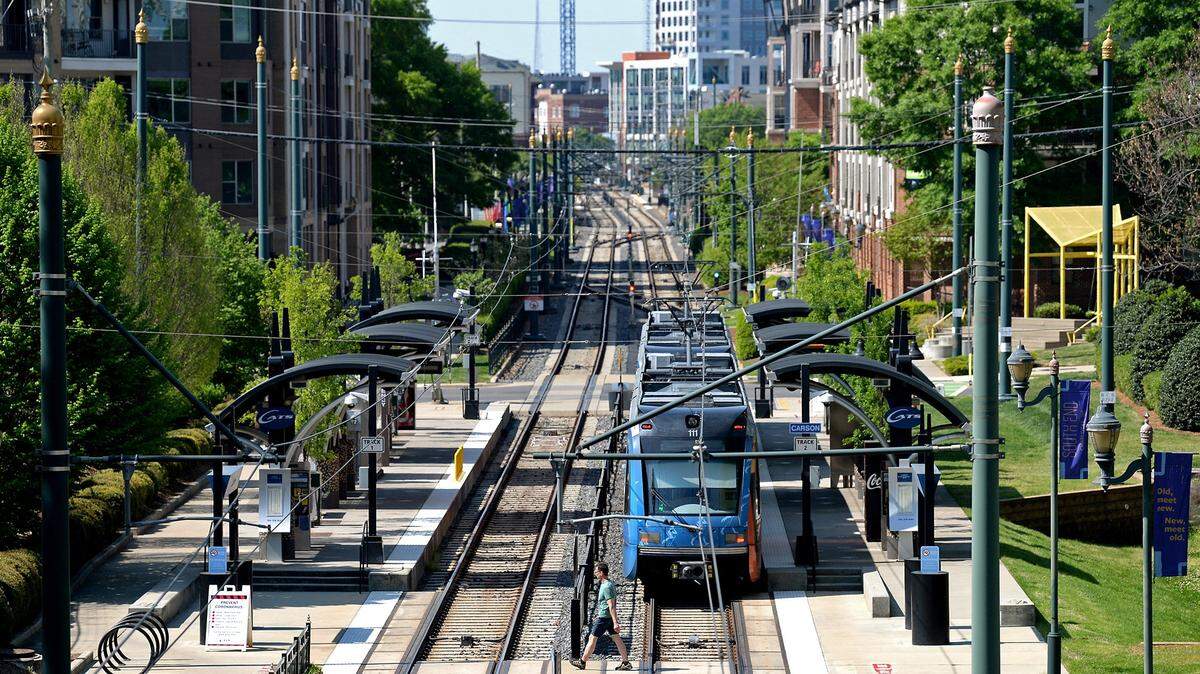
Greg Jarrell says has seen “an enormous wave of money” crash into west Charlotte in recent years. That’s a new phenomenon for the historically working class part of town, where he has lived for two decades.
He’s also seen scores of neighbors leave their homes in search of more affordable options in Gaston or Union counties as prices in the city continue to climb, he said.
“Most neighbors here would welcome the investment if they were able to enjoy the fruits of it and not be simply run out of their homes,” said Jarrell, who organizes around housing justice issues for The Redress Movement. “But that’s been the case for so many residents.”
The proposed 1% tax referendum on this year’s ballot is exacerbating gentrification unease in a part of town that already feels the creeping growth of big box apartment buildings. The measure would fund multiple rail projects, including the Red Line commuter rail going to Lake Norman and an extension to the Gold Line streetcar. The proposed Silver Line light rail would run from Bojangles Coliseum to the east and down west Charlotte’s Wilkinson Boulevard to the airport.
Proponents say the referendum and the transit plan it would pay for are critical for a city where more than 150 new residents move every day.
The Charlotte Area Transit System projects the tax increase would generate $19.4 billion over three years. It would fund other major transformations to transportation infrastructure besides rail projects, including new bike paths and a host of bus and road upgrades.
The west side is sandwiched between the airport and trendy destinations like South End and Uptown, making it a prime spot for future development. The proposed rail sweetens the deal for developers — and raises further alarms for residents and neighborhood advocates who worry the investments will accelerate gentrification and price them out of their homes.
It wouldn’t be the first time.
“What we’ve experienced in west Charlotte is the fruit of decades of municipal disinvestment,” Jarrell said.
Charlotte’s history of displacement
Urban renewal efforts of the 1960s set off a rolling housing shortage that has persisted ever since, according to Charlotte historian Tom Hanchett.
The federal government encouraged local leaders to declare areas as slums and resell the land for “better” uses, Hanchett said. The city made little effort to gather resident input. Many of these communities were largely African American.
“Maybe one or two public hearings, and then, bam, the bulldozer showed up,” Hanchett said.
One of those neighborhoods was Brooklyn in Uptown. A thousand families were kicked out, by Hanchett’s estimates, as were 200 businesses and a dozen churches.
The displaced settled wherever they could afford. Many landed along West and Wilkinson boulevards, once white and middle class areas that Hanchett said would become almost entirely Black and low-income by the ‘70s.
Around the turn of the century, a federal program called HOPE IV that intended to remake America’s public housing caused another wave of displacement for some who had relocated to west Charlotte.
Elsewhere in the city, the Lynx Blue Line light rail caused a dramatic and rapid population shift in some communities it passed through after opening in 2007.
The number of white residents in the Wilmore neighborhood increased more than 220% from 2010 to 2020 while the number of Black residents dropped 40%, The Charlotte Observer previously reported. In Optimist Park, where an extension brought the light rail in 2018, the white population increased by 461% while the Black population increased by just 21%.
West Charlotte residents worry history could repeat itself.
“It’s a real fear given what has transpired with the Blue Line, and given the history of light rail. So it’s not an unfounded, unwarranted concern,” said Rickey Hall, the board chair of the West Boulevard Neighborhood Coalition and a lifelong west Charlotte resident. “I don’t think that with growth and prosperity that you ought to have wholesale displacement of people who have been historically investing in these areas.”
A 2022 study published in the journal Travel Behaviour and Society by UNC Charlotte associate professor Isabelle Nilsson and a colleague found Black and lower-income residents felt Charlotte’s growth, including the construction of the Blue Line, benefited younger, wealthier residents over themselves.
“(Displacement) is something that is etched into the memory of, particularly, blue collar African American folks,” Hanchett said.
How the 1% sales tax referendum would benefit Charlotte
For years Hall has advocated for the types of road improvements on West Boulevard now proposed in the city’s transportation plan.
Sidewalks are too narrow. Cars speed excessively. A small sliver of greenway doesn’t connect the west side to the rest of Charlotte. And tons of bikers pass through any given day, but they don’t have designated bike lanes or multimodal pathways, Hall said.
“When we talk about quality of life, all of these things need to be addressed,” said Hall, who still has “serious reservations” about the referendum’s potential for gentrification. “If we’re going to do it and do it right, these are the types of improvements we hope to see.”
Those changes aren’t just beautification projects, said Shannon Binns, executive director of Sustain Charlotte. Binns and his organization, which advocates for sustainable growth and mobility, are campaigning in support of the referendum.
The transportation plan is a matter of safety, Binns said.
A database called the high injury network tracks serious injuries and deaths on Charlotte roads. The tax referendum requires 40% of the money to go toward road improvements. The city would use that money to address safety issues based on data like the high injury network, Binns said.
Large stretches of Wilkinson and West boulevards are highlighted as areas of concern on the network.
The city identified 22 strategic investment areas to benefit from focused mobility upgrades. Wilkinson and West boulevards are on that list, meaning those streets and the ones around them would receive upgrades under the transportation plan if the referendum passes.
Although the city hasn’t hammered out every project in detail yet, it has outlined general plans. Citywide projects include the following, according to Binns’ calculations:
- 239 pedestrian and bike signal upgrades
- 95 redesigned high-crash intersections
- 76 miles of streetlighting
- 60 miles of greenway-style paths for walking and biking
- 58 new pedestrian and bike crossings
- 43 miles of street extensions and new connections
- 41 new traffic signals
The transportation plan also calls for 43 miles of additional rail, quicker bus service, upgrades to bus stops and 19 microtransit zones. Microtransit is a rideshare-like service where passengers can hail a low-fare ride from their location and go anywhere within the zone, including bus stops or rail stations.
The rail and other improvements could accelerate gentrification in the area, Binns said. But the referendum would bring a benefit to the impacted communities, too.
“The reality is, Charlotte and Mecklenburg County, we are growing exponentially. And so when it comes to concerns around displacement and gentrification, that is happening with or without a transportation plan,” said Tonya Jameson, the director of civic advancement for economic mobility nonprofit Leading on Opportunity. “At least with the transportation plan and the referendum … now we have a lens on it, and we can also create some type of framework to try to mitigate this.”
What is Charlotte doing to prevent displacement?
Conversations about gentrification have ramped up since the Blue Line was created, Jameson said. City leaders are discussing it proactively and working to combat it.
In 2021, Charlotte City Council established the Neighborhood Equity and Stabilization Commission to research and recommend anti-displacement strategies. Jameson was one of 16 people who served on the three-year commission, which published its recommendations in November.
The city has already implemented some of those recommendations, said Justin Harlow, the commission co-chair and a former city councilman.
“It’s an opportunity to help get rid of blight in neighborhoods while also helping people stay in neighborhoods,” Harlow said.
Charlotte fully funded the Acquisition, Rehab and Resell Program, which provides single-family homes to partner organizations like Habitat for Humanity to rehab and resell as affordable housing.
The city also expanded its housing rehab program, which provides funding to low- and moderate-income homeowners to improve their homes and to property providers to rehab houses to become affordable rentals. Those investments come with deed restrictions to ensure tenants aren’t priced out of the area.
The House Charlotte Program, which provides down-payment assistance to qualified first-time homebuyers, raised its forgivable loan cap from about $40,000 to $80,000 to reflect the current housing market, Harlow said.
“A lot of these recommendations are, they’re not a full fix, right? They’re just a stopgap. But it is something to help slow down this process of displacement or gentrification,” Harlow said.
Are the city’s displacement efforts enough for what’s ahead?
While Charlotte worked with the North Carolina General Assembly to pass the P.A.V.E. ACT — the legislation allowing the city to put a 1% countywide tax referendum on ballots — advocates pushed for a carve out of those funds devoted to anti-displacement efforts.
Legislators did not include the carve out in the final bill.
“They were very prescriptive about how that sales tax could be used,” Binns said. “The GOP right now is not too concerned about matters of equity, which is what we’re really talking about here.”
Harlow thinks there needs to be a guaranteed, permanent funding mechanism for anti-displacement initiatives in the budget every year.
“Otherwise, we’ll be hearing about displacement forever. We’ve got to invest in it to try to stop it, or try to help mitigate,” Harlow said.
Charlotte does have a housing trust fund to fall back on, which is funded through biennial voter-approved bonds. These bonds generate $100 million every two years.
The city devotes about half that amount to anti-displacement: $25 million for home ownership initiatives, $14 million for rental housing preservation, $5 million for housing rehabilitation and emergency repair and $5 million for land acquisition for current and planned transit areas, said Rebecca Hefner, the city’s director of housing and neighborhood services.
Those categories were outlined in a new affordable housing funding policy Charlotte City Council adopted last year.
“If they maintained that level of investment over the 30 years of the sales tax, it would be a significant investment,” said Rebecca Hefner, the city’s director of housing and neighborhood services. “Not permanent, but yes sustainable.”
The bond is the largest source of funding for affordable housing, but it isn’t the only source. Other pots of money include Department of Housing and Urban Development allocations, which contribute approximately $4.5 million to anti-displacement each year. And the city’s affordable housing density program collects fees from some developments in transit-oriented areas. Those funds are dedicated to land acquisition and affordable housing.
“There’s not a single solution to mitigate displacement. There’s not a single tool that does the work. There’s not a single funding source ... There’s not a single entity. The city can’t do it alone,” Hefner said. “This is work that requires partnerships, creativity, dedication and investment.”
“The great thing about Charlotte is we have all of those things.”
This story was originally published September 22, 2025 at 5:00 AM.