Confederate monument honoring former North Carolina governor will be destroyed
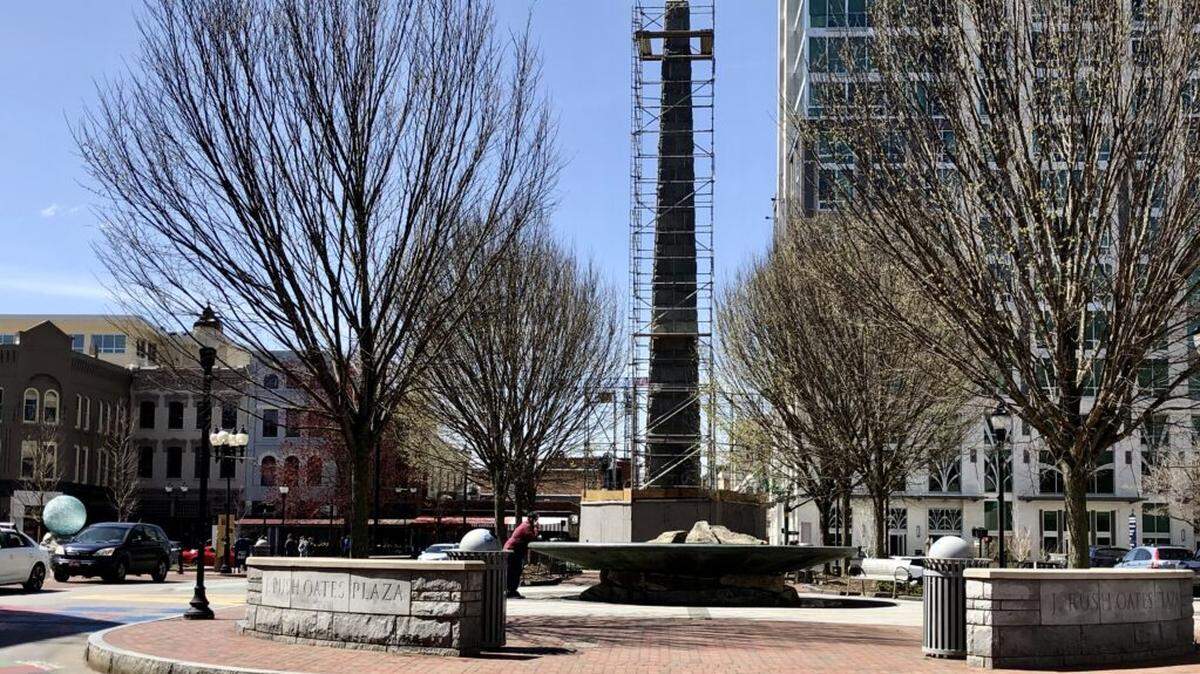
A Confederate statue that has sparked contention in Western North Carolina will be destroyed rather than moved to another location or stored in a warehouse.
Asheville city leaders on Tuesday voted 6-1 to remove the Vance Monument, which honors former N.C. Gov. Zebulon Vance, a white supremacist. It has stood since 1897 at a downtown site where slaves may have been sold.
The city council’s decision paves a way for destroying the 75-foot obelisk — a marked change from plans for other Confederate monuments across the state that are being stored or moved rather than demolished.
“We have written in the scope for the bidding that the contractor must remove and dispose of all portions of the monument,” Jade Dundas, capital projects director for the city, told McClatchy News.
The city must approve the way the demolished monument is discarded, according to documents. Parts of the statue can’t be used again in “similar likeness,” and intact pieces from the project can’t be sold or given away.
When Gov. Roy Cooper ordered the removal of Confederate monuments from the N.C. Capitol grounds in June, they were taken to a “secure facility” while a permanent location was considered. That same month, a statue that officials voted to move from downtown Salisbury, roughly 40 miles northwest of Charlotte, was expected to find a new home in a cemetery.
In Asheville, the city council took a step toward demolishing the monument after a task force called for its removal, citing concerns about safety, a potential blow to tourism and impacts on people who view it as a symbol of white supremacy. Most people who shared public comments wanted it removed, according to the group’s recommendation.
“The story of Zebulon Vance and the Civil War live on in documents, books, and memory institutions like museums and historic sites,” the task force wrote. “Removing the monument is an acknowledgement of our racist history and will allow our community the opportunity to move forward in unity.”
But some have contended that taking down monuments in Asheville and beyond removes Southern heritage and Civil War history.
Asheville, a popular tourist town in the mountains, joins a list of cities that has seen renewed debates over Confederate monuments after the death of George Floyd, a Black man who died in Minneapolis police custody in May. Amid nationwide demonstrations, the Vance Monument became a target of vandalism as people threatened to knock it down.
“Increasingly, the monument has become a focal point for protests and counter protests, often resulting in a dangerous condition for the community,” the city said in a news release. “For these reasons, it was deemed a public safety threat.”
While Asheville leaders voted to relocate two other Confederate statues that were in private hands, the ownership of the Vance Monument was initially unclear, McClatchy News reported in June. The city teamed up with Buncombe County to form a task force that looked into the monument and eventually recommended removing it, officials said.
Under a plan presented to city leaders, demolishing the monument is expected to cost roughly $114,000. MS Lean Landscaping, a Black-owned business, would temporarily restore the site for another $23,000, according to a document shared with McClatchy News.
After a month and a half, a team is expected to start making future plans for the site.
“I am looking forward to the day that we have a centerpiece in our city that reflects our Asheville today,” Mayor Esther E. Manheimer said before Tuesday’s vote, according to video of the council meeting.
Debate about removal
While the monument that bears Vance’s name is a recognizable landmark in Asheville, it has long been a point of contention.
“The Vance Monument is very much the centerpiece of the city,” Manheimer said during Tuesday’s council meeting. “It is featured on postcards. It is iconic in its correlation with our city.”
But its towering presence doesn’t sit well with everyone, including people who say they view it as a reminder of painful moments in the area’s past.
“I realized that it was more than just some big thing in the middle of downtown to tell your friends to meet up with you at,” Victoria Estes told the city council. “I realized that it was a monument to pain and suffering.”
The monument was named after Vance, a Buncombe County native born in 1830 to a family that owned enslaved people, according to DocSouth at the UNC University Library.
Vance became a Confederate officer and was first elected North Carolina governor during the Civil War. He served as a U.S. senator from 1879 until he died in 1894.
“Of all of Governor Vance’s policies, the most remarkable was his insistence, in the midst of the devastation and confusion of war, upon the maintenance of the rule of law,” the N.C. Historical Sites said on its website.
Vance believed in white supremacy and used “extremely racist dialogue to gain supporters,” according to historians. He strayed away from the Republican party and supported the Conservatives at a time when officials said the Ku Klux Klan resorted to murder to influence state elections.
“The Klan’s violence, supported by the Conservative party, intensified in advance of the 1870 election,” N.C. Historic Sites said. “Vance capitalized on the tension created by the Klan in the mountain region to help the Conservatives sweep the western counties.”
Among those arguing in favor of the Asheville monument’s removal was a relative of Vance.
“The task force engaged in a careful, thoughtful and balanced process,” descendant Noel Nickle told council members. “If you choose to vote against their recommendation, it would be a disservice to our community and a clear indication that any invitation for community engagement on important issues related to racial justice is merely performative.”
The lone vote cast against the Vance Monument demolition came from Sandra Kilgore, who argued that efforts would be “futile” unless the community also works on healing.
“This is symbolic,” Dee Williams, a Black resident, said during the city council’s public comment period. “It means absolutely nothing. So what we would want is the opportunity to work with folks on economic development opportunities, real tangible opportunities.”
Since Floyd’s death, more than 100 symbols to the Confederacy have been removed nationwide, including at least 20 in North Carolina, McClatchy News reported in October.
Some of the monuments became flashpoints during demonstrations after video emerged of Floyd, who died after an officer kneeled on his neck for about eight minutes. That officer and three others were fired and charged in connection with Floyd’s death.