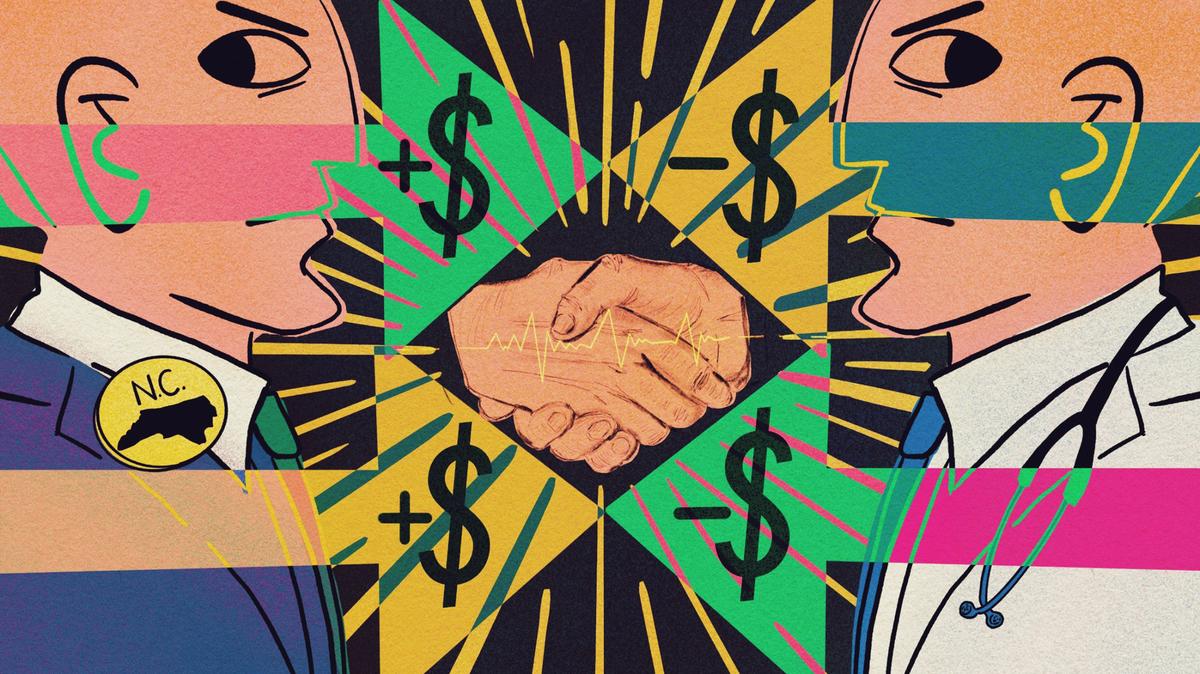
Struggling to heal: The stories of five North Carolinians bruised by hospital debt
READ MORE
Confronting Medical Debt in North Carolina
Expand All
North Carolina is home to high-ranked medical centers, well-funded hospitals where doctors use the latest medical technology to heal the sick and save lives.
But a painful truth lurks beyond the walls of these lavishly appointed hospitals: Medical debt has disrupted the lives of thousands of North Carolinians.
It’s a nationwide problem, but research shows that residents here suffer more than most. Just four states have a higher percentage of people with medical debt on their credit reports, according to a recent study by the Urban Institute.
Among the reasons: Hospital prices in North Carolina are higher than those in most other states, while family incomes are lower. The percentage of people lacking health insurance has been higher here too, though that ranking will likely fall after state legislators expanded Medicaid coverage last year.
A new state initiative is expected to help those hurt by big hospital bills. In August, all 99 of North Carolina’s hospitals agreed to take part in an ambitious state program that’s designed to relieve the burden of medical debt for up to 2 million lower-income patients.
The program requires that hospitals forgive the older hospital debt of lower-income residents, and take steps to protect such patients from massive bills going forward. In exchange, they will receive billions more in federal Medicaid money.
But for many North Carolinians, the damage is already done. Over the past five years, nearly 600 former patients have written to the state Attorney General’s office to complain about hospital billing and collection practices that often left them with overdue bills and damaged credit. Hundreds more have filed complaints with patient advocates and the Better Business Bureau.
Hospitals overbilled some of them, and refused to provide financial assistance that others felt they were entitled to, the complaints say. Still others say hospitals turned them over to debt collection agencies after failing to bill their insurance. For many, the billing nightmares came at the worst of times: when they were struggling with major health problems.
Over the past three months, the Charlotte Observer interviewed more than a dozen people who’ve grappled with bills from North Carolina hospitals. Some may be helped by the state’s new debt relief plan.
Here are some of their stories:
Medical debt crushed dreams
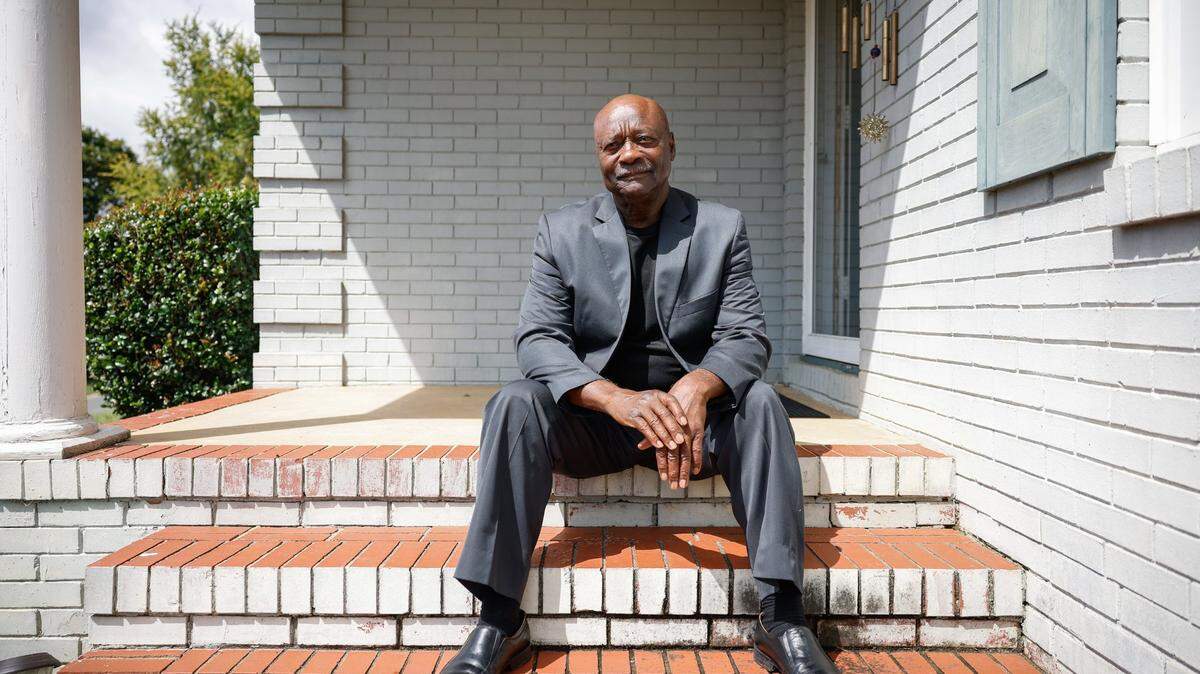
In 2019, Brenda Campbell applied for a $500,000 loan to buy the Charlotte day care center she’d managed for 30 years. She’d hoped one day to leave the business to her three children.
But a bank lending officer delivered disturbing news: She wasn’t eligible for a loan because hospital bills had damaged her credit. That forced her to downsize her plans.
The day care’s owner sold the business to someone else who didn’t allow Campbell to stay on as the center’s director. So Campbell had to move her child-care business to her family’s three-bedroom home in Charlotte’s Clanton Park neighborhood, near Interstate 77.
Her child-care business, which once cared for 70 children, now can accommodate just eight. That means much less income.
Campbell, now 65, has been working since the age of 16 and she had hoped to retire by now. But without the income from the larger business, she expects she’ll have to keep working another 10 years.
“We’ve worked all our lives to have the American dream,” she said, sitting in a child’s chair near blocks and toys that fill the front room of her home. “But right now, we can’t even afford to have a vacation.”
The problems began in 1999, when a family member was badly injured in a car crash. The family member got back surgery at Novant Presbyterian Medical Center — and then a second surgery in 2017 to address continuing pain.
The hospital bills totaled around $100,000. Campbell negotiated with Novant to reduce the total to about $60,000, and she has been trying to pay that amount off gradually — usually $25 to $100 a month, she said. Novant turned her account over to collections in 2018 nonetheless, she said.
“A lot of our dreams got smooshed,” Campbell said, sharply clapping her hands for emphasis.
Now Campbell has what she jokingly calls “white coat syndrome” — fear of going to the hospital. She has fibroid tumors, which periodically cause bouts of intense pain. But when pain strikes on weekends or nights, she doesn’t go to the hospital emergency room. She waits to go to her family physician.
“I can’t afford to go to the hospital,” she said.
A Novant Health spokesperson said the hospital system would need the family member to sign a privacy release form before it could provide details about the case, but the family member declined.
Speaking generally, the spokesperson said the system has stopped reporting patients to credit bureaus and that its concern for patients “has fueled us to create industry-leading financial assistance policies.” The system also offers patients interest-free payment plans, the spokesperson said.
“These policies, which we are working to strengthen even further, ensure that all patients have access to the remarkable care they need and deserve, regardless of their ability to pay,” the spokesperson said in a written statement emailed to the Observer.
Told about North Carolina’s plan to relieve hospital debt, Campbell’s eyes brightened. She hopes she qualifies for help.
“Just to not have that pressure would be great,” she said.
Turned over to collections after hospital mistake

On a spring night in 2022, Dara Yang woke up struggling to breathe.
She was taken by ambulance to Novant’s hospital in Huntersville, where doctors did blood tests and imaging scans but could not determine what went wrong. She was there for about 13 hours.
In June of that year, Novant sent her a bill for $22,000. She then called her insurance company, which said it had not received any claims from Novant. She repeatedly contacted Novant representatives to make sure they were billing insurance, and was told that they would do so, she said.
But by November, Novant turned her account over to collections. Paying $22,000 was out of the question. Yang, who runs a small Etsy shop, brings home about $20,000 a year, she said.
The collection agency sent her a letter the following January, threatening to report her account to a credit bureau. She knew that could damage her credit, making it impossible for her to get a car, house or loan.
She said she contacted several lawyers who told her that fighting the matter in court would be too costly. They suggested she ask Novant for a reduced repayment amount, along with an itemized bill. She did that, and Novant reduced her bill to $11,000.
But her insurance company said Novant still had not submitted a bill.
By February 2023, she was fed up. She called Novant and told a representative that she wanted an insurance claim number — or some other proof that the hospital had billed her insurance. The representative told her something that stunned Young: They’d never successfully filed a claim with her insurance company.
The following month, she filed a complaint with the state Attorney General’s consumer protection division.
“I am bewildered by the incompetence and lack of empathy from Novant regarding my case,” she wrote. “I believe I have made multiple good faith attempts to resolve this issue and each time it was left unresolved leaving me feeling neglected and deceived.”
In an April 2023 letter responding to Yang’s complaint, Novant said it had filed the insurance claim with the wrong address and, as a result, had missed the insurance company’s six-month deadline for filing the claim. It would write off her bill and notify the collection agency of the error, the letter states.
Yang, now 32, is happy with the care she received from Novant’s doctors and nurses. But the experience with the billing error has left her unsure about whether she’ll ever return to a Novant hospital.
Even those with insurance can get hit
When a severe asthma attack struck Alex Montalvo, he was in no position to be choosy about where he went for help. He was struggling to breathe, and he knew from experience that he needed medical care.
He went to a Novant urgent care clinic that Saturday afternoon in 2021 but it was closing. So he drove to Atrium Health’s emergency room in Waxhaw, where he said staff gave him nebulizers and steroids and monitored his breathing. He was there for about four hours.
His insurance paid the hospital system about $1,700 for that visit. But three months later, Atrium sent Montalvo a letter saying he owed $1,908 more because Atrium was not in his health plan’s network.
His account was turned over to a collection agency several months later. He’d been thinking about buying a house at the time, but he knew the damage to his credit would have made it impossible to get a mortgage.
More hospital bills came this summer. On July 2, Montalvo was hit with excruciating stomach pain.
“It felt like somebody shot me with a 12-gauge,” he said.
He returned to the nearby Atrium emergency room in Waxhaw, and was soon transferred to the system’s Pineville hospital, where doctors operated to remove a segment of dead tissue from his intestine.
Montalvo, now 63, credits the surgeons with saving his life. But he’s less grateful to the hospital’s billing department.
The bill for his emergency room visit and four-day hospital stay exceeded $80,000.
Among the charges on his six-page hospital bill: $14,309 for anesthesia; $2,308 for the 80 minutes he spent in a recovery room; and $6,208 for a CT scan — more than 10 times what Medicare typically pays for that type of scan, according to the agency’s price lookup page.
Montalvo’s insurance paid most of his bill, but Atrium billed him more than $4,800 for his deductible and out-of-pocket costs. He doesn’t have the money to cover it, he said.
“It doesn’t seem like hospitals are looking out for your best interest as much as their bottom line,” he said. “You’re at the mercy of the billing department.”
In response to questions about Montalvo’s case, Atrium sent the following statement:
“We understand the medical billing process is complex and too often results in unnecessary frustration for patients. While we cannot comment on the specifics of any patient’s care or billing, we are committed to guiding and assisting our patients through the financial costs of their health care and resolving issues to the best of our ability.”
The state’s new debt relief program, Montalvo said, is “fantastic” and he predicts it will ease the stress faced by many North Carolinians.
He works in IT, and earns too much to be eligible for the debt forgiveness that hospitals must provide lower-income residents, he said. But he’s pleased that the plan requires hospitals to cap interest rates on medical debt to 3% and to stop reporting debt to credit bureaus.
“At least I won’t be taken to the cleaners,” he said.
Medical debt affects ‘every aspect’ of life
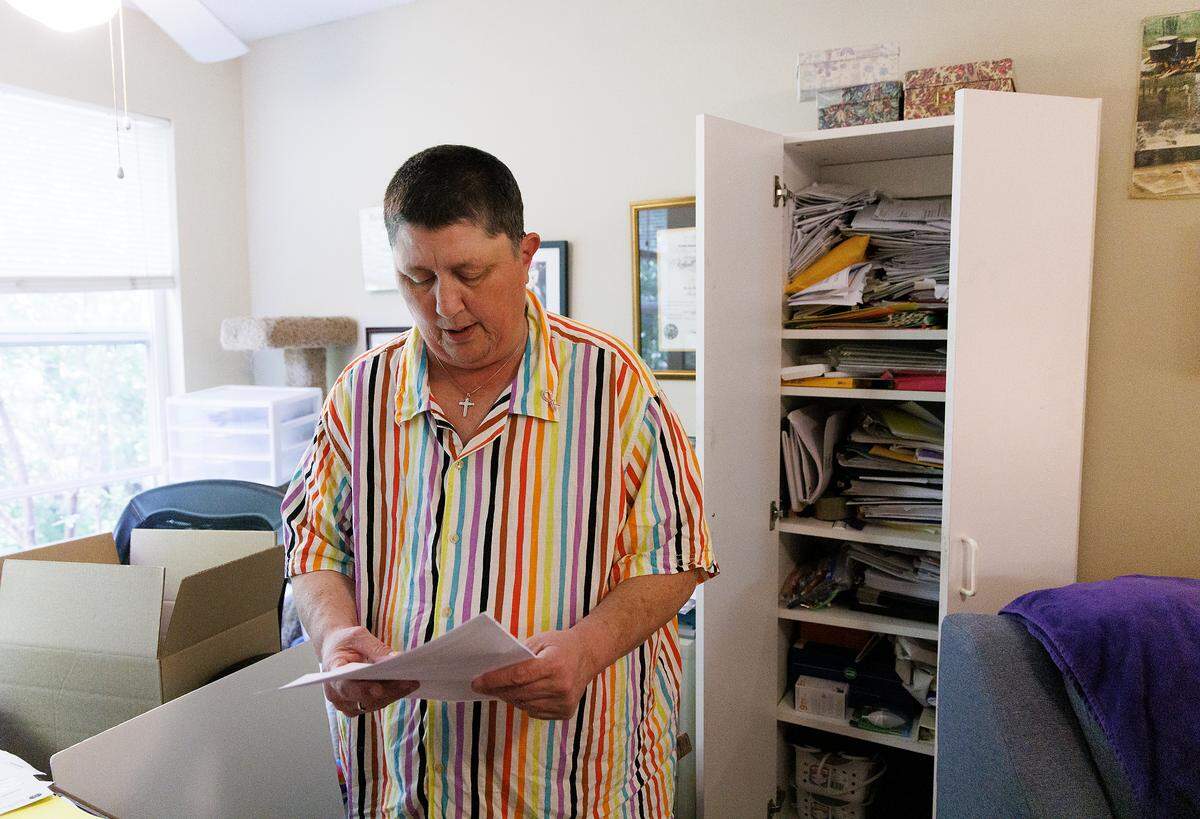
Hospital bills fill Kerry Holbrook with so much anxiety that when they arrive in the mail, she no longer opens many of them. She simply stacks them in a cabinet where a pile with dozens grows taller each month.
The former preschool teacher, now 61, has battled breast cancer and a number of other medical problems. But her current income, all from disability payments, amounts to just over $2,600 a month. Once she pays for rent on her one-bedroom apartment in Durham, food and other expenses, she has no money left, she said.
After enduring a double mastectomy and many other treatments for breast cancer since 2013, Holbrook has racked up tens of thousands of dollars in debt from Duke University Hospital. She’s always had health insurance, but she’s had costly deductibles and copays, too.
She’s grateful to the doctors and nurses at Duke for saving her life.
But collection agencies have hounded her for years, she said, and at one time they were calling her every day or two. She had to ask her brother to co-sign for a car she bought 10 years ago, a 2012 Hyundai Elantra, and she’s not certain what she’ll do if that car dies.
“The whole thing is one big morass for me. It doesn’t give me a moment’s peace emotionally,” she said. “Medical debt affects every aspect of a person’s life. It’s certainly affected every aspect of mine.”
Duke is no longer asking her to repay much of her old debt, she said. But the hospital system is asking her to pay more than $3,200 for her more recent tests and treatment.
Asked about Holbrook’s situation, Duke Health sent a written statement saying staff “make every effort to work with patients to ensure they receive appropriate financial assistance.” The health system had taken steps previously to reduce Holbrook’s debt and are ready to do so again, the statement said.
“This patient did qualify for financial assistance at a 70% discount, and the remaining balance was moved into bad debt when no further applications for assistance were made,” Duke’s statement said. “We have reached out to the patient to help them complete a full application form for additional discounts.”
Under North Carolina’s new relief plan, patients with hospital debts that are more than two years old — and incomes as low as Holbrook’s — will be entitled to debt forgiveness.
After an Observer reporter informed Holbrook about the program, she began to think out loud about what it might mean for her.
“Emotionally it would take a lot of the pressure off,” she said. “Because I wouldn’t be getting the calls from collections agencies.”
Despite low income, she struggled to get aid
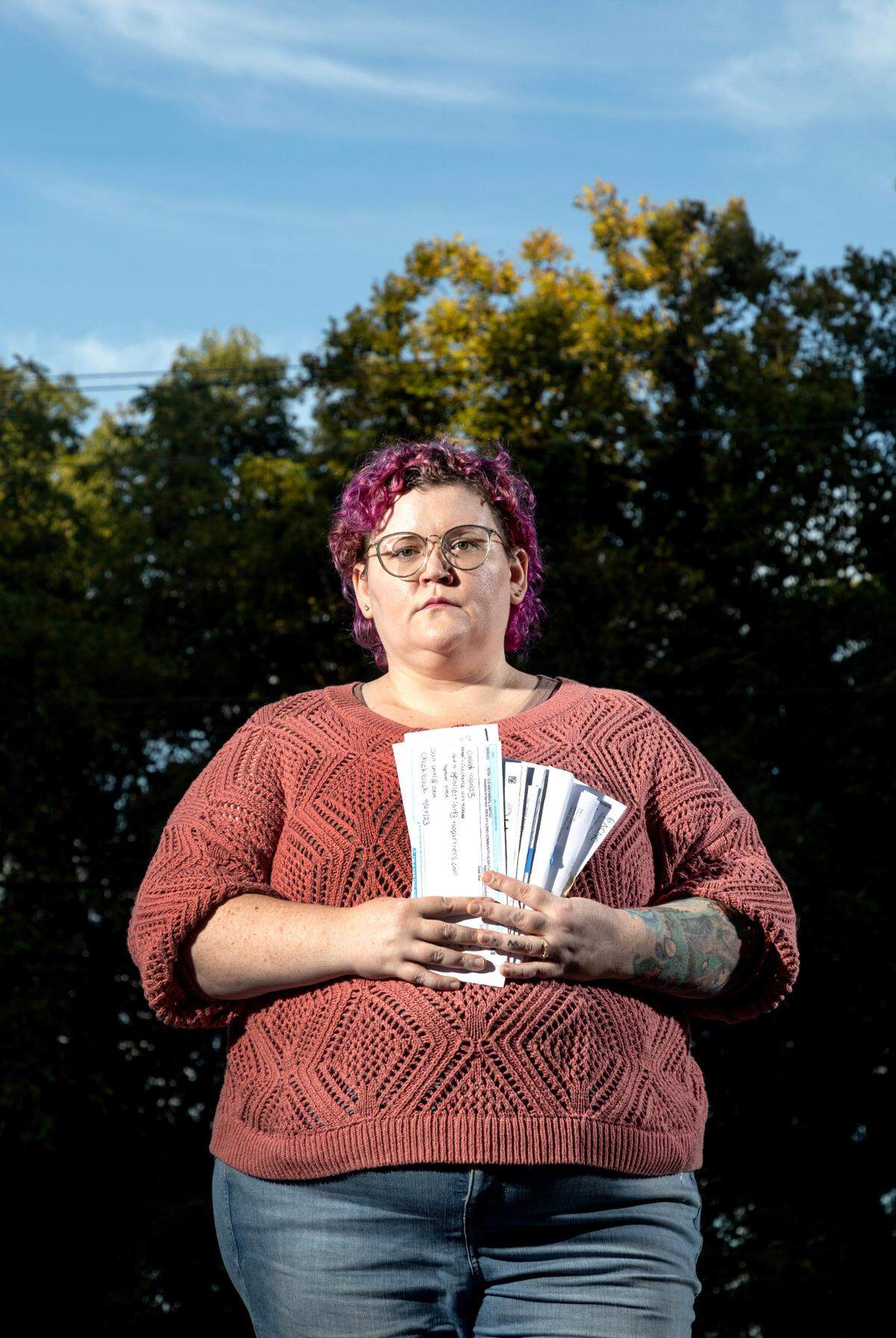
In 2022, Greensboro artist Jordan Montanez was feeling so weak that she had trouble walking.
So in November of that year, she went to the emergency department at Moses Cone Hospital, where she got tests but no diagnosis. The problems persisted, so she returned to the hospital, where she was kept overnight for more tests.
Uninsured and too sick to work full time, Montanez had less than $10,000 in annual income and relied on food stamps.
She applied to Cone Health for charity care. The hospital system covered some of the bill, but initially didn’t cover the $12,900 for her November visit, she said.
While Montanez was collecting the many bank statements, pay stubs and other information needed to get the hospital to cover that bill, she said, she discovered another “ticking time bomb” — a separate bill for $980 from Wake Forest Emergency Providers, which is affiliated with Atrium Health Wake Forest Baptist and employs staff who work at emergency departments.
No one at the hospital had explained that she needed to file a separate application for charity care to Wake Forest Emergency Providers, she said.
Her account was sent to collections.
Cone Health, meanwhile, wrote her a letter stating that it had denied her application for financial assistance because she had not provided all required information, specifically a letter from Social Services with information about her food stamps award.
The hospital system agreed to reduce her bill to about $5,500, and offered to set up a payment plan that she said would have cost her more than $300 a month — far more than she could afford, she said.
Montanez eventually learned that she was suffering the debilitating effects of a virus, maybe COVID, that for months left her feeling weak and in a “brain fog,” she said. How, she asks, was a person struggling with such an illness to figure out the many steps needed to get all her medical bills covered?
“I’m already scared and stressed. And I’m getting these bills that are making me more scared and stressed,” said Montanez, now 37. “And I’m having to figure out on my own how to deal with it. It definitely felt isolating.”
For a full year, she made calls and sent faxes to try to resolve the problem, she said. But it was only after she sought assistance from Dollar For, a national nonprofit that helps patients get financial aid from hospitals, that she said the two hospital systems agreed to cover all of her bills.
Cone Health is committed to providing “exceptional care for everyone in our community” and strives to provide financial assistance based on a patient’s ability to pay, its website says.
Montanez is among many patients nationally who have struggled to get approved for hospital charity care. Patients who apply for such help often face unreasonable requirements, advocates say.
“Patients are frequently required to gather an absurd amount of documentation to prove their income and financial situation,” Dollar For noted in written comments to the U.S. Consumer Financial Protection Bureau last year.
And many hospitals steer patients away from financial assistance and toward higher-cost options, such as financing through third-party companies, Dollar For wrote in its comments.
Under North Carolina’s new debt relief program, hospitals will be required to use a streamlined process to automatically qualify people for financial aid if they are enrolled in public benefit programs such as food stamps.
Montanez said she wishes the plan had been in place when she was going through her billing ordeal.
“It definitely would have taken a lot of the pressure off,” she said. “I wouldn’t have had to worry as much about the bill. And I could have focused more on healing.”
COMING THURSDAY: What are the expected benefits and possible problems with North Carolina’s ambitious debt-relief plan? Read more of our medical debt coverage here.
This story was originally published October 23, 2024 at 5:00 AM.
.JPG)