Evacuations underway on the NC Outer Banks ahead of Hurricane Erin. The forecast
AI-generated summary reviewed by our newsroom.
- Dare and Hyde counties ordered evacuations ahead of Hurricane Erin landfall.
- Forecasters expect wave heights up to 20 feet and wind gusts near 42 mph.
- Erin will pass 200–300 miles offshore but expands to impact North Carolina coast.
Update: Find our latest forecast story here. See photos of the damage here.
North Carolina’s Outer Banks are bracing for high waves, strong winds and flooding that could close sections of N.C. 12 for days as a powerful Hurricane Erin passes by this week.
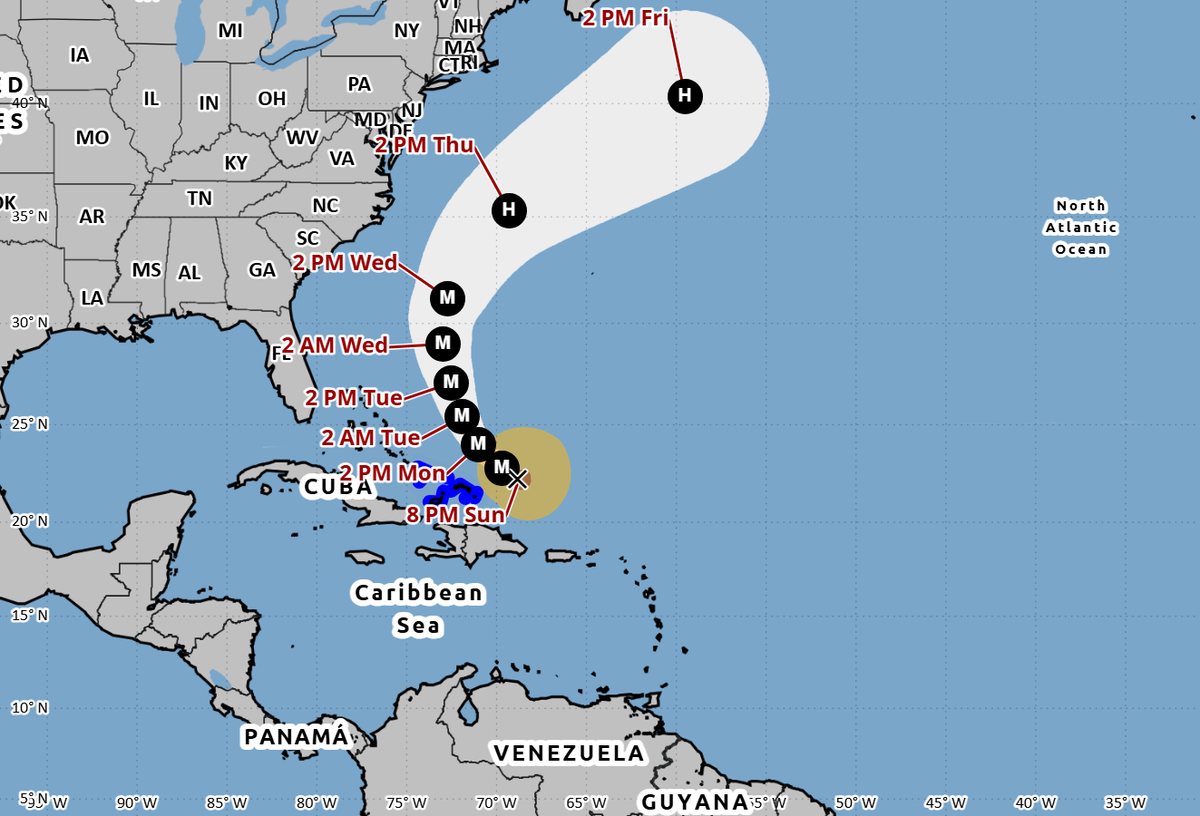
As of Monday morning, Erin was about 115 miles north northeast of Grand Turk Island in the Turks and Caicos, and about 890 miles south southeast of Cape Hatteras, according to the National Hurricane Center.
Several Caribbean islands — including the Turks and Caicos and the Bahamas — are expected to face tropical storm conditions, heavy rainfall and possible flash and urban flooding Monday, Aug. 18 and Tuesday, Aug. 19.
Erin is a category 4 hurricane with maximum sustained winds near 130 mph. It is moving toward the northwest near 13 mph.
Evacuation orders issued for Outer Banks
With forecasters calling for waves up to 20 feet in the surf on Wednesday and Thursday, Aug. 20 and 21, Dare and Hyde counties ordered tourists and residents to leave flood-prone Hatteras and Ocracoke islands.
In its announcement Sunday, Hyde County reminded those who might consider riding out the storm that, “It is extremely likely that Hyde County EMS services will not be available in Ocracoke due to Highway 12 being inaccessible. Please take this warning seriously, especially if you have medical issues or are likely to need special care.”
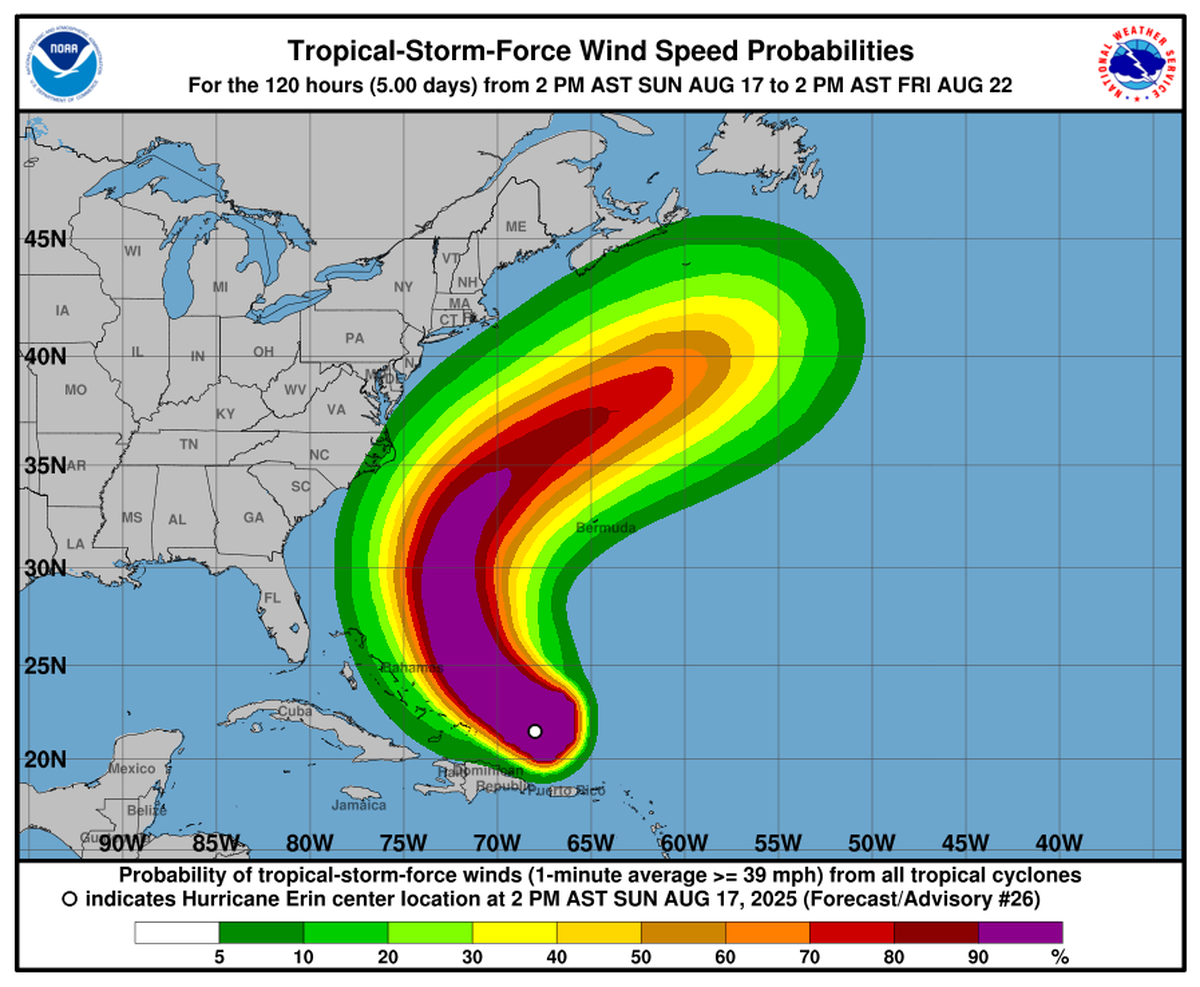
Both counties declared a state of emergency ahead of the storm, which is expected to begin traveling north on Monday, on a path that will have the center of the storm passing 200 to 300 miles off the North Carolina coast. By the time Erin gets this far north, it’s expected to have grown larger and stronger with a wind field that will reach all way to shore.
The National Weather Service has issued a flood watch for much of the N.C. coast.
The National Park Service on Monday announced closures at Cape Lookout National Seashore in response to the hurricane. The seashore, Light Station Visitor Center and Keepers Quarters Museum will close at noon Tuesday, according to a press release.
Also, the Island Express Ferry Service will pause service out of Beaufort and Harkers Island beginning Wednesday through Friday.
Erin developed rapidly from a disturbance in the Atlantic to a tropical storm and then a powerful hurricane, with sustained winds of 125 mph as of Sunday evening, when it was centered north of Puerto Rico and the Dominican Republic. The storm knocked out power for hundreds of thousands of people there.
The National Hurricane Center said Sunday that Erin is expected to move northward over the next couple of days, passing North Carolina Wednesday night and Thursday, before eventually turning to the northeast, away from the U.S. coast.
Hatteras Island, which projects off the coastline, can expect breaking waves of 15 to 20 feet or more in the surf zone as the storm passes, Dare County officials said Sunday.
Local forecasts for other communities along the coast as of Sunday evening were calling for gusty winds on Wednesday and especially Thursday, with gusts up to 26 mph at Carolina Beach, up to 30 mph at Emerald Isle, and up to 42 mph at Hatteras Island.
How often do N.C. counties evacuate for hurricanes?
Beach communities in North Carolina don’t order evacuations lightly, in part because a mandatory evacuation order may trigger travel insurance or rental companies to make partial or full refunds on vacation stays. Dare County officials say they reserve the move for when there is a likely safety threat.
Hatteras and Ocracoke, along with other islands, were ordered to evacuate for Hurricane Isaias in August 2020 and for Dorian in August 2019.
Forecasters have said the 2025 Atlantic hurricane season will be busier than average. The National Oceanic and Atmospheric Administration issued its updated forecast earlier this month, calling for 13 to 18 named storms (with winds of 39 mph or greater), with five to 9 becoming hurricanes and two to five becoming major hurricanes with winds of 111 mph or greater.
A typical hurricane season brings 14 named storms, including seven hurricanes, three of them major hurricanes. Climate experts have said global warming is contributing to more frequent and more intense storms.
Hurricane season runs from June 1 to Nov. 30, with the busiest part of the season from mid-August to mid-October.
Will Hurricane Erin affect Raleigh and central NC?
Local forecasts show a chance of showers and thunderstorms Wednesday and Thursday but otherwise there should no significant effects from the storm this far inland.
This story was produced with financial support from the Hartfield Foundation and Green South Foundation, in partnership with Journalism Funding Partners, as part of an independent journalism fellowship program. The N&O maintains full editorial control of the work. If you would like to help support local journalism, please consider signing up for a digital subscription, which you can do here.
This story was originally published August 18, 2025 at 5:00 AM with the headline "Evacuations underway on the NC Outer Banks ahead of Hurricane Erin. The forecast."