Here’s where and when you’re most likely to encounter a copperhead in NC
AI-generated summary reviewed by our newsroom.
- Copperheads cause 90% of venomous snakebites in North Carolina but are rarely fatal.
- Copperheads are found statewide but most frequently in woodlands.
- Copperheads thrive in mature suburban and urban landscaping with cover and prey.
North Carolina is crawling, or perhaps slithering, with copperheads. But where are they?
Copperheads cause 90% of venomous snakebites in North Carolina. While bites are almost never fatal, they can be painful and expensive to treat.
In the larger, urban areas of North Carolina, they are typically the only venomous snake found out of six in the state. They made international headlines this June when German World Cup players said they came across one near their base camp in Winston-Salem.
Where are copperheads in NC?
Copperheads are found all over the state, but they’re most frequently in woodlands. The snakes prefer spots that offer both cover and sun, according to the North Carolina Wildlife Resources Commission.
Favorite spots include:
- Woodland edges
- Rocky south-facing slopes
- Ivy thickets
- Old sawdust piles
- Slab piles Trash dumps
- Dilapidated buildings
Wooded areas provide more prey, but copperheads can be seen in suburban and urban areas too. North Carolina Wildlife Biologist Falyn Owens previously told The Charlotte Observer not to rule out copperheads in more heavily populated areas.
“They do pretty well in mature suburban areas, especially if there’s a lot of very mature landscaping,” said Owens. “Even in an urban area, there could be a parking lot that has bushes and trees and tall grass that hasn’t been mowed, so that could be good habitat for a copperhead.”
When are copperheads active?
Like all snakes, copperheads are cold blooded. They are more active as the weather warms, usually March through October.
The copperhead is also largely nocturnal in hot weather, though it can be seen during the day. The snakes are often encountered on roads at night; many are killed by cars.
Copperheads are well camouflaged, and operate as sit-and-wait predators. People may not see them until they are within striking distance, so it is important to be vigilant in spaces copperheads like.
Tall bushes and hiding spots may draw copperheads, as can food sources.
“Things like pet food or bird seed can attract rodents, and then the copperheads are going to come and take advantage,” Owens said.
How to identify a copperhead
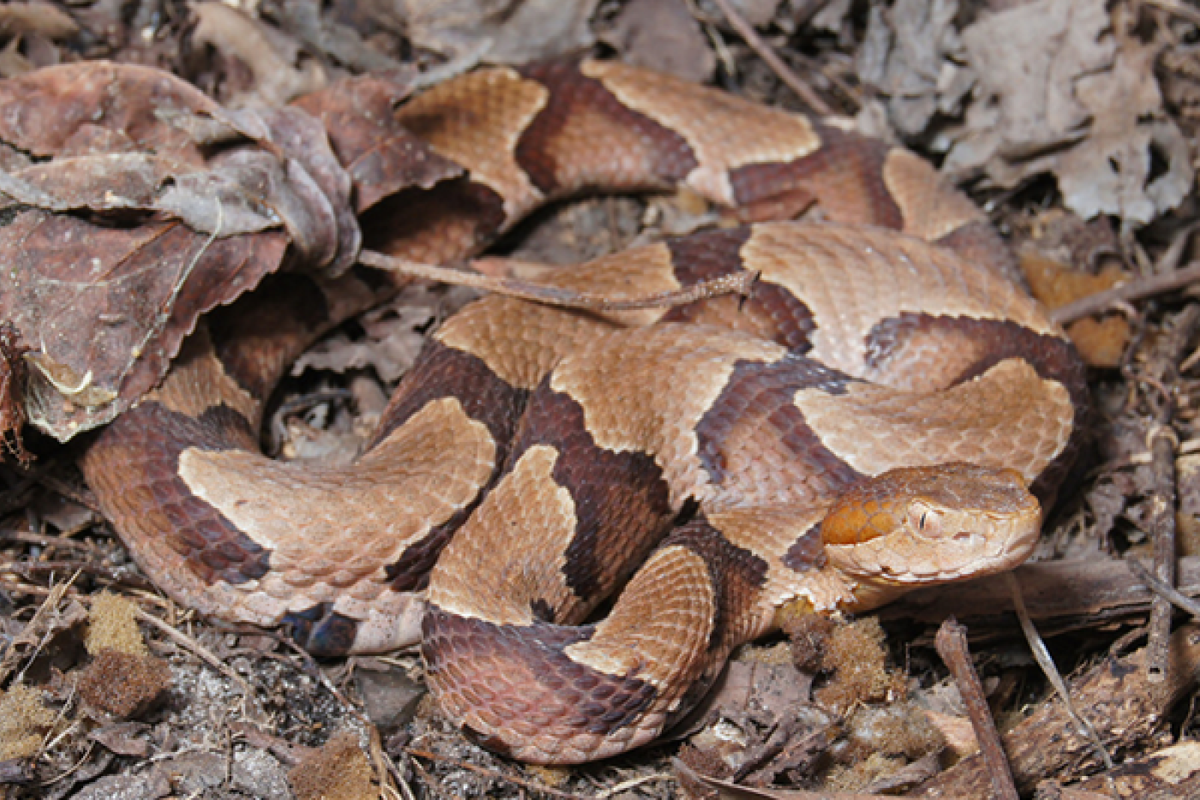
The snakes have contrasting brown crossbands shaped like an hourglass or dumbbell, according to the North Carolina Wildlife Resources Commission. The shapes are narrow in the center of the back and wider along the sides. While individual patterns may vary, the commission says nearly all individual copperheads have at least some complete hourglass-shaped crossbands.
The snakes are also fairly wide and heavy. The average adult is between 2 and 3 feet. Their heads are triangular, with a dark line from the eye to the rear of the jaw.
Portions of this story were previously published in the Charlotte Observer.
This story was originally published June 22, 2026 at 9:13 AM.