
A tropical system just formed in the Caribbean. How worried should the Carolinas be?
Editor’s note: Ian became a hurricane over the weekend. Find more storm updates here.
Carolinians should “closely monitor” a tropical depression that became Tropical Storm Ian in the Caribbean late Friday and could strengthen into a hurricane in Florida this week, National Weather Service meteorologists said.
On Saturday, NWS forecasters warned that Tropical Storm Ian could spawn tornadoes, heavy rains and coastal flooding when it’s expected to reach the Carolinas by Friday. Ian could arrive as a category 1 hurricane, NWS forecasters said.
“The consensus is that we’re going to have a lot of rain on Friday and Friday night,” meteorologist Doug Outlaw of the NWS office in Greer, South Carolina, told The Charlotte Observer at 9:15 a.m. Saturday.
“But exactly how much rain and how high the winds will be is still uncertain,” he said.
“Still too early to determine impacts on our area, but it is time to keep up with the latest forecasts and have a plan in place should Ian move toward our area,” the NWS Greer office reported on Twitter at 5:18 a.m. Saturday.
Ian is expected to arrive in the Charlotte region “Friday into Saturday,” according to a bulletin Sunday morning by the Greer office. That also goes for the North Carolina foothills, parts of the North and South Carolina mountains and Upstate South Carolina, NWS forecasters said.
“Windy conditions and strong to severe thunderstorms with heavy rainfall would be possible if the track is over or near our area,“ Sunday’s NWS alert said.
‘Most serious hurricane threat’
Ian could still be a category 1 hurricane when the eye of the storm is predicted to reach southeastern North Carolina by 8 a.m. Friday, according to the private AccuWeather service.
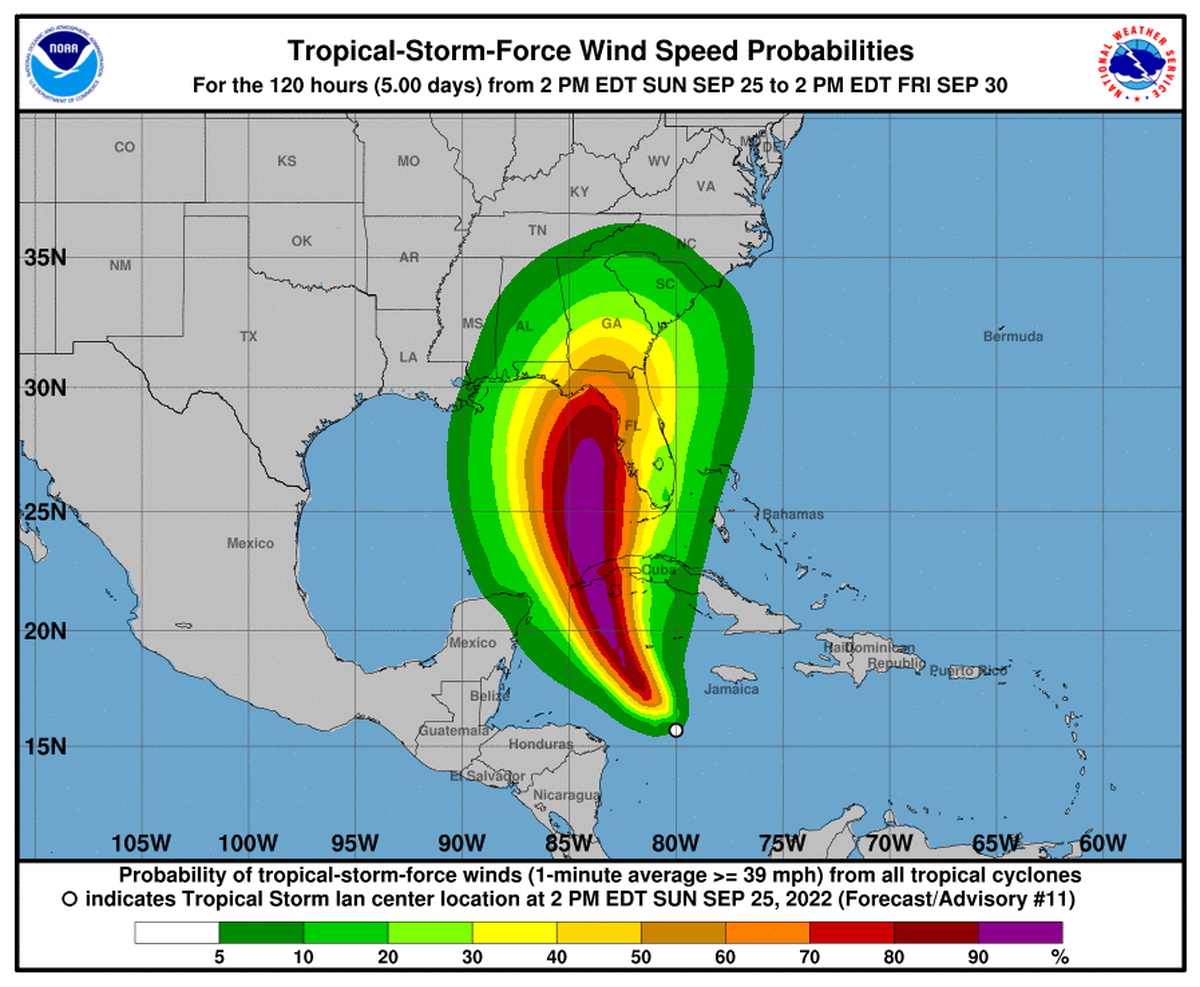
Ian could become “the most serious hurricane threat to the continental U.S. so far this year,” Alex Sosnowski, senior meteorologist with the private AccuWeather service reported.
Category 1 hurricanes pack 74-95 mph winds, according to the National Hurricane Center.
While the weakest of five categories on the Saffir-Simpson hurricane wind-speed scale, category 1 storms carry “very dangerous winds” that can produce “extensive damage to power lines and poles,” according to the Saffir-Simpson page on the National Hurricane Center website.
Outlaw said it was too early to predict on Saturday the storm’s path and intensity once it’s expected in the Carolinas.
At 5 p.m. Sunday, Ian was motoring along at 12 mph about 220 miles southeast of Grand Cayman and about 495 miles southeast of the western tip of Cuba, according to the National Hurricane Center in Miami.
Ian was set to deliver “significant wind damage and storm surge” in western Cuba, and a tropical storm watch was issued for the lower Florida Keys, the National Hurricane Center reported.The storm is expected to be “a major hurricane” approaching the Florida peninsula by Tuesday, according to a NHC bulletin at 5 p.m. Friday.
Hurricane Center officials warned Sunday morning in an alert that “regardless of Ian’s exact track and intensity, there is a risk of dangerous storm surge, hurricane-force winds and heavy rainfall along the west coat of Florida and the Florida Panhandle by the middle of the week.”
The N.C. Emergency Management office on Friday morning also urged North Carolinians to track the tropical storm.
“The forecast uncertainty beyond Sunday remains fairly high, and this system will need to be monitored over the weekend as forecast details and potential impacts to NC later next week become more clear,” the office posted on Twitter.
An Air Force Reserve “hurricane hunter” plane on Friday produced satellite imagery and data as its crew tracks the storm, Hurricane Center officials said.
Fiona’s ‘powerful swells’
North Carolina’s Outer Banks dealt with a different hurricane on Friday.
“Powerful swell from distant Hurricane Fiona continues to impact area beaches today,” NWS meteorologists in the Newport/Morehead office said on Twitter. “Overwash impacts could be significant with travel along some portions of NC 12 potentially impacted. “
Charlotte forecast
On Sunday, Sept. 25, severe storms could strike anywhere across the Charlotte region and the N.C. foothills and mountains, according to an NWS hazardous-weather bulletin early Saturday.
“Damaging winds and possibly large hail would be the main threats,” according to the alert.
Charlotte should otherwise remain sunny to partly sunny through Thursday, with a 40% chance of rain Friday and 50% chance Friday night and Saturday, according to the NWS forecast at 5 p.m. Sunday. Sunny skies are predicted for Sunday, Oct. 2.
Daily highs are expected to bounce around this week, from a predicted high of 82 Sunday to 81 Monday, 76 Tuesday, 72 Wednesday, 68 Thursday, 64 Friday, 70 Saturday and 76 Sunday, Oct. 2.
Triangle forecast
In the Triangle, the NWS says rain and thunderstorms are possible Sunday afternoon and evening, followed by several days of clear weather.
After high temperatures in the low 80s Sunday and Monday, a cooler spell is expected to set in with high temperatures in the low to mid-70s through Friday.
This story was originally published September 23, 2022 at 2:25 PM.