Tropical Storm Erin moves toward the US. Here are the latest updates for NC
AI-generated summary reviewed by our newsroom.
- Tropical Storm Erin may strengthen into a hurricane by Friday, Aug. 15.
- Erin could bring strong winds, rain and rip currents to Caribbean islands by the weekend.
- Uncertainty about U.S. impact continues, but the risk for dangerous coastal conditions increases.
Erin is now a hurricane. Read the latest updates on the storm.
Tropical Storm Erin continues to move across the Atlantic, and the National Hurricane Center now expects it to develop into a hurricane by Friday, Aug. 15.
The storm is traveling west-northwestward around 17 mph, and its center is expected to move near or north of the northern Leeward Islands over the weekend, according to the National Hurricane Center.
As of Thursday morning, Aug. 14, Erin’s maximum sustained winds were near 50 mph, with higher gusts, and forecasters expected gradual strengthening throughout the day.
How will Erin affect Caribbean islands, the US?
Swells that are likely to cause life-threatening surf and rip current conditions, along with locally heavy rainfall and strong winds are expected to begin affecting parts of the northern Leeward Islands, the Virgin Islands and Puerto Rico by this weekend, according to the National Hurricane Center.
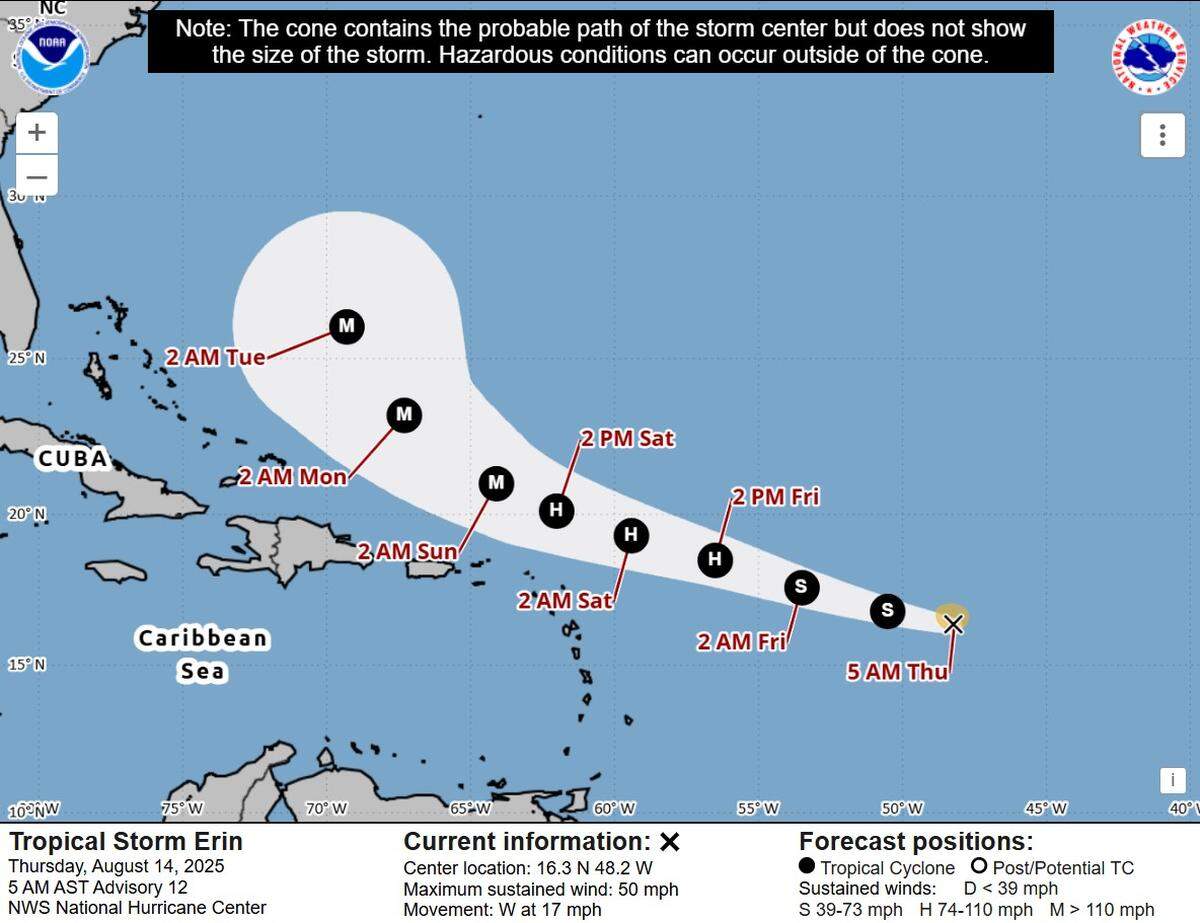
Tropical Storm Erin path
The National Hurricane Center said there is still uncertainty about what impacts Erin may bring to the Bahamas, the U.S. East Coast and Bermuda. However, the center said the risk of dangerous surf and rip currents across the western Atlantic basin next week is increasing.
AccuWeather forecasters predict that Erin will most likely turn north a few hundred miles off the U.S. coast.
But there is a possibility that the storm continues to move farther west, closer to the East Coast. That could result in a greater risk of strong winds, rain and coastal flooding, including in North Carolina.
The worst-case scenario for the U.S., AccuWeather said, is that Erin moves directly onshore, bringing strong winds, flooding rain and storm surge flooding.
Many models predict that the storm will stay hundreds of miles offshore.
Hurricane season 2025
The climatological peak of hurricane season is approaching. Hurricane season runs June 1-Nov. 30 each year, and most activity occurs between mid-August and mid-October.
Forecasters at the National Oceanic and Atmospheric Administration predicted in May that there would be between 13 and 19 named storms in 2025. Of those, the forecast predicted six to 10 would be hurricanes.
Erin is the fifth named storm this year.
This story was originally published August 14, 2025 at 1:05 PM with the headline "Tropical Storm Erin moves toward the US. Here are the latest updates for NC."