
Julie Eiselt: Silver Line is Charlotte’s next big transit move. We must get it right.

Charlotte recently hit the “reset button” on public transit planning.
Weighing post-pandemic ridership changes (which may or may not last), revised approaches to land development policies via the 2040 Comprehensive Plan and the Unified Development Ordinance (assuming its approval by Charlotte City Council this summer) and our worsening traffic, the Charlotte Area Transit System is re-thinking its master plan.
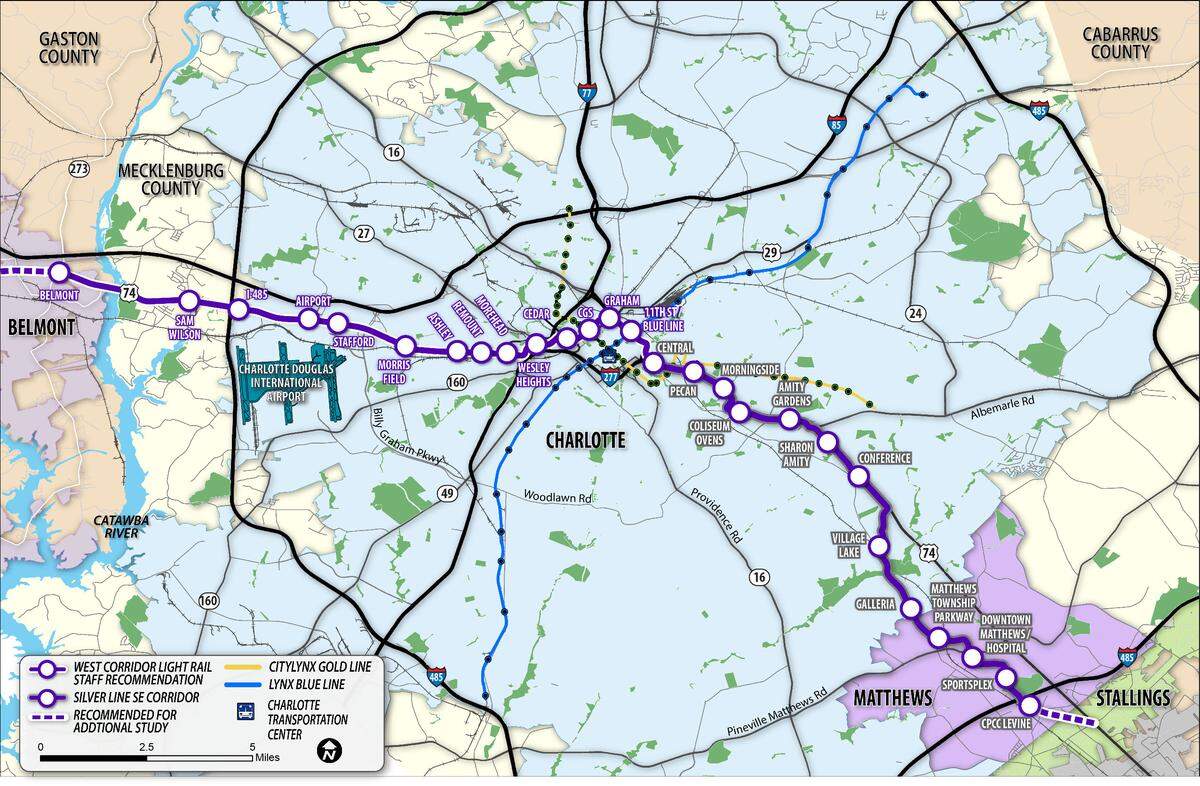
A key element for revision is the Silver Line, a 26-mile east-west, light rail counterpart to the north-south Blue Line, running from Matthews to Belmont via Uptown. Like the Blue Line, it would allow residents to travel efficiently across the area and spur denser, more sustainable development along its corridor. It would bring light rail service to Gaston County and, with an extension, could also serve Union County.
Feedback from the public and third-party experts from the Urban Land Institute, (ULI) has CATS weighing several changes to its original Silver Line alignment. For one, instead of skirting the northern edge of Uptown and only allowing transfers with the Blue Line via a nearly two-block, open-air walk, CATS is looking to run straight through Uptown with a direct transfer point like those on most transit systems. I’m very happy to see this; a cardinal rule for successful transit is making transfers between rail lines, or between buses and rail, quick and easy.
ULI recommended that the Silver Line share a segment of the Blue Line’s track. But that also has complications, potentially limiting future service expansion on both lines. You can only get so many trains down the tracks in an hour, and this “interlining” also would cause auto traffic congestion at the numerous at-grade crossings already there.
The Silver Line’s planned western leg includes an airport station a mile away from the Charlotte-Douglas terminal, with a “people mover” mini-train carrying people into the terminal. Here again, there is a danger of making the trip so cumbersome that travelers — especially those managing luggage — will not use the service.
Some suggest an in-terminal station would get little use anyway because Charlotte-Douglas’ hub status means only 20% of passengers actually check in or out of the terminal, with the rest simply changing planes. But hubs in Atlanta, Salt Lake City, Chicago and elsewhere have in-terminal transit stations that are well-used by locals and visitors alike.
As we build transit to serve Charlotte 20 to 50 years from now, we should not leave on the table this option for fully meeting the needs of future travelers.
The final Silver Line plan needs to resolve these operational questions with an eye toward sound investment in our future, and the plan must be clearly communicated and understood by the public well ahead of a ballot referendum on funding transit expansion.
Voters need to know they will get a system that takes them where they want to go, and that the service will be reliable and predictable. CATS also must demonstrate to the federal government, which will fund at least part of the work, that this investment will attract enough riders to justify the public investment.
This story was originally published July 6, 2022 at 11:13 AM.