GOP bill could mask donors skittish about backing Mark Robinson | Opinion
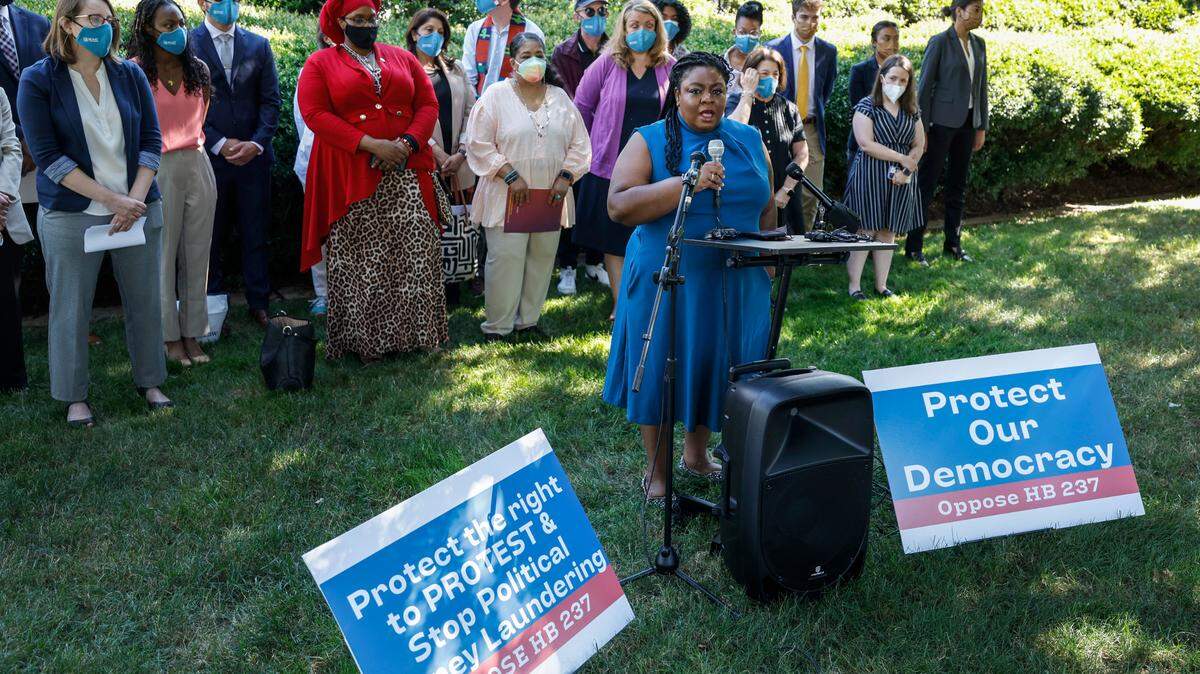
Buried inside a bill about mask-wearing is a change to campaign finance law. Critics say it amounts to political money laundering and could benefit Republican candidates in the upcoming election.
The provision removes existing limits on how much a federal political committee can contribute to a state campaign. Existing law does not permit corporations to contribute to political campaigns in North Carolina, so certain federal political committees that get money from corporations can’t give money to state committees.
But what exactly does that mean? What does it do, and who would it benefit?
The change Republican lawmakers are proposing would allow wealthy donors to skate around individual contribution limits by simply donating large sums of money to federal committees, who could then use a state political party’s committee as a vehicle to donate the money directly to a candidate. They would also be able to do so without having to publicly disclose the purpose of their donation, preventing voters from knowing who exactly is funding these campaigns.
Democrats say it’s a ploy to help Lt. Gov. Mark Robinson in his campaign for governor. The race between Robinson and Attorney General Josh Stein is expected to be one of the most expensive gubernatorial elections in the country, but Stein is greatly outpacing Robinson in fundraising.
That may be because wealthy Republican donors are reluctant to tie themselves to Robinson and his track record of hateful, dangerous comments. Even some Republican consultants have expressed concern that Robinson’s rhetoric could prove to be politically toxic to the party in November’s election.
Under these changes, a donor could give a few million dollars to the Republican Governors Association, for example. The RGA could then give that money to the North Carolina Republican Party, who could then give it directly to Robinson’s campaign, or the campaign of another Republican candidate. While the public would know that the donor made a sizable donation to the RGA, there would be no requirement to disclose the fact that it eventually ended up in North Carolina.
Curiously, the proposed change came just a few days after Stein’s campaign launched a seven-figure television ad buy highlighting Robinson’s anti-abortion views. Robinson may not have the financial resources to respond in kind, at least not while he is lagging behind in fundraising.
These committees can always purchase ads on Robinson’s behalf. But, as freelance journalist Judd Legum pointed out in his newsletter, there is a benefit to Robinson purchasing them himself, as candidates receive a discounted rate when buying ad spots directly.
We ought to be skeptical of any attempt to change election rules in the middle of an election — especially during an election as important as this one. It’s like trying to change the rules of basketball because you don’t like the way it’s going — it’s shady, and it’s not fair. It’s suspicious, too, that the change was slipped into an unrelated bill at the last minute, with limited opportunities for discussion or debate.
Republican lawmakers say that the change is necessary to “level the playing field” after the North Carolina State Board of Elections issued an advisory opinion in 2020 allowing the Democratic Governors Association to use a non-corporate account to send money to the state party. Since the Democratic Governors Association keeps its corporate donations in a separate account than individual donations, it is permitted under state law. Of course, Republicans could do the same if they chose to separate their donations the same way, but they currently do not.
In a committee hearing Tuesday, Democrats asked about the timing of the change, given the fact that it’s been four years since that advisory opinion was issued.
“Well, it certainly takes some time to see the consequences of the opinion,” Rep. Grey Mills, the chair of the House’s Election Law and Campaign Finance Reform committee, managed.
There’s an element of hypocrisy here, too, considering how much Republican lawmakers have suggested that “dark money” and “out-of-touch billionaires” are helping Democrats win elections.
Of course, Democratic candidates could benefit from this change as well, if they wished to take advantage of it. That doesn’t make it OK. Dark money should be concerning no matter the source or recipient, as it tips the scales of our elections and allows undue influence from wealthy interests, even if they don’t live here at all.