Charlotte’s pedestrian bridge is way behind schedule. Here’s why it’s taking so long.
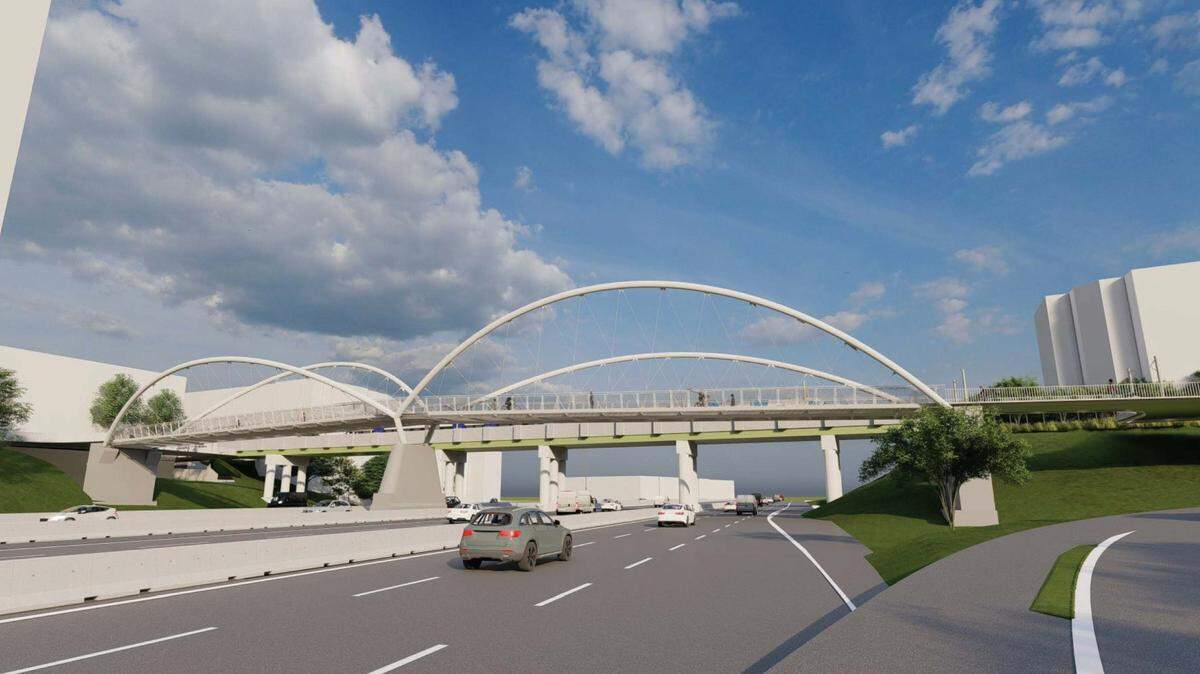
The Rail Trail Bridge kind of feels like a Charlotte fairytale. It’s approaching the level of things Iike the Red Line and Eastland Yards — projects that were promised long ago but have yet to be delivered.
By now, we should’ve already been walking on the bridge, which will link South End and Uptown by allowing pedestrian and bicycle traffic to safely cross over Interstate 277. When city officials began work on the project in 2019, it had an expected completion date of 2023. Two years later, the estimate was pushed back to 2025.
But it’s 2025 now, and construction still has yet to begin.
Here’s the good news: Charlotte City Council recently approved a contract for the Rail Trail Bridge, which is the biggest sign yet that the project is finally moving forward. The bad news, though, is that it won’t be done until mid-2028.
Wondering why it takes so long to build a bridge? You’re not the only one.
It’s easy to write off the delays as a Charlotte problem, and in some ways it may be one. Charlotte has long been a city that’s better with ambition than follow-through — its ongoing struggles to implement its transit plan, for example, are evidence of that. The skyline can change in what feels like a blink of an eye, but the infrastructure seems to take ages to catch up. In fact, the idea for the pedestrian bridge dates back to the city’s original Blue Line plans decades ago.
But there’s more to it than that.
For one, COVID threw a wrench in the city’s plans, most notably by increasing the cost of materials which forced the city to come up with a new design in order to make it more affordable, city spokesperson Lawrence Corley told me. The planning and design process can take an awfully long time, which is why the city didn’t send out a request for bids on the project until 2024.
“The funding for any type of public project is usually the easiest part. What follows that, of course, is all of the planning,” Crista Cuccaro, a professor at the UNC-Chapel Hill School of Government who specializes in procurement and contracting, said.
Bridges in particular can be more complicated than a project that occupies just one plot of land, Cuccaro said. For one, the land on one or both sides of the bridge may not be owned by the city, and the fact that it crosses over a highway requires the city to obtain approval from the N.C. Department of Transportation. According to Corley, the city did need to require the rights to use some of the land, and the NCDOT approval process alone took almost a year.
But Cuccaro said that the funding sources for a project like this can also determine the length of time it takes. Since some of the funding comes from the Charlotte Regional Transportation Planning Organization, the city’s federally designated transportation planning agency, it must satisfy the requirements for federal funding that can make the process a lengthier one.
Three years of construction sounds like a lot. But state law requires that a number of factors be taken into consideration when choosing a contractor for a project like this, and time isn’t usually one of them. Under North Carolina law, a local government must award the contract to the lowest responsive and responsible bidder — and in some cases the most affordable route can also be the slowest one.
There are some instances in which expediting a project might be reasonable, Cuccaro said, such as restoring highways in Western North Carolina that were devastated by Hurricane Helene. But while the Rail Trail Bridge will be valuable to the city and its residents, it doesn’t exactly rise to that level of urgency.
While the reasons for the bridge’s delay may be legitimate, it doesn’t make it less frustrating for Charlotte residents who have been waiting ages for a safe pedestrian and bicycle crossing between two of Charlotte’s biggest neighborhoods. It’s particularly frustrating given the fact that a city like Charlotte probably should have had something like this a decade ago. To many, it’s another example of how Charlotte lacks many of the amenities of the world-class city it’s growing into — and that it says it wants to become. But sometimes, good things just take time.
This story was originally published January 21, 2025 at 5:00 AM.