With a new Pledge of Allegiance bill, NC Republicans are solving a nonexistent problem | Opinion
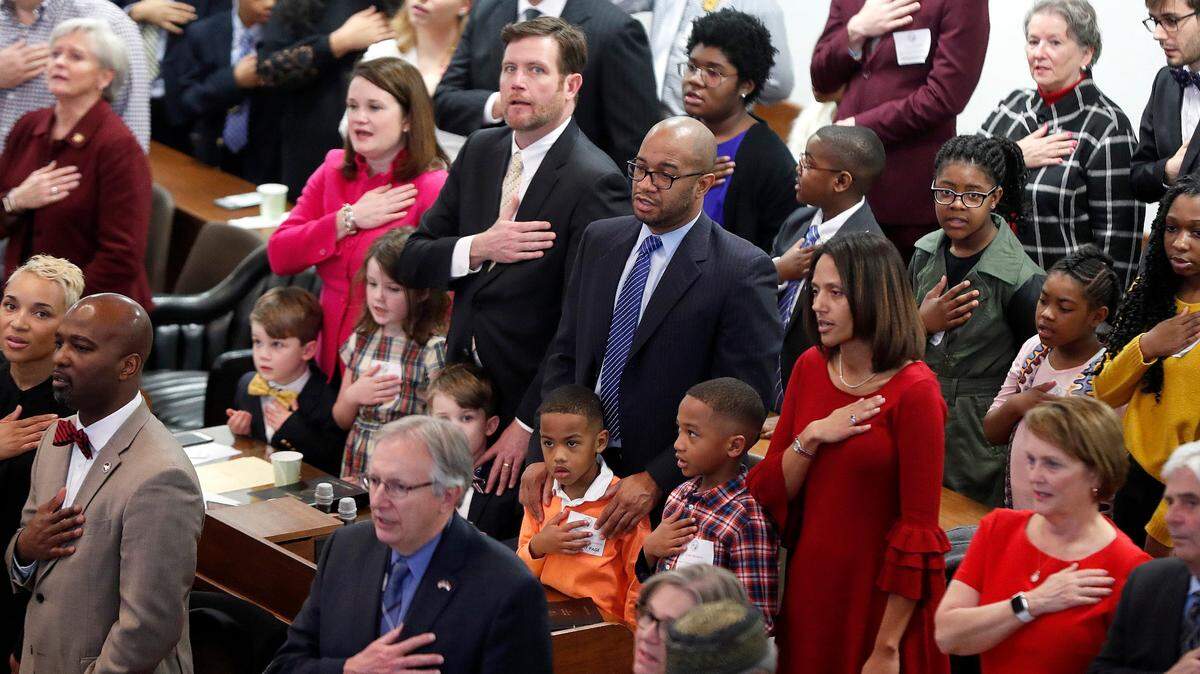
A bill recently filed by North Carolina Republicans would compel public schools to devote time each day to reciting the Pledge of Allegiance.
Most people who have attended public school in North Carolina in the past 20 years know this already happens — because it is already the law. North Carolina is one of 47 states that require the Pledge of Allegiance be recited in public schools. A state law passed in 2006 states that schools must display United States and North Carolina flags in each classroom and require the recitation of the Pledge of Allegiance on a daily basis, although it does not compel any individual student to stand or recite it.
The legislation filed by North Carolina Republicans would make a minuscule and seemingly unnecessary change to that law by requiring the pledge to be recited within one hour of the beginning of the instructional day. The bill — which is named “The Stars and Stripes Commitment Act” — states that regional and laboratory schools must also adopt the same policy on daily recitation of the pledge. It would also require the State Board of Education and local school boards to recite the pledge at the beginning of each meeting. (Many school boards already do this, including Wake and Charlotte-Mecklenburg Schools, despite it not being the law.)
The bill’s primary sponsor is Rep. Brian Biggs, a Republican who represents Randolph County. A spokesperson for Biggs told me via email that the bill was filed because “it is our understanding that some schools have not been reciting the pledge” and that it is meant to “encourage a sense of civic pride in our students.” More than a dozen House Republicans have signed onto the bill, including Rep. Tricia Cotham, who chairs the House’s education committee.
Reciting the pledge at school each day is already standard practice, so there’s nothing inherently wrong with wanting that to be the law. When it received nearly unanimous support in the legislature 20 years ago, it was merely codifying a ritual that many schools already practiced, which is why some questioned the need for such a mandate in the first place. At the time, the only legislator to vote against it called it a “feel-good and unnecessary bill,” because “saying the pledge every day doesn’t necessarily make one a better patriot.”
This bill is even more unnecessary, considering its purpose is purely to dictate not whether, but when the pledge must be recited. Does it really matter what time students stand to recite the pledge? Does it really matter whether school boards do so at their meetings, especially if most of them are already doing it? What it feels like is a messaging bill — one designed to show voters that they’re solving a problem, even if that problem doesn’t actually exist. It could also be a test for Democrats: if they oppose the bill because they believe it’s unnecessary, Republicans could accuse them of being unpatriotic.
Surely, there are more pressing matters for legislators to prioritize, especially when it comes to public schools. School districts across the state are struggling with teacher retention, infrastructure needs, inadequate staffing and a myriad of other issues that legislators have failed to address in recent years. All of those have a far bigger impact on a child’s education than reciting the Pledge of Allegiance. Of course, passing this bill doesn’t mean that legislators can’t or won’t address those matters. But it does signal what their priorities are — and perhaps more importantly, what they aren’t.
This story was originally published February 26, 2025 at 12:13 PM.