
“There has never been a more important time”: What NC faces next with COVID-19
North Carolina, like other states, is now seeing the effects of two accelerants that health officials had feared would ignite the spread of COVID-19. Thanks in part to Thanksgiving gatherings and colder weather pushing people indoors, daily case counts regularly reach record highs, as does the positive rate of infections and the hospitalizations that follow both of those metrics. Our state is, right now, in its most urgent stretch of the COVID pandemic.
Quite possibly, things could get worse.
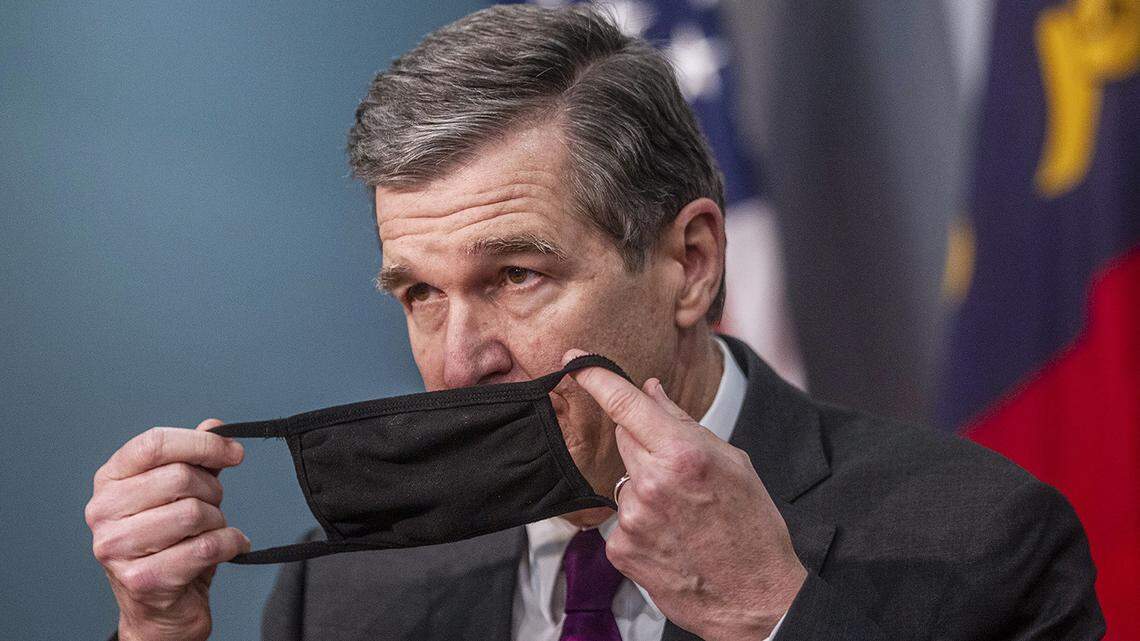
As Gov. Roy Cooper held his weekly update on the virus Wednesday, he was faced not only with daunting numbers but the possibility that we haven’t yet paid the price for the most recent holidays. Christmas and New Year’s gatherings are just beginning to show themselves in new infections, and if those numbers continue to rise — as the growing positive infection rate suggests — more hospitalizations will inevitably follow.
Add to that a new, highly-contagious virus variant that has been documented in Georgia, and the landscape is clear: It’s critical in the next 2-3 weeks to once again bend the COVID curve and get North Carolina’s numbers headed in the right direction.
“There has never been a more important time to take this seriously,” the governor said.
For his part, Cooper has been hesitant to tighten COVID-19 restrictions beyond the curfew and early halt to on-site alcohol sales he mandated in early December and extended Wednesday. He announced no other new restrictions this week, and we understand why. Such a move would burden businesses and workers already struggling in the pandemic, and it would be met with backlash across the state that could become counterproductive to containing the virus. As Cooper said when he warned of more restrictions last month: “None of us want that.”
But the curfew has not had the impact on the virus that many had hoped. Hospital ICU occupancy has risen to 83 percent statewide — above the national average of 77 percent but not quite to urgent levels. In spots throughout the state, however, hospitals are reporting that ICU beds are becoming scarce. In Mecklenburg County, health director Gibbie Harris told county commissioners Tuesday night that she was concerned about hospitals and hopeful that Mecklenburg doesn’t see conditions like Los Angeles, where hospitals overwhelmed with COVID-19 are turning away emergency patients.
There is good news — at least in the distance. Vaccine distribution is ramping up in North Carolina, with the first group of Phase 1b lining up for shots this week and Cooper taking steps to fix distribution issues by mobilizing the National Guard. While the effects of vaccines won’t be felt in the immediate future, the COVID-19 caseload should start to decline at the end of January, Dr. David Priest, Novant infectious disease expert, told reporters Tuesday morning.
That assumes, however, that individuals and businesses follow COVID safeguards, and that the new fast-spreading virus variant doesn’t prompt a sudden spike in cases and hospitalizations. That’s what has happened in Britain, where infections prompted by the new strain forced Prime Minister Boris Johnson to impose a nationwide lockdown this week. Johnson ordered schools and colleges to shift to remote learning, and he urged individuals to stay at home unless they were working or buying food and medicine.
Cooper could consider lesser measures, such as further limiting capacity of places where people from different households interact, especially indoors. Any such measure should be accompanied by relief for businesses and workers, and N.C. lawmakers should be ready to fill gaps left by the second COVID package Congress approved last month.
Mostly, though, these critical 2-3 weeks ahead are in the hands of North Carolinians. If you’re not already doing so, stop gathering indoors with people not in your household. Wear a mask wherever and whenever you are near others. The daily creep of record highs can be more numbing than alarming, but without continued vigilance to COVID, the alarming could quickly become our reality.
BEHIND THE STORY
MOREWhat is the Editorial Board?
The Charlotte Observer and Raleigh News & Observer editorial boards combined in 2019 to provide fuller and more diverse North Carolina opinion content to our readers. The editorial board operates independently from the newsrooms in Charlotte and Raleigh and does not influence the work of the reporting and editing staffs. The combined board is led by N.C. Opinion Editor Peter St. Onge, who is joined in Raleigh by deputy Opinion editor Ned Barnett and in Charlotte by deputy Opinion editor Paige Masten. Board members also include Observer editor Rana Cash and News & Observer editor Nicole Stockdale. For questions about the board or our editorials, email pstonge@charlotteobserver.com.
This story was originally published January 6, 2021 at 11:48 AM.