
Charlotte Hornets draft talk: Mitch Kupchak's history, who's out of reach, centers
First in a series of weekly draft columns leading up to the June 21 NBA draft:
It’s a little less than a month until the June 21 NBA draft; if you’re a Charlotte Hornets fan, you want to know who will still be available when the team selects 11th overall.
The only way to even start projecting that is to eliminate who pretty much can’t last that long.
Remember a year ago? There was a lot of conjecture Kentucky’s Malik Monk couldn’t possibly last to No. 11. You’d hear how Monk’s “floor” was the New York Knicks at No. 8.
Then, it became obvious a few days before the draft that Monk’s status was more fluid than many in the media had anticipated. He was there at No. 11, and the Hornets ended up choosing him over Louisville’s Donovan Mitchell.
This far prior to the draft, I try to think of the order more in strata than linking specific players to specific teams. It’s fun to do early mocks – I’m sure I’ll participate – but specificity isn’t a realistic goal.
With that in mind, I think it’s fair to say there are five players who it’s virtually impossible to imagine lasting to No. 11. Arizona’s DeAndre Ayton, European pro Luka Doncic, Duke’s Marvin Bagley, Michigan State’s Jaren Jackson and Texas’ Mo Bamba.
I’m not saying those will definitely be the first five players chosen. I am saying that barring some huge red flag, they’ll be gone before the Hornets pick.
It’s more complicated with, for instance, Missouri’s Michael Porter. That’s because his back injury cost him almost all of his one college season and the few games he could play were nothing like representative of how scouts anticipate him performing, based on what he showed in high school.
The next plateau, players unlikely to last to No. 11, obviously includes Porter. It would include some combination of Porter, Duke’s Wendell Carter and Oklahoma’s Trae Young. I think with both Carter and Young, there is a significant range of opinion about where they fit in this group.
There are rumors the Atlanta Hawks like Young, a guard capable of huge scoring games, a lot, but think they could trade out of the third spot and still get him. Carter played with so many other scorers (Bagley and senior guard Grayson Allen among them) that scouts might not have the best fix on what he’ll be in the NBA. Porter’s back surgery, no matter what his medical records now say, will be an issue until he’s selected.
I think pretty much anyone beyond those top eight could be available at No. 11. I’d be more surprised if, for instance, Mikal Bridges from Villanova or Miles Bridges from Michigan State was there than if Kentucky’s Shai Gilgeous-Alexander or Kevin Knox was, but nothing beyond that circle of eight would feel like a shocker.
Kupchak history
While this is Mitch Kupchak’s first draft overseeing the Hornets, he has a long NBA track record: He led the Los Angeles Lakers’ basketball operation (after Jerry West left the franchise) from the fall of 2000 until early 2017.
What can be gleaned from his draft history?
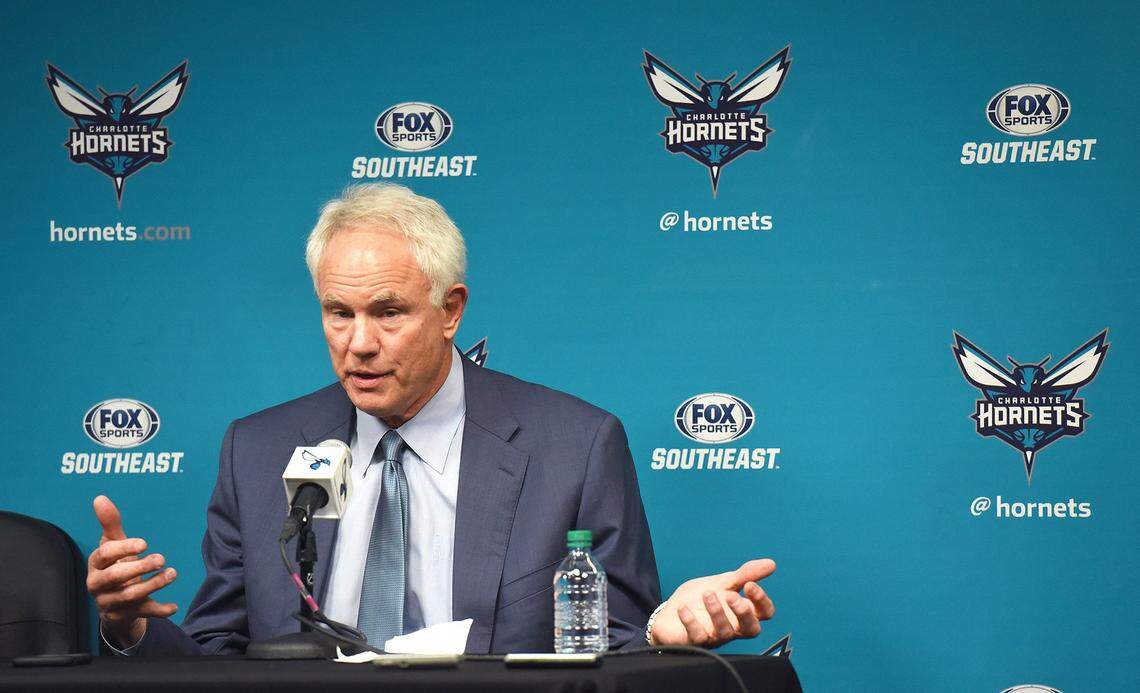
In that span the Lakers made 31 draft picks: 11 in the first round and 20 in the second round. They were so successful during portions of that run (six NBA Finals appearances) that seven of those 11 first-round picks were 19th or later in the round.
Arguably, the best pick Kupchak made was center Andrew Bynum with the 10th pick in 2005, straight out of high school. Not yet 18, Bynum was the youngest U.S. player drafted into the NBA at the time.
Bynum played seven seasons for the Lakers; his best was his last one – 2011-12 – when he averaged 18.7 points and 11.8 rebounds and was named an All-Star. A knee injury cost him the following season, and he played only 52 more games, for Cleveland and Indiana, before retiring.
Kupchak was pretty good at finding talent in the 20s or later, which has not been a Bobcats/Hornets strength since the NBA returned to Charlotte in 2004.
Future multi-time All-Star Marc Gasol (traded to Memphis) was obviously a coup with the 48th pick in 2007. Some other late picks who worked out: Larry Nance Jr., (27th in 2015), Ronny Turiaf (37th in 2005) and Luke Walton (32nd in 2003).
The Hornets getting impact out of the second round will be a big challenge in this draft: What would have been their pick – 41st overall – now belongs to the Orlando Magic from previous trades. The Hornets have No. 55, which was the Cleveland Cavaliers’ selection, six spots before the end of the draft.
Position analysis: Center
The Hornets have nearly $39 million tied up in guaranteed contracts next season for three centers: Dwight Howard ($23.8 million), Cody Zeller ($13.5 million) and Willy Hernangomez ($1.5 million).
Trading for Hernangomez was the last significant move by Rich Cho before he left as general manager in February. Howard was the major deal of last offseason, and at 32 this is the last season on his contract. Zeller has three seasons left on his contract, with a total remaining value of about $43 million. Hernangomez has one more season beyond this one at $1.7 million.
It’s fair to say Howard isn’t a long-term solution here, but I wouldn’t call center a position of particular need for the Hornets. Obviously, if Bamba somehow slipped out of the top 10 (highly unlikely), Kupchak would have to be interested. But a center doesn’t seem likely at No. 11.
This story was originally published May 25, 2018 at 7:56 PM with the headline "Charlotte Hornets draft talk: Mitch Kupchak's history, who's out of reach, centers."