Proposed Medicaid cuts may threaten NC waiver programs supporting fragile children
Grayson Ketchie's family fears loss of care as Medicaid waiver covers vital services
Critics urge lawmakers to find budget savings without harming vulnerable patients
RALEIGH
N.C. State superfan Grayson Ketchie is well known in North Carolina, regardless of sports team affiliation. His lifelong medical challenges have been well documented, and his affiliation with the Wolfpack — and its heartwarming reciprocation — has inspired many.
But, according to his mother, Ketchie’s next big challenge may originate in Washington, D.C.
Congress recently approved President Donald Trump’s spending bill, which includes nearly $1 trillion in cuts to Medicaid services over the next 10 years. Those cuts could prevent Grayson, 14, and children like him from receiving proper medical care, his family worries.
Dianne Ketchie said Grayson’s primary health insurance is through her employer-based plan with Blue Cross Blue Shield. It covers a limited portion of Grayson’s medical treatments, services and supplies. She works as a project controller with an engineering firm.
N.C. State’s Davin Vann and KC Concepcion greet Grayson Ketchie during the Walk of Champions before N.C. State’s game against Western Carolina at Carter-Finley Stadium in Raleigh, N.C., Thursday, August 29, 2024. Ethan Hyman ehyman@newsobserver.com
The rest of his coverage comes from North Carolina Community Alternatives Program for Children, or CAP/C. Grayson does not qualify for Medicaid under the traditional or expansion plans because his parents are ineligible. The entire family must qualify, Ketchie said.
CAP/C is an optional Medicaid waiver program run by the state that provides at-home health coverage for medically fragile and medically complex children, up to age 20, regardless of financial status.
“The Medicaid waiver program exists to allow kids like Grayson to live at home instead of living in an institution,” Ketchie said, noting her son thrives on socialization. “Living at home is what is best for Grayson, best for our family.”
While the bill does not explicitly call for the elimination of specific programs, the Ketchies are concerned the cuts will impact programs like CAP/C first.
The bill limits what are known as provider taxes. That drew opposition from Republican Sen. Thom Tillis of North Carolina, who releaseda report saying: “This means that effectively everything else funded by provider taxes would be on the table for cuts or full elimination, depending on actions by the General Assembly. This includes home and community-based services, postpartum care for women 12 months post-birth, GME payments, rates for hospitals, and expansion.”
According to the North Carolina Department of Health and Human Services, CPA/C falls under community-based services.
Approximately 6% of children covered by Medicaid are considered medically fragile, but account for an average of 40% of pediatric Medicaid expenditures, according to an article published in medical policy journal Health Affairs and reportsfrom KFF.
It’s logical on paper, Ketchie said, to cut optional, more expensive programs instead of mandatory, cheaper ones. But it’s not that simple.
The Medicaid waiver might be optional for the state, but the services and tools it provides are not. “There’s no way,” Diane said, they, or families in similar situations, could afford everything necessary to meet Grayson’s needs.
Grayson remains in hospice care and his health remains unstable. CAP/C helps pay for Grayson’s nursing care, oxygen supplies, wheelchair, walker, feeding tube, among other needs to provide a positive quality of life.
The bill provides certain exemptions for dependents, but the Ketchies’ income would remain too high for eligibility. If the waiver program is cut, Grayson could not receive individual benefits, despite his documented need.
“We need you to think about these people as human beings and the value that they provide to society,” Ketchie said. “Their lives matter, and it’s not their fault that it takes so much to keep them alive. That’s not Grayson’s fault. It is what it is, so we need people in the community to stand with us to say this can’t be where we’re taking money from. We can’t be taking money from these children.”
Most people probably don’t know this program exists but Ketchie wants the public to know this is a lifeline for families and has kept Grayson alive. It’s hard to think about what would happen if program funding is slashed or eliminated.
Grayson’s services would go away. His parents would need to figure out care, or Ketchie would request to work from home. They would likely incur significant medical debt, too.
“We would not send Grayson into a facility,” Ketchie said. “Whatever that meant is what we would do. It would be devastating, but I’ll do whatever it takes. It’s terrifying to think about, because it’s just one more burden. It takes away from focusing on quality of life.”
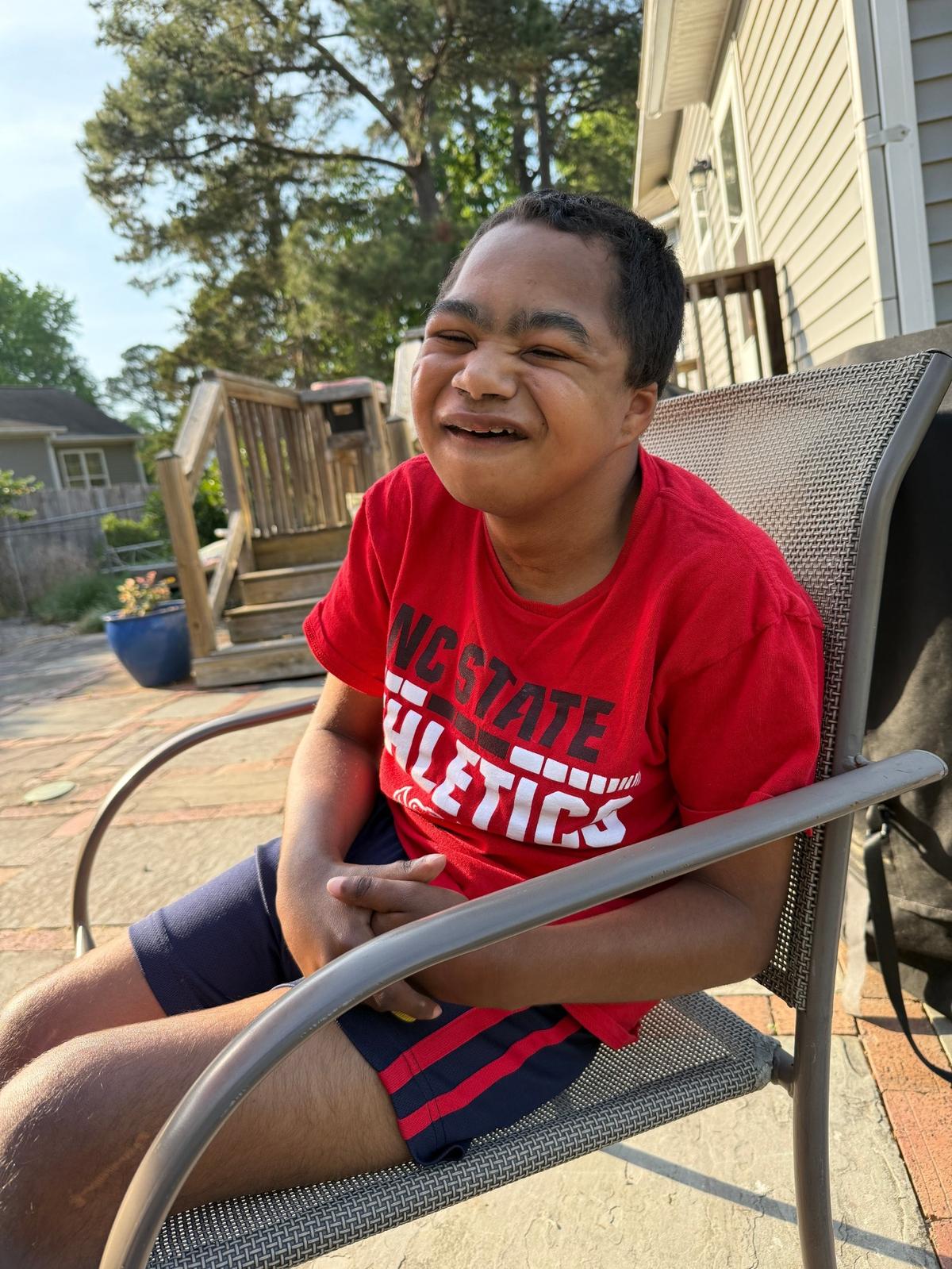
N.C. State superfan Grayson Ketchie, 14, smiles as he sits in a chair at his family home on April 29, 2025. (Dianne Ketchie/Courtesy) Dianne Ketchie Courtesy
‘Not trying to con the government’
Supporters of Medicaid cuts say the new requirements will eliminate wasteful spending and fraud.
“Every system is going to have flaws to it,” Ketchie said. “It’s not like the majority of the people who are getting Medicaid, who are getting Medicare or getting any kind of hand up from society, they’re not taking advantage of the system.
“Nobody in our shoes is out to have some sort of gotcha moment.”
Immigrants in the country without legal authorization are not eligible for services, either, according to state and federal websites.
In cases like Grayson’s, there is a high burden of proof to receive and maintain eligibility. The family meets annually with a case manager, who speaks with providers, reviews medical records and care notes, and other documentation.
The family also does not receive money to pay for his care. Providers are paid directly through Medicaid, the same method as private insurance.
“We’re not trying to con the government out of anything,” Ketchie said. “There’s no sitting at home collecting paychecks.”
Urging lawmakers to find cuts elsewhere
Tillis criticized fellow lawmakers, including his Republican colleagues, for supporting the bill. It alters funding so much that millions of Americans stand to lose coverage, either due to eligibility or cuts in appropriations. That could include more than 600,000 North Carolinians. Democratic Gov. Josh Stein estimated 1 in 4 residents would lose health care coverage under the proposal.
Most Medicaid patients live in rural counties, are elderly or have significant health challenges. Tillis said cuts would be “devastating” to North Carolina residents.
There are people who know Grayson and support the bill, Ketchie said. She thinks they’d say that it’s not about him and they don’t want him to lose care.
“That’s not the reality,” Ketchie said. “There’s no way you can make the cuts that they want to make to Medicaid and not have an impact across the board.”
Implementation of the Medicaid cuts are set to begin in December 2026, providing time for states to evaluate their budgets, but Ketchie has already contacted state lawmakers via phone and email asking to seek alternative avenues. She encourages others to follow suit.
Ketchie does not want anyone to lose medical care or access to social services, she emphasized, and believes cuts on the state and federal level can be made without sacrificing vulnerable populations.
“This isn’t the country that I like to believe we are at our core,” Ketchie said, “that we take care of each other and nobody minds paying their taxes for programs that help the people who need help.”
News & Observer political reporter Luciana Perez Uribe Guinassi contributed to this story.