How fake recruiting offers target Charlotte athletes through email, social media
AI-generated summary reviewed by our newsroom.
- Imposters send fake scholarship emails and DMs to Charlotte-area recruits.
- Scammers solicit payments on social platforms by promising nonbinding offers.
- Coaches urge parents and players to verify recruiting contacts through schools.
This week, just before National Signing Day, Lenoir-Rhyne assistant Nick Vagnone got a call from a Charlotte-area high school football coach who, it turned out, had a bit of an unusual story.
One of the coaches’ players had gotten an email from Vagnone offering a scholarship.
There were three issues with that:
1. Vagnone, and most Division II schools, don’t recruit underclassmen heavily.
2. Vagnone hadn’t heard of the player.
3. Lenoir-Rhyne doesn’t make offers through email.
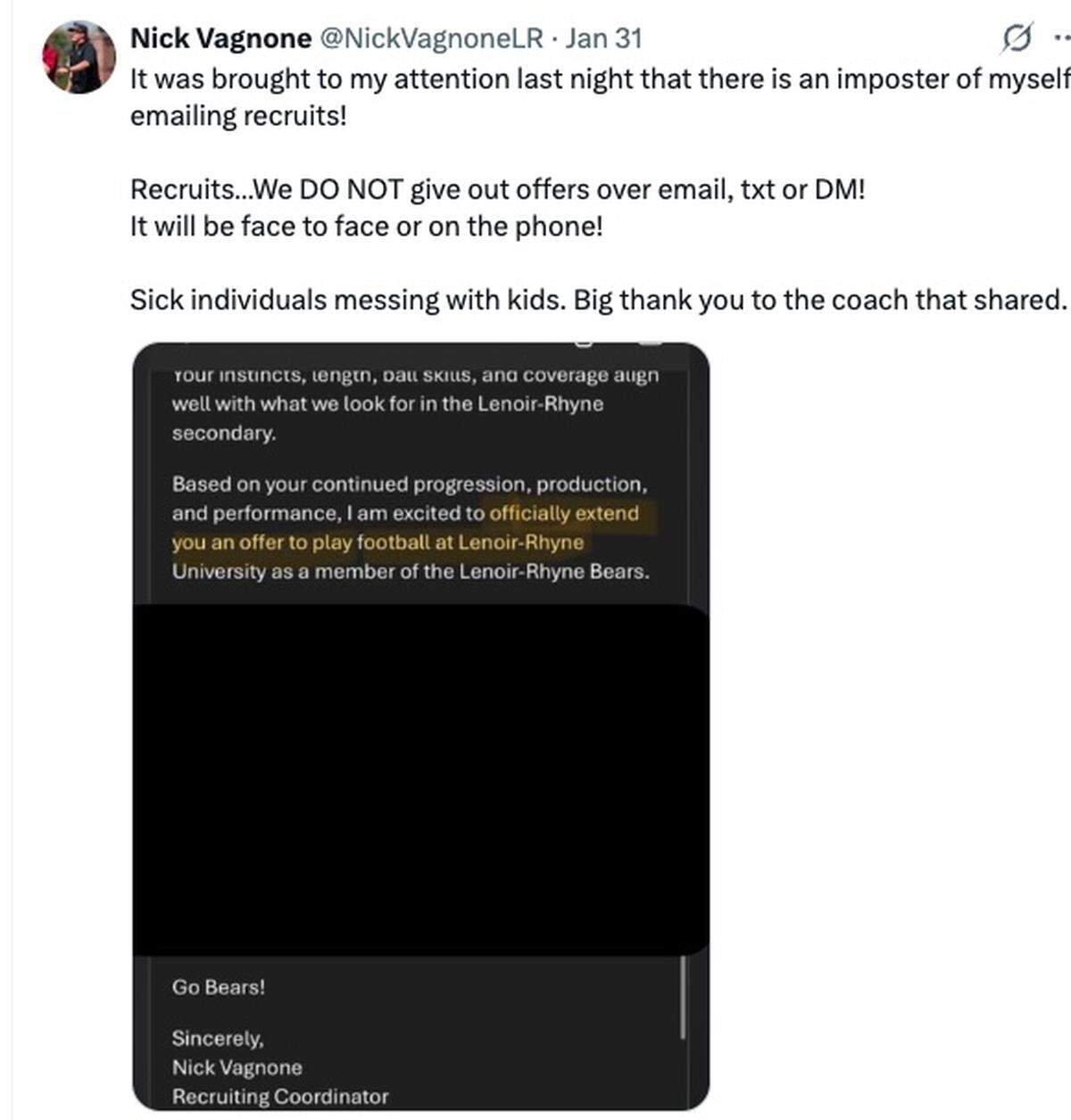
So after talking to the coach, and getting a screenshot of the “email”, Vagnone took to social media to try to clear the air.
“It was brought to my attention last night there is an imposter of myself emailing recruits,” Vagnone wrote on X, formerly known as Twitter. “Recruits, we do not give out offers over email, (text) or DM. It will be face to face or on the phone!
“Sick individuals messing with kids. Big thank you to the coach that shared.”
Vagnone, who came to Lenoir-Rhyne from NAIA power Keiser University in Fort Lauderdale, said he’d seen this type of behavior before in football-crazy Florida, but not in North Carolina. And that’s why he quickly made his social media post.
“I didn’t want any other kids, anybody else, to receive an email and think that they got an offer,” Vagnone told The Observer this week. “So I wanted to get out in front publicly with that and educate these kids on the process. A lot of them are unaware of how recruiting works, or how it starts. And so when they get an email from a college coach that says ‘You have received an offer,’ as far as they know, they believe it to be the truth.”
People posing as coaches on social media
At the same time “email-gate” was unfolding, there were reports of players paying $30 to someone on social media posing as a coach, with a promise to give them an offer — which both parties understood was not a committable one — in order to help out the player with his recruiting, the thinking being if one school offers, others will, too.
A sophomore wide receiver from Virginia, Rahem Lipford, made a post that went viral on social media retracting one he made about receiving an offer from Maryland. He said he didn’t pay for the offer but apologized for not verifying it.
Vagnone said it’s sad that any of this is happening: Fake emails and pay-for-offer scams.
“Mostly,” Vagnone said, “it’s adults acting immaturely, somebody that wants to mess with kids for whatever twisted reason. I’ve seen where kids have claimed they received an offer but they never talked to somebody. But more often that not, somebody pretending to be a coach has reached out to them. Most kids aren’t going to claim that they have offer from somewhere that they haven’t talked to, but it happens.”
‘We’re getting to a sad state’
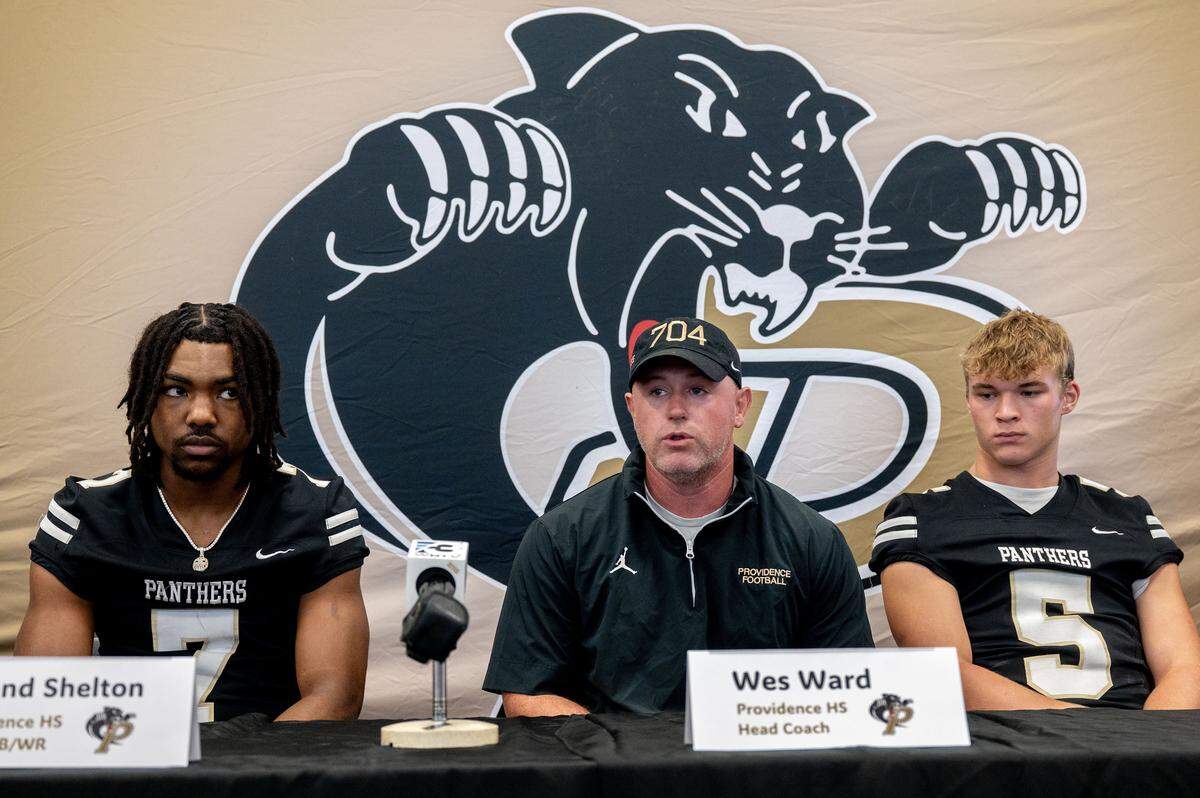
Providence High coach Wes Ward said he’s not seen a player on his team with a fake offer, but he followed Vagnone’s story this week.
“It’s becoming where that’s what it’s all about,” Ward said, “getting the offers, and it’s even worse that people are stooping so low, that they’re willing to make money off of kids.”
Vagnone, the Lenoir-Rhyne coach, said he hates to see what was going on in Florida starting to migrate north.
“It’s just really sad and unfortunate,” he said, “because for a lot of these high school kids, the time to get recruited and go play college athletics has never been harder than it is right now, just to play the sport you love. Your dream is to go do that in college and it’s never been more difficult to get to that point. So I think people are taking advantage of kids, you know, where they see an opportunity to do so, unfortunately.”
The pressure to be “blessed to receive”
According to the National Federation of High Schools, more than one million boys play high school football. According to the NCAA, just 7.5 percent of them will play college football and just about 3 percent will play Division I.
But local high school coaches say, to the average teenager, it feels like everybody is getting an offer, and there’s pressure when you’re not the one posting “Blessed to receive” an offer on social media like X, Instagram or TikTok.
The coaches say perception is a long way from reality, however.
“It would be interesting to know the percentage of kids that post they have offer from a school where it’s not actually an offer,” Myers Park coach Chris James said. “That’s where a lot of it comes from. I see my friend pick up an offer and I feel I’m just as good if not better than he is. So yeah, there’s a lot of pressure. If you’ve got a senior class of 20 kids and 12 of them have posted that they’ve committed or are going to sign, well the other kids who want to play at the next level are looking at that.”
Ward agrees that the social media watching can give players a false sense of reality.
“I don’t think kids really understand how many football players there really are in this country,” he said, “and that offers are still rare. But they see it on social media, because it’s so present, and they get this pressure of like, ‘I don’t have an offer so I’m not a good football player,’ which is totally untrue. It’s hard to navigate. Kids are like, ‘Well coach why am I not getting this?’ And them not understanding that it’s hard to get that.
“Just because you see this kid get (an offer) doesn’t mean you’re a bad football player. It’s just the way the world is now.”
James said that desire can open kids, and parents, up to paying a stranger online, someone they believe is a real coach, to get an offer that they couldn’t take. And James said colleges are also passing out real offers to players that may end up not being worth much.
“Sometimes the kids don’t know whether it’s real or not,” James said. “You have these non-committable offers, where a kid can have an offer early in the process, because of the potential, but as time goes, maybe (the college) got somebody else, maybe they’ve hopped into the (transfer) portal. Maybe the kid didn’t turn out the way they thought. And so you have an offer sitting here, and six months prior to, you think this is a place I could possibly go, and then time passes and you’re ready to commit, and the school’s like, ‘Hey you know, we’re going to have to go in a different direction.’”
Back to the social media problem
James said social media causes the most issues with recruiting for players.
“Like I can pull up Instagram or Twitter, and I can see the ‘blessed to receive’ or ‘blessed to be committed,’” James said. “And you see it so much that it becomes ingrained in you as a kid. When I was playing high school ball, there were no posts. I had my offers. I talked to my coach. I committed, and that was it. Like everything now in society, the social media blows it out of proportion.”
And now on social media, there is at least one person, posing as a coach, that traded fake offers for CashApp payments.
“It’s obviously a situation where you’re exploiting kids,” James said. “Nobody’s a fan of that. Kids are chasing offers. That’s not a new thing. That’s the whole purpose of kids creating highlight tapes and going to camps. They want to play at the next level. So you might say they are eager, or over-eager, to receive the attention and receive an offer.”
Advice for parents
Vagnone said college recruiting should always go through the high school coach.
“From my perspective,” he said, “that’s the best avenue. I can always trust what that guy has to say. They know the kid best. When I am messaging with a kid on Twitter, I don’t want to be talking to a parent. I don’t want to the parent to be running the kid’s Twitter or running his email, but they need to be involved. They 1,000 percent need to know every conversation that the kid is having.”
Vagnone believes that is paramount, his word, for the parent to be involved, especially early in the process.
“The parents need to be in contact with the high school coach so (they’re) in the know,” he said. “There’s a lot of times we’ll stop by the school and talk to the coach and the kid, and the parents have no idea we did that. So I think that’s a big piece moving forward, to be as educated on the recruiting process as you possibly can.”
James said that parent-high school connection can stop a lot of bad situations before they get going.
“If I’ve never heard from a (college) coach, that’s a red flag,” James said. “Not to say it hasn’t happened. Some coaches have reached out to a player first, but nine times out of 10, even when they’re doing that, they will still reach out to me, and the majority of the time, the coaches are reaching out to me first.”
At Providence, Ward said he has a coach who focuses on college recruiting at his school and he tells parents that they always need to check in with him and that coach first.
“My kids always say, ‘Coach, this guy is reaching out to me,’” Ward said. “I always tell them that needs to be run through myself, just to make sure we don’t have situations like these fake offers and whatnot.”
James said parents should stay in contact with the high school coach, as well as research the coaching staffs of the colleges their kids are talking to.
“I created a database for recruiting,” James said, “and I make sure I go in there each year, because coaches leave. So let me make sure I know who the high school relations person is, or who is recruiting this area. But I can only do that if I go look. Parents have got to be a little more diligent at looking at it, too.”
James said players, just like their parents, need to be researching everything.
“Hey, y’all are 16, 17, 18 years old and you want to play a man’s game,” he said. “So part of that is being accountable and being a little bit more mature and saying, ‘Hey let me find out who this coach is. What position does he coach? What area does he recruit. Can you verify that? That takes all of five minutes. That would alleviate the problem of the fake coaches telling you you’ve got an offer; because I would hate to have been that kid who found out that, ‘Oh wait, I don’t have a scholarship offer.’
“Because, of course, he posted it on social media. He told his friends. He told his family, and now he’s got to go to back and tell them, like, ‘No, that’s not actually real.’ So I think if we all do our homework — and you’re not going to avoid all the fakeness — but you will do a good job avoiding most of it.”