Panthers organization gets involved in effort to give back to Grier Heights
During practice in early December on a Thursday, coach Matt Rhule gathered his team at the middle of the practice field.
Getting together in a huddle is something that takes place during almost every Carolina Panthers practice. There is time during Thursday practices for him to share any thoughts he has because there isn’t a team meeting that day. But during this specific practice, he talked for a bit longer. He had something on his mind.
While the team was preparing for a game against the Denver Broncos potentially without multiple starters due to COVID-19 regulations, he shared about how the needs of others had also been weighing heavily on his mind.
“I worry about what we’re going through like, who’s on the (NFL’s) COVID reserve list, and there’s kids that are trying to find a way to do virtual learning and there’s kids that don’t have jackets, and I’m worried about something small,” Rhule said. “I better be grateful for what I have.”
His thoughts stemmed from multiple places, but one of them was the work his wife, Julie, was doing with the Grier Heights Community Center.
Grier Heights
Grier Heights is a community in Mecklenburg County with a rich history. In the 1890s, a formerly enslaved Black man, Sam Billings, bought 100 acres of land. It was the first time recorded that a Black man or woman bought land in Charlotte.
Now, the about 3,300 person Grier Heights community is 87.7% Black, the median age is 24 and the median household income is just over $18,000, per the City of Charlotte’s Quality of Life Explorer.
“From his blood, sweat and tears, we are now sitting in a community that he imagined that he dreamed of,” Tiffany Capers, executive director of CrossRoads Corporation, the nonprofit organization that supports the Community Center. “A place where Black people could own homes.”
The Community Center is located in the building that formerly housed the Billingsville School and offers a variety of resources to members of the Grier Heights community, such as GED classes and now COVID-19-related programs and services . Among the issues that Grier Heights deals with is gentrification as surrounding neighborhoods grow.
“Resilience, love, pride, certainly pain and struggle, all the things that make any community a community exists within Grier Heights,” Capers said.
The Center’s resources grew to include hosting virtual school for students who need somewhere to go while in-person attendance has been restricted. They started in the spring, but since August, the number of students coming to the Center daily has grown to about 50.
Tijua “Ms. T.” Robinson, the executive director of the Center, helps the students with their schooling, along with volunteers. Roughly 7,000 meals — from breakfast to snacks and lunch — have been provided since August.
The difficulties that have come from the COVID-19 pandemic have simply brought some of the challenges the children already dealt with to the forefront.
“For many of them, they would be even more disproportionately disadvantaged if the center was not there,” Capers said. “... Students who were already at a disadvantage with respect to their academics, the pandemic is just highlighting and exacerbating what already was. Some of our students are three months behind; they are now probably six to nine months behind.”
Having somewhere to go is important as many parents are not home and working during the day. Making sure they have internet access and the proper tools is among the bare minimum for schooling.
Getting involved
Julie’s mother, Donna Nibert, had worked with a Women’s League while she was growing up in Pennsylvania, and they would give back to families in the community during the holidays with toys, clothing, food and in other ways. Julie wanted her children to have the same experience.
Showing her children — Bryant, Vivienne and Leona — what many families are going through is important, especially with the Center not far from their own backyard.
“I believe in having those tough conversations with my children about the reality of what is going on and how you can make a difference and help people,” Julie said.
So, she worked to get the whole team involved with the help of various staffers and other coaches’ wives. Players, coaches and staff were all encouraged to pitch in for the effort to see what they could do as a team, even though many staffers have to yet to meet Julie in person because of COVID-19 protocols. Everyone rose to the occasion, with some adopting a family as a way to support their needs.
“I didn’t know what we were going to be able to support in the beginning, I didn’t know if this would sort of touch people’s heartstrings or not,” Julie said. “Certainly, during these times, it’s up to everyone whether they can or are willing to help out. I was pleasantly surprised it was so well-received and (I was) thrilled, what we were able to accomplish.”
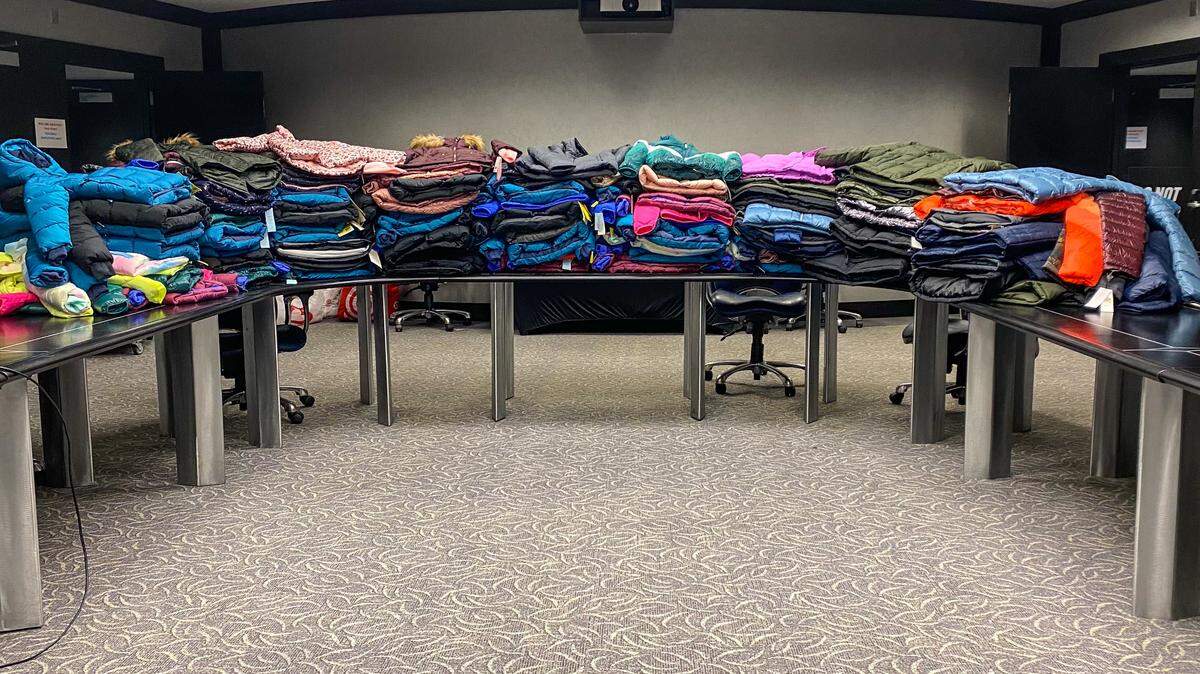
It started by getting connected with the Center and then identifying 44 families with toy wish lists. From there it grew into also getting 125 coats donated to the families. Many of the students have been walking to the Center for virtual school without warm outerwear on.
Then it also grew to include providing funds for a holiday dinner for each family. After all that, additional money was also raised to give back to the virtual schooling.
There are still many areas in which the Center could use some help from resources to provide breakfast to more diverse volunteers.
Julie, who has a background in nutrition, is familiar with food scarcity and how important it is for students to be able to get their meals at school. Being more involved in the future is a goal of Julie’s and hopefully in a more hands-on way sooner rather than later.
The pandemic has forced many to think differently about attending to the same needs that have always existed. One of the biggest goals for Capers and the Center is that the focus on supporting communities like Grier Heights continues into the new year.
“I don’t want this to be episodic. I don’t want this to just be a moment in time for people. I’m hoping that this shift in attention is permanent,” Capers said. “These problems are going to persist well beyond January 2021. So, folks who have become connected with us, we deeply appreciate the connection, and we hope that they stay connected for the long haul.”