What’s penalty box life like in NHL playoffs? Inside hockey’s worst two minutes
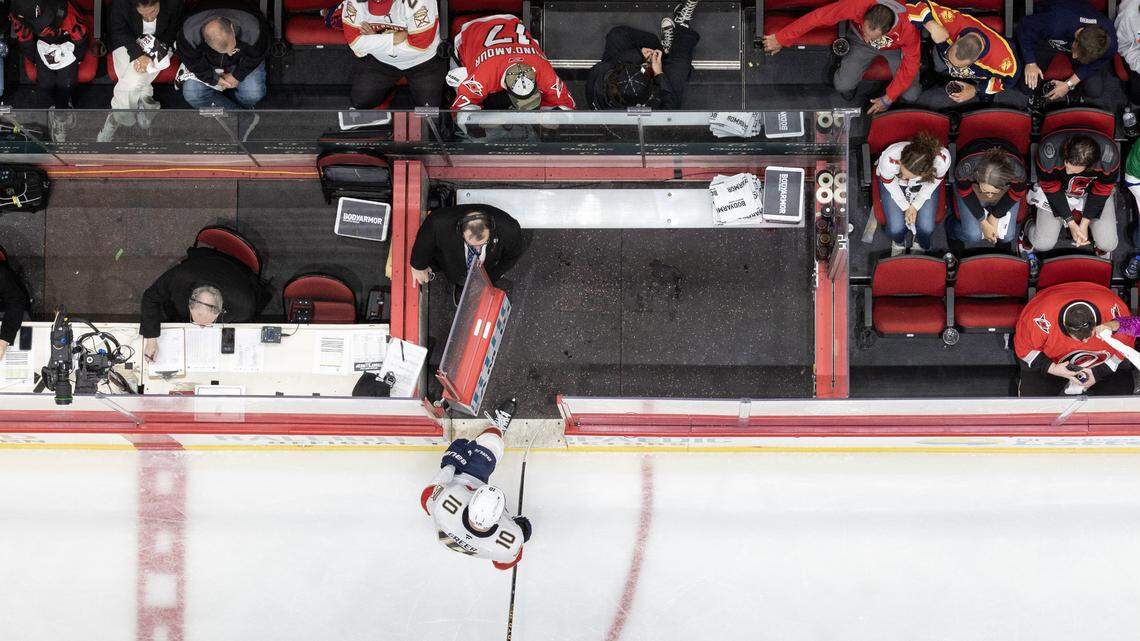
The door slams behind you. The bench is hard, even through the heavy pads of hockey pants. The game goes on without you. You view it through battle-scarred Plexiglas, the same as any fan wearing your replica sweater in an $1,100 front-row seat, helpless, resigned to your fate.
Every hockey player knows that specific pit of suffering, the exile of punishment, some more than others. While the world outside focuses on the power play on the ice, the penalized player sits in his small cell and considers his crimes, guilty or innocent, until his two-minute sentence is served or the opposition scores and the damage is done.
“It just sucks to go in there,” Carolina Hurricanes center Sebastian Aho said. “There’s nothing you can do about it.”
“You can’t change anything,” Hurricanes defenseman Dmitry Orlov said. “You just pray.”
NHL Rule 3.2 specifies only that a “penalty bench” for each team, on the opposite side from the team benches, must be able to accommodate 10 people including the off-ice official responsible for opening the door, with protective glass at the same height as around the rink. It’s hard to believe any in an NHL rink is actually that big, although players certainly feel smaller while sitting inside.
The penalty box is a world of its own, especially in the playoffs, when every penalty is a controversy and a single power play can change the course of a series or even a season. Occasionally, it gets crowded when the officials lose patience after some fracas like exhausted parents. Sometimes there’s the opportunity to continue an argument with an opponent across the timekeeper’s box that separates the offenders.
Most of the time, it is a lonely penitence, served in solitude.
And, on longer penalties, a frigid one.
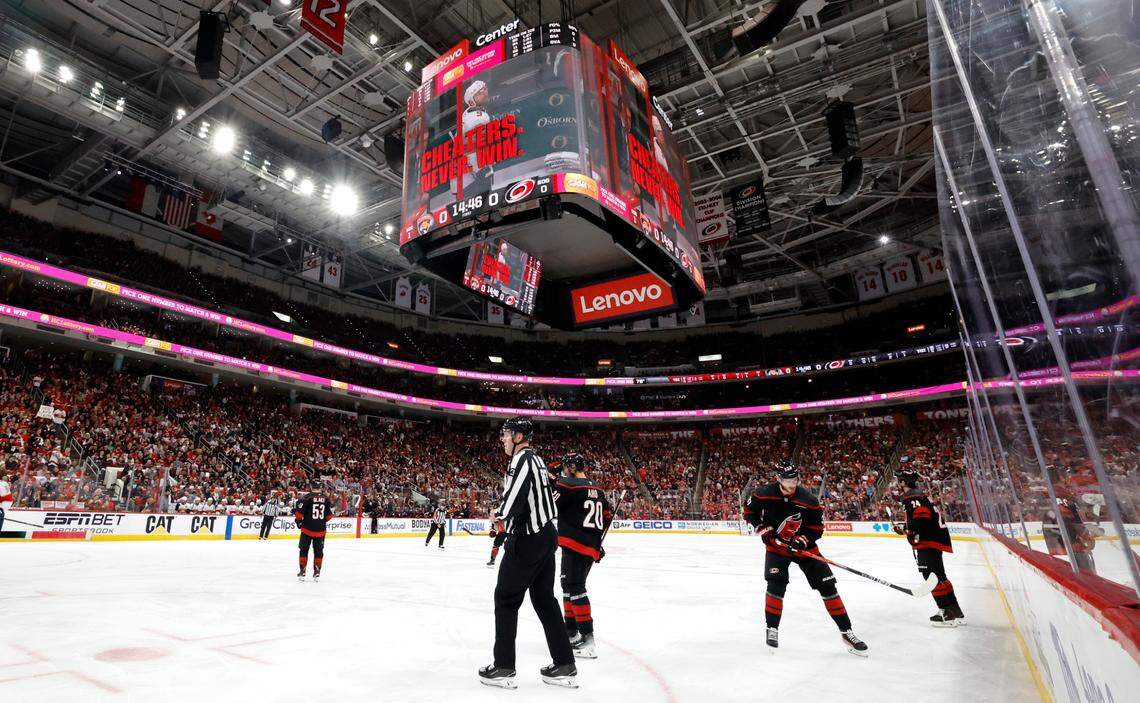
“It’s freezing out there and you get kind of stiff sitting there,” Hurricanes center Jesperi Kotkaniemi said. “It’s bad. Two, you’re fine. Five, you get cold. Then you get one of those commercial breaks and it turns into 15 minutes? It’s a long time.”
Then again, even 120 seconds can stretch out into hours. When it turns out to be the final play of a season, as it was for Hurricanes captain Jordan Staal in the final seconds of Game 4 of the Eastern Conference Final against the Florida Panthers in 2023, watching from the box as Matthew Tkachuk scored the series-winning goal, it lasts weeks, months, forever.
“That sticks with you all summer,” Staal said. “Not enjoyable.”
Earlier this month, Winnipeg Jets center Mark Scheifele went through the same experience, watching his season end from inside the penalty box, and somehow even worse: It was only hours after his father died. Jets captain Adam Lowry had to step into the box and help Scheifele out.
In those extreme times, the penalty box really does feel like some kind of purgatory, some liminal space between hockey and hell.
“Time feels pretty long, sitting there alone, watching the boys kill the penalty,” Kotkaniemi said. “I kind of hope for the best. Our guys have done a pretty good job this year on the kill. It’s not as big of a panic as you would think. Lot of trust in these guys.”
The existential nature of the penalty box was best expressed by the French-Canadian philosopher Denis Lemieux, better known as the goalie for the Charlestown Chiefs in the movie “Slap Shot,” unforgettably played by Yvon Barrette: “Two minutes by yourself, and you feel shame, you know. And then you get free.”
But shame is only one of many emotions that can overwhelm a player in the penalty box: Helplessness, frustration, indignation, anger, self-pity. Sometimes, it’s just pure, unfiltered, uncut fear and anxiety.
When Orlov was penalized late in Game 4 of the second round to give the Washington Capitals a two-man advantage, with the Hurricanes up 3-1 in the game and 2-1 in the series, he was, in his own words, concerned about his immediate personal hygiene.
“I almost (expletive) myself,” Orlov said afterward.
“That’s probably not far from the truth,” Kotkaniemi said, especially when Alex Ovechkin scored 17 seconds later.
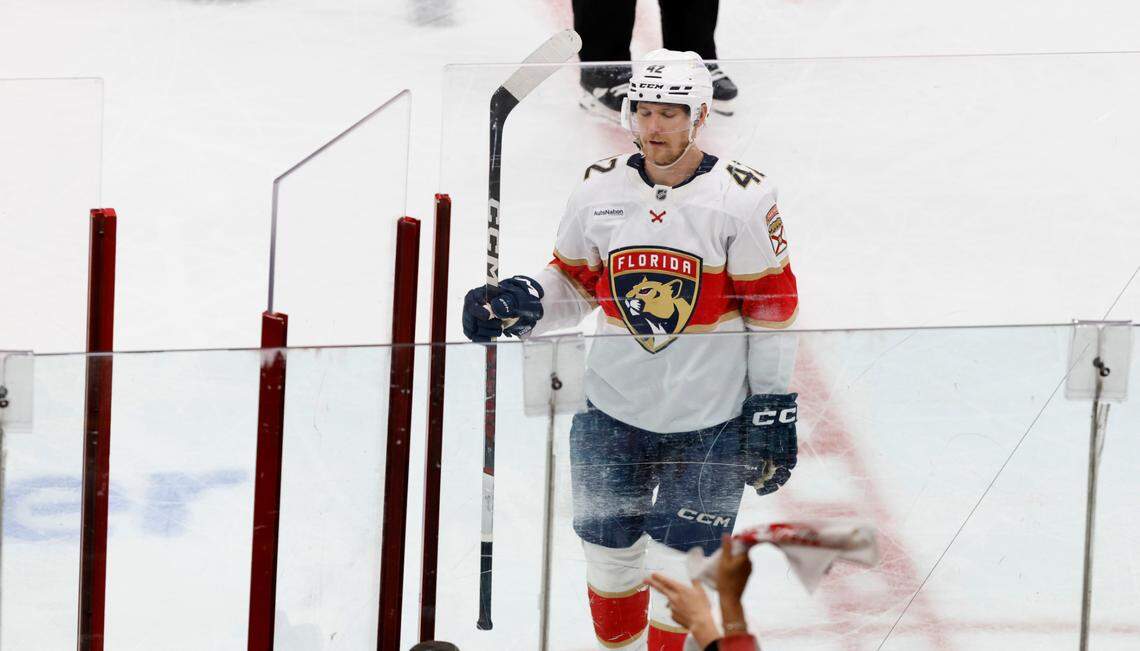
“In that moment, it can still change the game, because they still have a power play, five on four, after they score,” Orlov said. “And this could change the game, and that can change the series, and your season could be over. So, yeah, you’re just nervous. You worry. You blame yourself. Everybody should be like that when you make a mistake in the game or take a bad penalty when you didn’t need to take it.”
The Hurricanes killed off the rest of Orlov’s penalty, got a Sean Walker goal to extend the lead and an Andrei Svechnikov empty-netter to put the game on ice, bailing out Orlov. And his drawers.
Certainly, the mood in the box can depend on whether it was a penalty that had to be taken or a terrible call that’s a historic miscarriage of justice. For some, it’s always two minutes of righteous anger and simmering fury, regardless of circumstances.
“‘This is (expletive).’ That’s what I think every time, you know,” said Svechnikov, who over the course of his career has spent more time in the box than the Hurricanes would prefer. “So, yeah. That’s the way it is. As soon as they call it, you’re like, ‘Oh my God, it’s so soft.’ Hockey is so soft these days. Sometimes you’re wrong. Sometimes you’re right. I think I’ve had so many of those ones I just touch someone and they give me a penalty. But every time it feels like that. ‘This is (expletive).’”
Among the Hurricanes, no one has spent less time in the penalty box over the course of his career than Jaccob Slavin, a two-time Lady Byng Trophy winner for sportsmanship and gentlemanly conduct — “I don’t hook people, come on. It’s always puck over glass” — who has averaged seven penalty seconds per game over his 10-season career.
When he’s in the box, it’s not only newsworthy, it’s a crisis for the Hurricanes considering he’s the defensive linchpin on the league’s best penalty-killing unit.
“I’m just watching the game, watching the penalty-kill,” Slavin said. “But really just hoping that we don’t get scored on. I’m not in there much and so when I am in there and they score a goal, it doesn’t feel good.”
Having a penalty-kill that good tends to help the seconds tick by. There are various other ways to pass the time, which moves at different paces depending on what is happening on the other side of the glass. An efficient kill, zinging the puck back the other way at every opportunity, makes time fly. A power play set up and comfortable, whipping it around, blasting shots, can make two minutes feel like two hours.
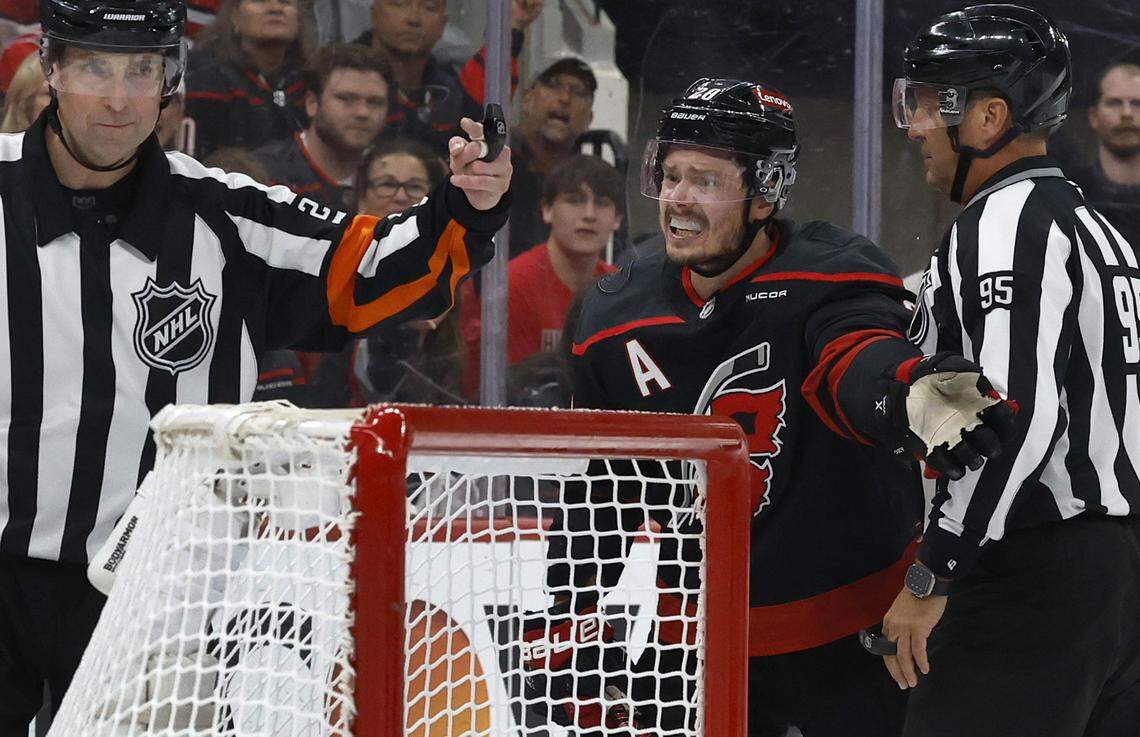
Some players talk to themselves, critiquing, excoriating. Some glare at the officials, secure in their righteousness. Some tap the blade of their stick on the glass to celebrate a clear or blocked shot. Some chat with the attendant, making small talk, asking if the coach is glaring at them.
“Last time I was asking him if he thinks I’ll get a breakaway out of the box and score, and I got a three-on-two out of the box and I had ‘Jordo’ open on a one-timer,” Hurricanes forward Seth Jarvis said. “But I promised the guy I would score, so I shot it and it hit a stick and went out of play.”
That is the moment every player hopes for when the time is up, one way or another. The attendant stands up and grabs the handle of the door. The player stands ready. There is, in that moment, the small possibility that circumstances will align so the door opens and the player puts skate to ice at the same moment a teammate is looking up the ice with the puck.
If it happens, it’s happenstance, but a lovely one.
“I’m not looking at the door,” Slavin said, but he also acknowledged some players (specifically, Aho) will start yelling for the puck before they’re even out of the box.
If the attendant isn’t paying attention, that can be a moment of extreme danger. In Chicago in 2001, Hurricanes defenseman Glen Wesley’s jaw was broken and his face ripped open when he was checked into the doorway as it opened to release Blackhawks defenseman Steve Poapst.
Attendants are supposed to wait to open the door when there are players nearby, which means two minutes can become a few seconds longer, for the right reasons, as opposed to shorter, for all the wrong reasons.
Then again, spend enough time in there, and those plastic walls become funny. First you hate them. Then you get used to them.
“I’ve been so many times in the box, it doesn’t feel so long,” Svechnikov said.
Never miss a Luke DeCock column. Sign up at www.newsobserver.com/newsletters to have them delivered directly to your email inbox as soon as they post.
Luke DeCock’s Latest: Never miss a column on the Canes, ACC or other Triangle sports
This story was originally published May 23, 2025 at 6:00 AM with the headline "What’s penalty box life like in NHL playoffs? Inside hockey’s worst two minutes."