Wells Fargo CEO on the defensive, and other takeaways as senators grill bank executives
Lawmakers grilled leaders of the country’s biggest banks on everything from interest rates to racial equity on Thursday at the Senate banking committee’s annual oversight hearing.
Questions covered a broad swath of financial topics, from inflation and the economy to overdraft charges and tracking fraudulent transactions. Wells Fargo came under some of the harshest criticism, with the committee chair asking CEO Charlie Scharf if the bank could ever recover from its prior scandals.
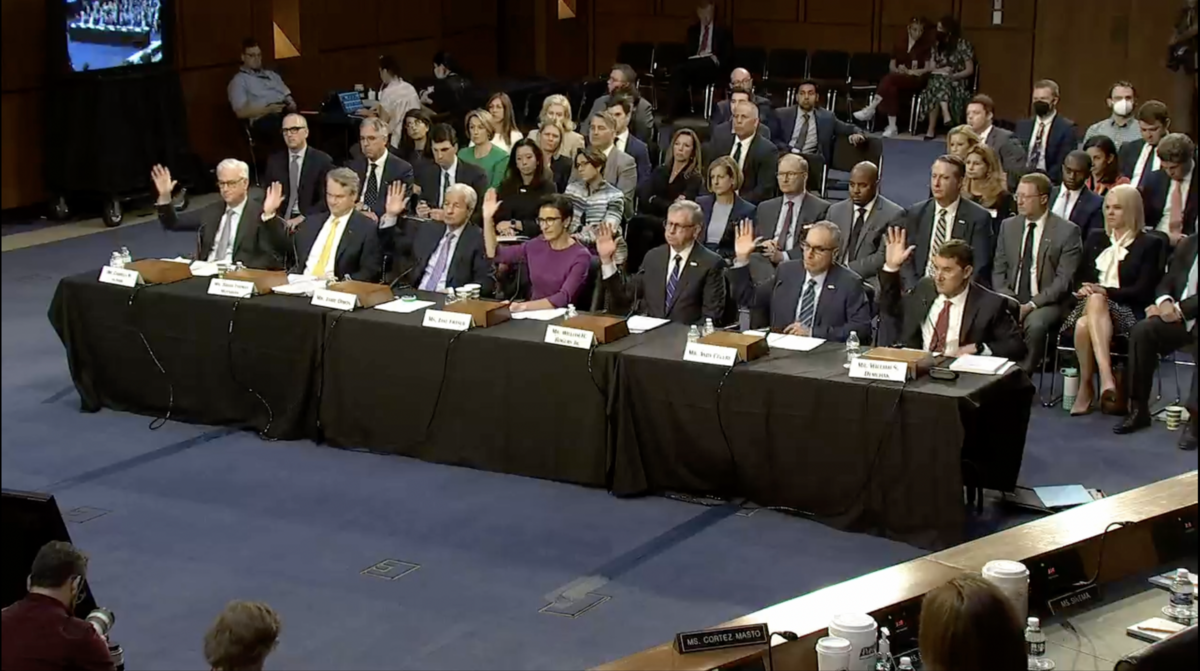
Thursday’s panel included seven chief executives, including Brian Moynihan, CEO of Charlotte-based Bank of America, and Bill Rogers, CEO of Truist, also headquartered here.
Here are the biggest takeaways from the three-hour hearing:
Wells Fargo not ‘too broken to fix,’ CEO says
Committee chair Sherrod Brown, a Democrat from Ohio, kicked off the meeting with a direct question to Scharf: “Is Wells Fargo too broken to fix?”
The bank is still dealing with the fallout of its 2016 fake accounts scandal, when it was discovered that employees created millions of accounts for customers without their knowledge.
It has continued to face a series of negative headlines this year, from a report of fake job interviews for diverse candidates to an investigation revealing racial discrimination in mortgage lending.
Wells Fargo is based in San Francisco but has its largest employment hub in Charlotte, with more than 27,000 workers here.
The bank has faced continued criticism from lawmakers and regulators alike. Earlier this month, it reached a $145 million settlement with the U.S. Department of Labor over an investigation into its 401(k) plan. And last fall, it was fined $250 million by the Office of the Comptroller of the Currency for failing to properly compensate harmed customers.
But Scharf insisted the bank was making progress in solving its regulatory woes.
“I’m very confident that we have made changes which will enable us to put all of our historical problems behind us,” he told Brown. “We have a new management team. We’ve changed our processes.”
Scharf said that although the company still has work to do, it’s “building a foundation” to move forward and address the issues at the heart of its prior scandals.
Overdraft fees concerns
Lawmakers continued to criticize the banks’ use of overdraft fees. Critics have long argued that the charges disproportionately impact low-income customers.
“It’s clear to me that there’s no reasonable explanation to continue to charge overdraft fees,” said Senator Robert Menendez, a Democrat from New Jersey.
He asked if the CEOs would commit to getting rid of the fees.
While most bankers demurred, several pointed out that they’ve already cut back on overdraft fees in the last few years.
Bank of America cut fees from $35 to $10 this year. PNC Bank limited the number of charges customers could incur last year and Citigroup is the sole member of the group to have ended the fees completely in February.
Other banks, like Truist, pointed to their overdraft-free account options.
Moynihan and JPMorgan Chase CEO Jamie Dimon said they don’t plan to completely eliminate the fees. Some customers want the option of overdrafting, Dimon said.
“There are a lot of occasions where if it’s not used, they will be charged a higher fee on the other side. That includes parking tickets, rent, mortgages,” he said. “It can… stop them from going to payday lenders.”
Zelle fraud
Sen. Elizabeth Warren, D-Mass., pressed the bankers on Zelle, a digital payment platform created by six of the banks on the Senate’s panel.
Warren said that though the banks marketed Zelle as a “fast, safe and easy way to make money,” this was only partly true. “Zelle is fast, Zelle is easy,” she said. “But Zelle is not safe.”
Last year, Zelle customers were defrauded out of about $500 million, Warren said. She chided the bankers for failing to respond to her request for specific data on the number of fraudulent Zelle transactions their customers have reported in recent years.
Truist was the only bank to respond, she said, reporting 52,000 claims of fraud.
“You built the system, you profit from every transaction on the system, and you tell people that it is safe, but when someone is defrauded, you claim that’s the customer’s problem,” she said. “I want to know exactly how big this problem is.”
Inflation and interest rates
Lawmakers also asked CEOs about rising prices, higher interest rates and whether the economy could avoid a downturn in the coming year.
As banks raise interest rates on loans in response to interest rate hikes instituted by the Federal Reserve, the CEOs signaled to lawmakers that customer deposit rates would also increase in the near future.
“The most important thing is to avoid stagflation,” Dimon said, referring to the economic phenomenon of rising prices combined with stagnant economic growth. “It’s the most damaging to every part of society… It’s important to get our hands around inflation as quickly as possible.”
This story was originally published September 22, 2022 at 5:46 PM with the headline "Wells Fargo CEO on the defensive, and other takeaways as senators grill bank executives."