As flexible payment options become more common, two terms often crop up at checkout: Buy Now, Pay Later (BNPL) and layaway. At a glance, both let customers spread the cost of a purchase over time rather than paying the full amount upfront; however, they are not the same thing. Each has its own mechanics, benefits, pitfalls, and ideal use cases.
If you’ve ever paused at the checkout screen wondering, “Is BNPL just modern layaway,” this article breaks down how the two compare, why they exist, and which might be better for your budget in different situations.
Key Takeaways
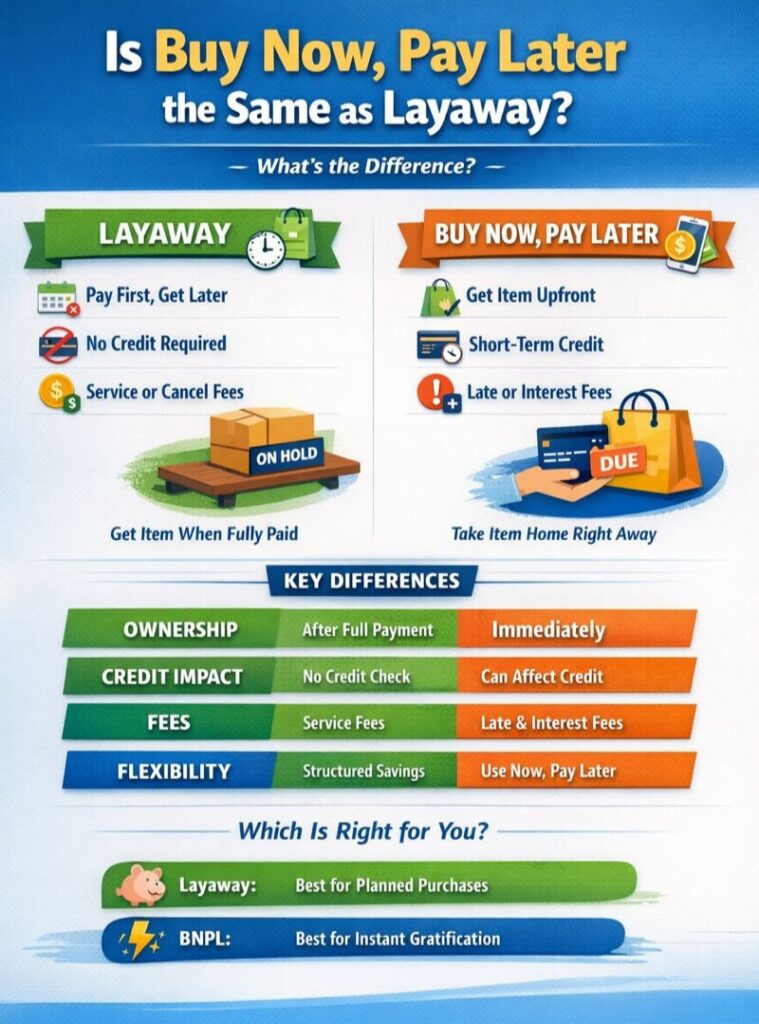
- Ownership Timing Is Key: Layaway holds your item until it’s fully paid off, while BNPL gives you access immediately.
- Credit vs. Commitment: Layaway is a payment plan without credit, while BNPL is a form of short-term financing with potential credit impact.
- Fees Work Differently: Layaway may charge service fees, but BNPL can come with late fees, rescheduling fees, or interest on long-term plans.
- Discipline vs. Flexibility: Layaway enforces saving; BNPL offers convenience but requires self-control to avoid overcommitting.
- BNPL Is the Modern Option: With mobile access, virtual cards, and broad availability, BNPL offers more convenience than traditional layaway.
What Layaway Is (And How It Works)
Layaway has been around for decades, long before digital payments or smartphones. At its essence, layaway lets you reserve a product by paying for it in installments before you take it home.
Here’s the typical layaway process:
- Select the item you want in a store that offers layaway.
- You pay a deposit and sign a layaway agreement.
- You make periodic payments over weeks or months.
- Once the full price is paid, you take the item home.
Key features of layaway include:
- You don’t take possession of the item until your balance is fully paid.
- No interest is charged, but there may be service or cancellation fees.
- It’s essentially a forced savings plan tied to a specific product.
For decades, layaway was popular at department stores around the holidays: parents could reserve toys or clothing for kids without borrowing. It’s particularly useful when you want to ensure you get an item without building up debt.
What Buy Now, Pay Later Is
Buy Now, Pay Later is a more recent phenomenon driven by financial technology. BNPL lets you take possession of the item immediately and split the cost into scheduled payments.
Here’s how BNPL typically works:
- You choose BNPL at checkout (online or in stores).
- The provider pays the merchant up front.
- You make a small initial payment (often one installment).
- The remaining amount is split into interest‑free or interest‑bearing payments.
Most common BNPL plans include:
- Pay in 4: Four interest‑free payments over six weeks.
- Pay in 2: Two payments (often within a month).
- Pay Monthly: Long‑term financing at a fixed interest rate.
BNPL is designed to feel less like borrowing and more like timing your cash flow, with minimal friction at the point of sale.
Side‑by‑Side: Layaway vs. Buy Now, Pay Later
Let’s compare the two side by side to see how they align — and where they diverge:
| Attribute | Layaway | Buy Now, Pay Later |
|---|---|---|
| Take item home immediately |  |  |
| Interest charged | Usually | Mostly (on short plans) |
| Ownership before full payment | | |
| Requires credit check | Rare | Soft (no impact) |
| Industry | Retailer‑specific | Fintech/credit product |
| Use cases | Reserved purchases | Broad checkout use |
| Risk of debt accrual | Low | Higher if misused |
| Fees | Possible cancellation/service | Possible late fees |
From this comparison, it’s clear that while layaway and BNPL share a payment‑splitting aspect, they function quite differently.
Key Differences Explained
1. Timing of Ownership
The biggest difference is when you get the product:
- Layaway: You only receive the item once you’ve completed all payments.
- BNPL: You get the item immediately with the first installment.
This difference changes how each tool affects consumer incentives. Layaway is a commitment to pay with no possession until completion, whereas BNPL treats you like a credit customer; you’re spending now and paying later.
2. Debt Implications
Layaway isn’t really debt. You’re simply making incremental payments toward a purchase you’ve already reserved. Because you don’t take possession until you’re done, there’s no traditional borrowing.
BNPL, on the other hand, is a form of credit. Even when marketed as interest‑free payments, you’re still entering into a payment plan with scheduled withdrawals. If payments are missed, fees can accrue, and in some cases, payment history may affect your credit standing if the provider reports to credit bureaus.
3. Accessibility and Convenience
Layaway is tied to specific retailers and often requires being physically present in the store. It’s a very manual process and is less common today.
Buy Now, Pay Later is integrated into e-commerce by financial technology companies like Affirm, Afterpay, Klarna, and Sezzle. You can use it with many online merchants and—through virtual cards—even at stores that don’t explicitly support it. The experience is seamless and digital, with no paperwork or waiting in line.
4. Fees and Penalties
Layaway may charge service or cancellation fees if you change your mind or fail to complete the plan. But there’s no interest in the traditional sense.
BNPL also promotes interest‑free payments, but that’s conditional on paying on time. Most BNPL plans will charge late fees, failed payment fees, and sometimes rescheduling fees. Ignoring these can turn a seemingly “free” plan into an expensive hassle.
5. Flexibility vs. Discipline
Layaway enforces discipline by design; you must finish paying before you benefit. That can be good for budgeting.
BNPL prioritizes flexibility. You can take home the item immediately, choose from several payment schedules, and even switch payment methods mid‑plan. But that flexibility can be a double‑edged sword. Without discipline, it can feel like a revolving door of expenses.
When Layaway Makes Sense
Layaway is best when:
- You want to avoid credit and interest entirely.
- The purchase is planned well in advance.
- You’re fine waiting for the item until you’ve paid in full.
- You’re working with a tight budget and want a built‑in savings mechanism.
For example, if you’re saving up for holiday gifts or a big purchase months out, layaway can keep you accountable without running up debt.
When BNPL Is More Practical
Buy Now, Pay Later shines when:
- You need the item right now, not later.
- You want short, interest‑free installments.
- You prefer a digital checkout experience.
- You want broader merchant support and flexibility.
BNPL works especially well for consumers with stable cash flow and budgeting habits who simply want more control over timing, not more debt.
Where People Get Confused
Some shoppers assume BNPL is just a fancy layaway because both break up payments. But that assumption misses the real distinction:
- Layaway doesn’t involve credit or early product access.
- BNPL is essentially micro‑credit with a payment schedule.
Understanding this difference matters because the two have very different implications for ownership, credit impact, fees, and financial behavior.
The Bottom Line
So, is buy now, pay later the same as layaway? No, they’re fundamentally different tools for different situations.
- Layaway is a budgeting tool that helps you plan purchases without debt.
- Buy Now, Pay Later is a payment option that offers flexibility and immediacy but behaves like a short‑term credit arrangement.
Neither is inherently “better.” Instead, the right choice depends on your financial habits, your need for immediate access to goods, and how disciplined you are with payments.
If you want predictability and ownership only after full payment, layaway might be your best fit. If you want flexibility, immediate access, and digital convenience (and you can manage scheduled payments responsibly), BNPL is a compelling modern alternative.
FAQs
No. Layaway requires full payment before you receive the item, while BNPL gives you the product immediately and spreads payments over time.
Yes, BNPL is a form of short-term credit, even when it’s interest-free, because payments are owed on a fixed schedule.
Typically no. Layaway usually doesn’t involve credit checks or reporting because it isn’t a credit product.
It can. BNPL may include late fees or interest on longer plans, while layaway costs are usually limited to service or cancellation fees.
Layaway works better if you want enforced savings, while BNPL is better if you have a steady cash flow and can manage payment dates responsibly.