
‘Death of a profession.’ Why one of Charlotte’s most prominent muralists is walking away
For the past five years, if you spotted murals awash in colorful swaths and swirls around town, from brewery walls to bridges and backyards, chances are good that Sam Guzzie created them.
The Charlotte artist is known for her murals, and for helping launch the nonprofit Brand the Moth, which organizes volunteer community mural projects, and has worked with the Talking Walls mural festival.
But all that’s about to change.
Last month, Guzzie, 32, shared the news on Instagram that she would no longer be painting murals. She titled the post, “An ode to murals: The death of a profession.”
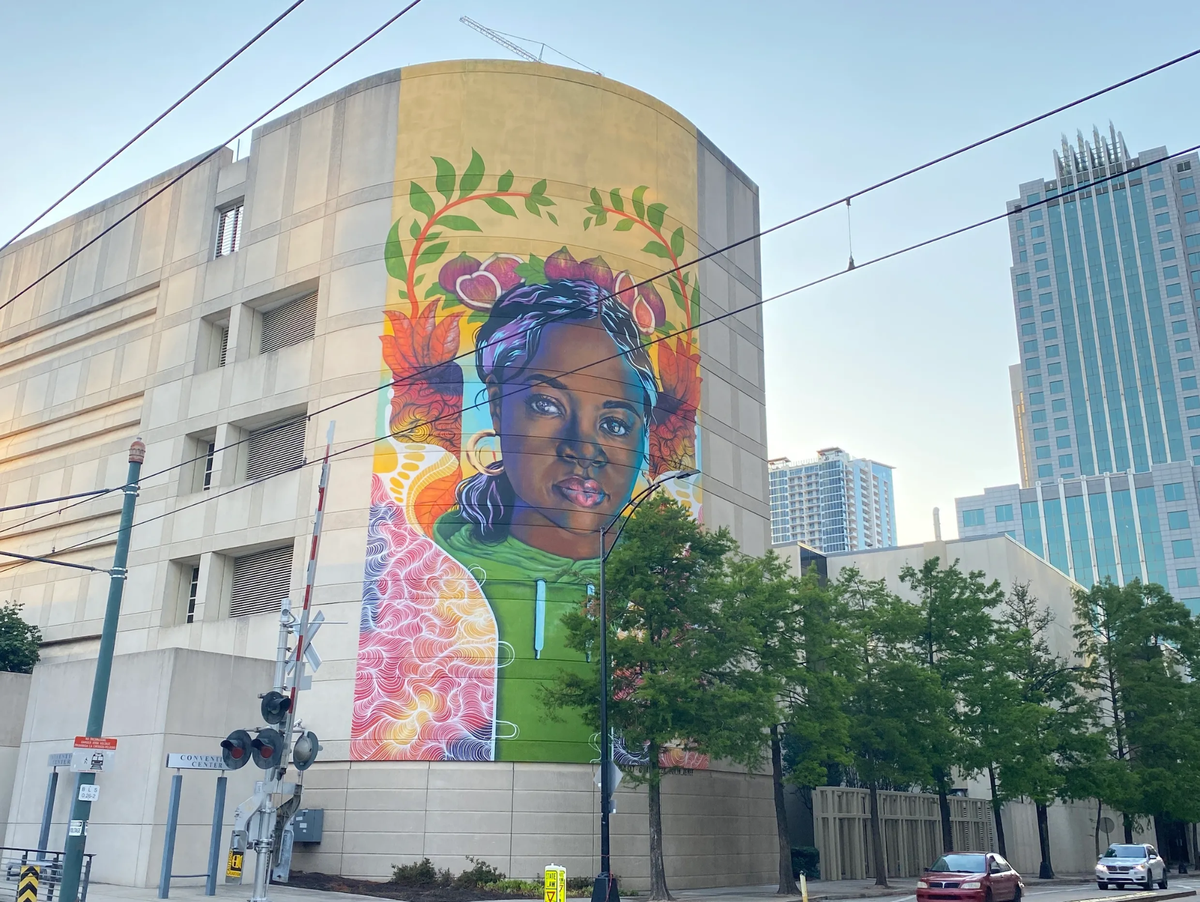
She also shared photos of her final mural, one that she worked on with two other artists. The roughly 80-foot-high piece on the side of an uptown building near the Charlotte Convention Center and Rail Trail depicts a woman surrounded by greenery and a crown of figs.
On Instagram, Guzzie wrote, “My excitement for murals and public installation, and my belief in their large scale healing potential, is genuine, to the core of my being. Public art is part of my identity, not just what I’ve done for work.”
But her health comes first.
The diagnosis
About five years ago, Guzzie was diagnosed with fibromyalgia, a disorder that causes musculoskeletal pain among other symptoms, including fatigue, and sleep, memory and mood issues.
The disorder affects the way the brain and spinal cord process painful and non-painful signals, and amplifies painful sensations.
“Ultimately my body is responding to things that are not actually happening in the present moment,” Guzzie said in an interview with The Charlotte Observer. “My body says I’m in pain, but there is no reason to be in pain right now. So it gives me a very interesting relationship with my body.”
In 2014, the artist gave birth to her son. “The pregnancy and the labor triggered so much of this in my body,” she said.
Guzzie’s mother, also diagnosed with fibromyalgia, started having symptoms shortly after she gave birth to Guzzie. Exhaustion, nausea, neck pain — the symptoms ran in the family.
Though Guzzie worked to manage her symptoms, mural work became increasingly more difficult.
The physical and mental toll
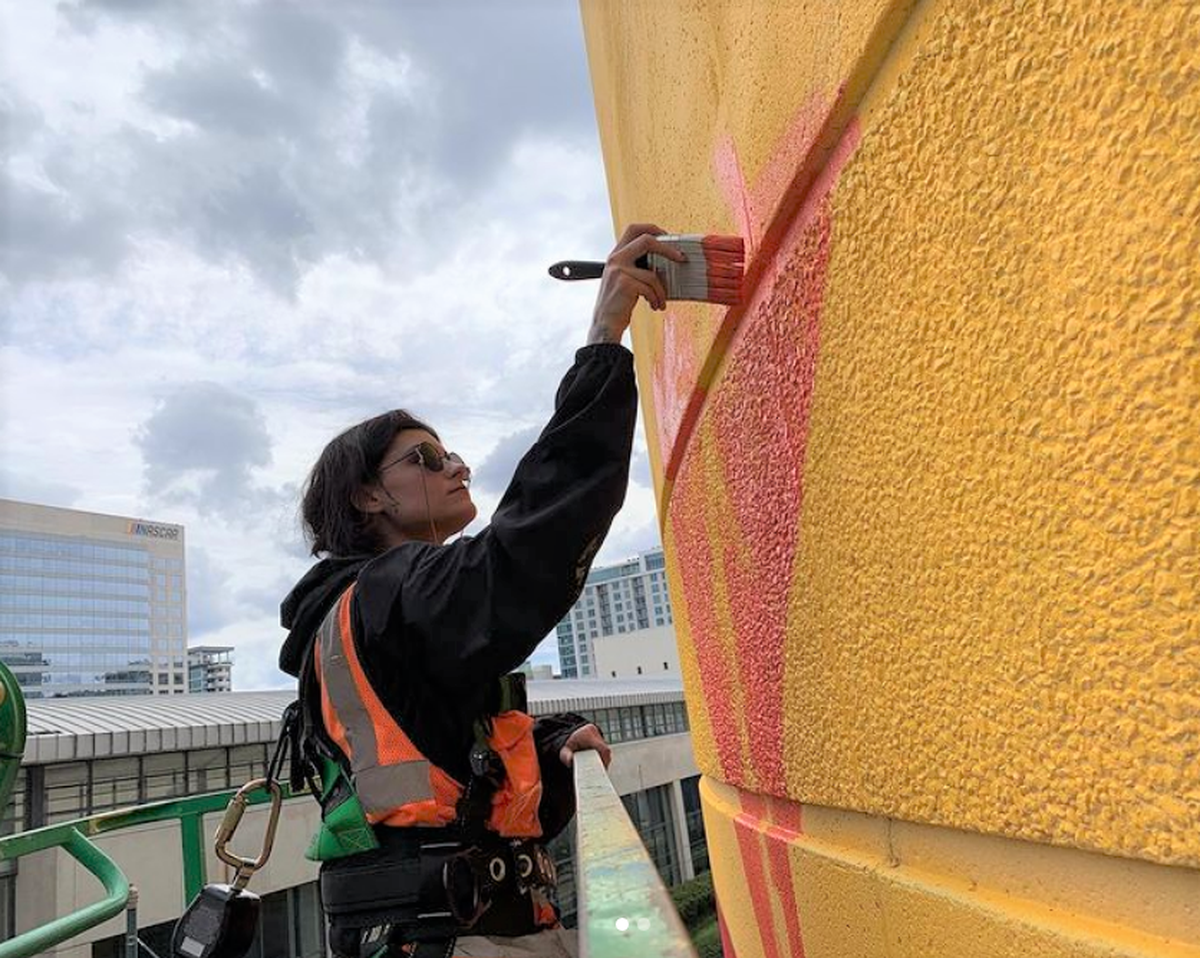
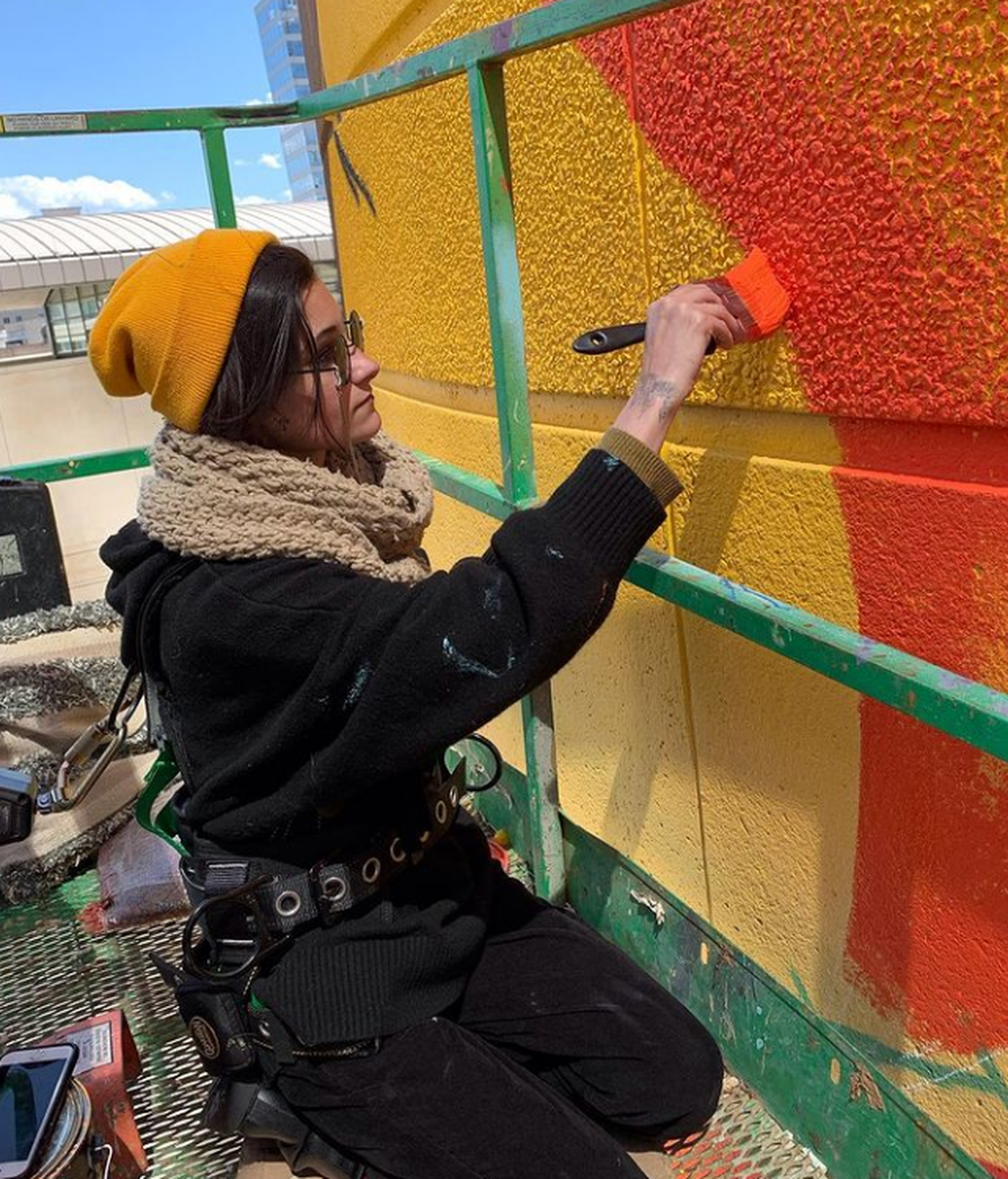
Painting murals is hard labor.
For a typical mural, Guzzie would push herself to work eight-to 12-hour days, sometimes for days or weeks on end. She’d carry heavy paint buckets and supplies to and from worksites, craning her neck for hours standing on a ladder or scaffolding.
Coupled with the direct physical effects of muraling, Guzzie began experiencing mental health issues as well. “It was also the heavy subject matter,” she said.
Last June, for a private commission, a man told her he wanted a mural in his backyard.
The two discussed the goal: a 1980s New York City theme. But then Guzzie asked him about a poem he wanted included. “There was no getting around the fact that it was about his mother being gone, and that’s what he wanted to wake up to when he looked out on his backyard,” she said.
At that moment, she began reflecting on her work.
“It got me looking back at all the paintings that I’ve had physically painted, not just project managed. But they all had this theme of death and transformation,” she said. “I don’t know how I missed it... But down to my very first mural, I realized that it was all about a kind of grief and changing – death.”
Early on, before the fibromyalgia diagnosis, Guzzie would take three or four weeks off after one of her projects because of the physical and mental toll they took.
In addition to the back and neck pain, she developed leg tremors. “And it would happen at very inconvenient times,” she said. “I would shake myself right off a ladder.”
She soon realized she would have to make some changes.
Compounding diagnoses
In late 2018, Guzzie was driving back to Charlotte from Philadelphia when a wave of debilitating neck pain caused her to stop at a hotel in Virginia.
“I had to stay for four hours, just to be able to make it back,” she said. “It was an extreme flare-up, or so I thought, but essentially it was an old injury that had been triggered and I didn’t know the injury existed.”
She consulted a chiropractor in South Carolina who specializes in the top two neck vertebrae, and he traced her injury to 2006.
That year, she had attended an overnight fundraiser at her old high school in Pennsylvania, and got “table-topped,” when someone is on their hands and knees behind another person’s calves, she said. “When you push out, they go over you like a bench,” she said.
At the time, the focus was on her concussion. But, according to her chiropractor, the fall had disjointed her top two vertebrae, crooked in opposite directions right at the brainstem. Over time, her neck muscles calcified in order to stabilize and protect her neck.
The final mural
In March, Guzzie worked on what she now knows was her last mural.
It’s one of the tallest murals in the city, on Duke Energy property in uptown on E Martin Luther King Jr. Boulevard, between Brevard and College streets. The project was funded through a partnership between U.S. Bank and Charlotte Center City Partners to enhance the experience along the Rail Trail.
Guzzie, along with fellow artists Owl and Kalin Renée Devone, worked on the project. Photographer Dionna Bright, a friend of Devone’s, served as the model for a piece called “Where Inspiration and Strength Blooms.”
“I don’t think I quite let myself register that this is the last one,” Guzzie said.
“I did the prep work for my body in exactly the right way,” she added. Guzzie capped off her work schedule to four or five hours in a day and when she got home, she “turned it off.”
“I didn’t have the mental health problems after that project, and I didn’t have half of the symptoms that I normally got,” she said. “But I had extreme vertigo and other tiny reminders that this still has to be the last one.”
Since moving to Charlotte in 2015, Guzzie estimates that she’s created or had a hand in producing over 80 murals.
%20Sam%20Guzzie%20(Right).jpg "Hannah Fairweather (Left) Sam Guzzie (Right).jpg")
“Not only did I thrive on the challenge of large-scale painting, but I saw repeatedly the positive impact on individuals, community and cities alike. And particular in healing grief and loss, collective heartache,” she wrote in her Instagram post.
“Murals have the power to inspire beauty in the mundane, offering the spark to ignite the endless possibilities of growth within our everyday.”
Anne Low, creator and founder of ArtWalksCLT praised Guzzie and her work, calling her “such an important leader in the mural and community-based art movement in Charlotte.”
A lifetime of art
Even though she can’t work on murals anymore, change and evolution is nothing new to Guzzie.
“I’ve spent a lifetime being an artist and redirecting myself based off of circumstance,” she said. “Murals are the longest standing (artistic) relationship, but I’ve been painting since my mom gave me finger paints at nine months.”
In her research to understand and process the mental health side of her work, Guzzie discovered the International End of Life Doula Association, an organization that works with the dying and their loved ones.
Because of her work with grief murals, she recently received a scholarship to study with them. “They’re trying to expand what that industry looks like and normalize conversations, like birth is a natural process, death is as well.”
Guzzie also plans to concentrate more on her studio work and her creative writing. She said she recently received a Creative Renewal Fellowship semi-finalist grant from the Arts & Science Council to working on a short series of poems and etchings.
But Brand the Moth, Guzzie’s community mural project co-led with Hannah Fairweather, is on pause.
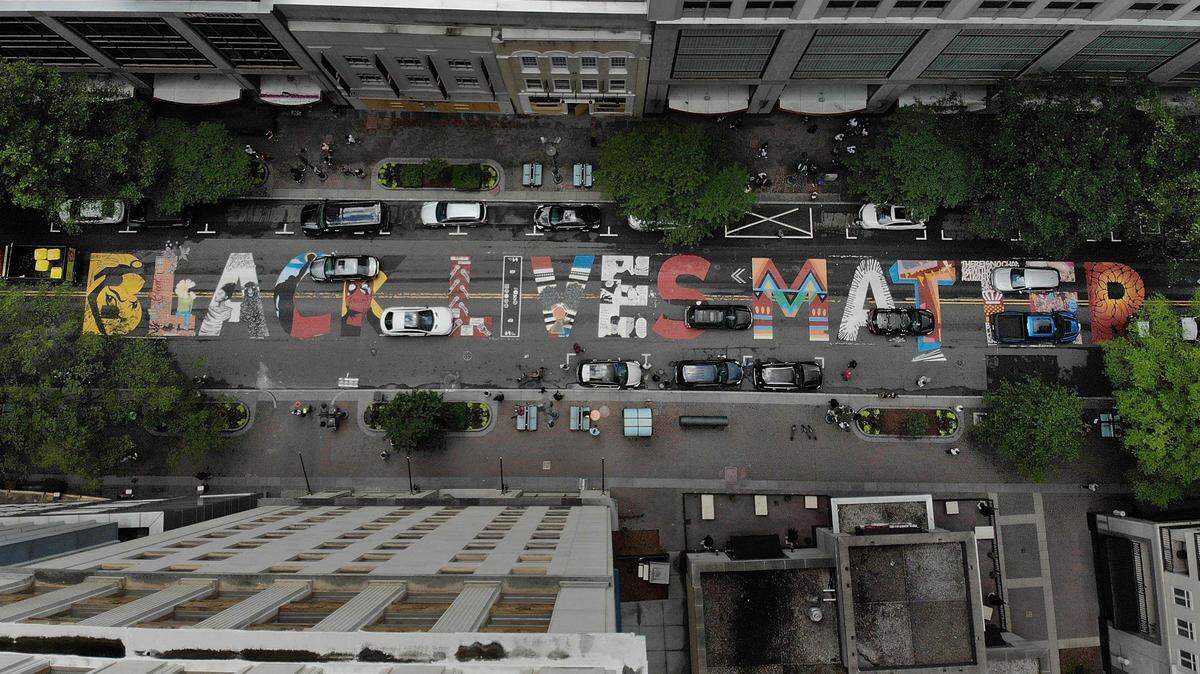
Brand the Moth was one of several groups that collaborated with the city of Charlotte in 2020 to produce the “Black Lives Matter” mural on Tryon Street in uptown during social justice protests.
“Five years ago, we thought there weren’t enough muralists working here and thought, how do we, as artists, live here and support ourselves,” she said. “Now we’re at the flip side of that. There’s so many artists.
“Whatever this turns into, or whatever happens, we are really proud of this community and we’re excited about what that future can look like.”
More arts coverage
Want to see more stories like this? Sign up here for our free “Inside Charlotte Arts” newsletter: charlotteobserver.com/newsletters. You can also join our Facebook group, “Inside Charlotte Arts,” by going here: facebook.com/groups/insidecharlottearts.
This story was originally published July 20, 2022 at 4:00 PM.