We’ve enjoyed working from home for a long time. But will we get away with it forever?
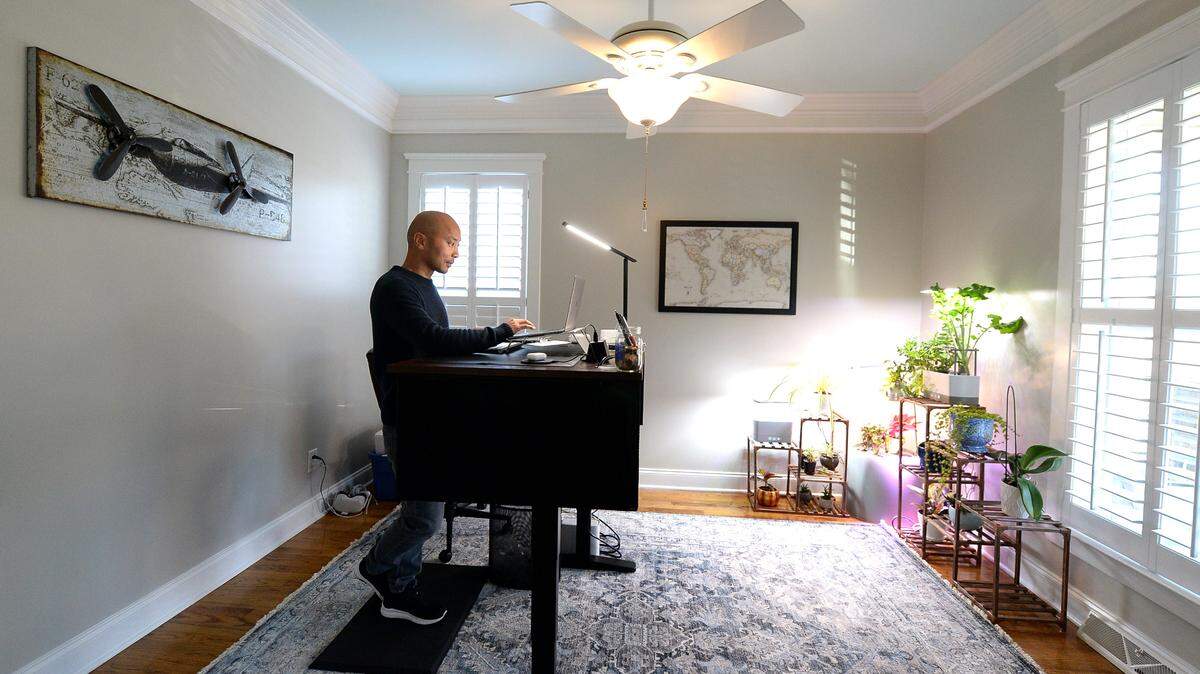
With a fair amount of frequency, a work contact, or a friend or family member, or some random stranger asks me a variation of the same question:
“So, are you guys back in the office?”
And if you, too, have a job that revolved, pre-COVID, around reporting to a physical space with all of your other colleagues on a regular basis, people are probably asking you that pretty often nowadays, as well. It’s become a standard icebreaker, replacing “So, how’s work going?”
But whereas the answers to the latter are typically as trite as the question — along the lines of “OK,” or “good,” or “busy!” — people tend to have strong feelings about where and how they’re being encouraged, or told, to work at this point.
Imagine, for instance, that you are employed right now by Elon Musk at Tesla, which at least by outward appearances seems to have been digging a deeper and deeper hole for itself ever since 1) mandating all staffers “spend a minimum of forty hours in the office per week” in the spring and 2) suggesting that those who prefer working from home like to do so because they can slack off.
(Word is it’s caused a decline in morale at Tesla. SHOCKER!)
Or take what happened in the unionized newsroom at The New York Times over the summer, when journalists were given free company-branded lunchboxes the same week they were told by management that it wanted them back in the office three times a week. Many refused and the situation ignited talk of a possible strike.
I, of course, can relate more to the folks making newspaper content than the ones making electric cars.
But even among journalists, there are significant differences in the way we work and what type of environment is best-suited for the type of job we do. Lots of the stories I tackle, for example, require long, involved, often-emotional conversations with sources, and I also find I do my best writing when I’m able to intensely focus on the process with minimal distractions.
So, prior to the pandemic, I already was spending probably half my week at home.
I had been working from home exclusively for more than two years when the company signed a lease for new office space. It’s been a good fit for some. Meanwhile, I’ve resisted — for the reasons I mentioned above.
I sympathize with colleagues who also have avoided going in. At the same time, I do understand the get-your-butt-back-in-the-office edicts.
These physical spaces cost money. A lot more than they did prior to March 2020. And I’m sure even reasonably trusting employers can’t help but sometimes wonder how often their people are wandering away from their work to tend to personal business. (Although, to be fair, some — like mine — actively promote both mental and physical breaks, with the idea that they help keep our brains fresh.)
With all of this in mind, I took an opportunity recently to bounce my various thoughts on the topic off the brain of Arvind Malhotra, a professor of strategy and entrepreneurship at UNC’s Kenan-Flagler Business School who for many years has studied and thought about the future of work and, of late, about remote working.
Our conversation has been edited for brevity and clarity.
Me: So first off, let’s talk about “the future of work.” Aren’t we in the future now? I mean, COVID really sped up a shift to remote and hybrid work that probably would have taken years to get to otherwise.
Dr. Malhotra: That’s right. It started after 9/11, when companies went a little more virtual; they were rethinking travel, so there was a push toward more global innovation, and toward creative work and how that gets handled in a virtual environment. Then the financial crash started and people wanted to divest away from real estate. So I worked with a ton of companies in 2009, 2010, trying to figure out, you know, “What’s the future of work?”
Then very unfortunately COVID happened, and so here I am talking to you.
Ultimately, employees are seeking flexibility. Take your industry, which is what I studied in my early days — specifically freelance writing. I talked to writers working for The New York Times who were living in Idaho or North Dakota, and that was pretty interesting. Your industry has been a forebearer of where we’re headed.
It’s a creative industry, and people wanted flexibility. People wanted to move to Boise, Idaho, or wherever; to be able to write stories from anywhere. And to write about things that they’re interested in, and then to syndicate their work. It was at the forefront of this movement.
Now everybody wants to do it.
But companies — basically, by default — think managing means managing in person. To give employees the kind of flexibility they’re seeking, companies have to re-imagine their cultures. In the absence of doing that, they default back to offices. Some companies are compromising by trying to get there in baby steps, by doing hybrid work schedules. But generally, I think companies want employees to come back.
So we will continue to struggle. Large societal changes take a long time.
Me: For obvious reasons, what you said about the business of writing resonates with me. I work almost entirely from home now. I do think that on the front end of the kind of work that I do, it would be beneficial to be around people, for brainstorming and creativity and that kind of thing; I’m a social creature, and like to be around other people. But when I’m really trying to concentrate on the actual process of writing, I don’t like to be around other people. I absolutely would rather be at home where it’s quiet.
Dr. Malhotra: I heard that a lot during my research into media, that writing completely needs to be “give me my peaceful time,” and “does it really matter if I’m writing in Charlotte, or if I’m writing in Asheville, or on the beach?” The media world had started to figure this out in many ways, which is: Given a task and employees having learned to manage themselves, their work can be performed remotely.
Of course, there are a lot of professions — if you’re a barista at Starbucks, or if you’re working at McDonald’s — where that’s not a choice.
But in industries where employees were given a choice during COVID, it’s hard to go back now, because people have tasted flexibility. People have tasted what it is to manage themselves. So, now, when you tell people, “You all have to come to the office,” you piss off a lot of people — pardon my French. But if you tell them, “Hey, when you want, you can come in,” I think you’d find a lot of people wanting to come in from time to time.
Some, for instance, feel pulled toward the office when A, they feel like they need to be noticed; or B, their team members may be doing something that they’re not part of, and they’ll miss out; and maybe C, they’re not getting the kind of mentoring or feedback that they think will help them do better work.
The angst for companies, meanwhile, is that they feel like they can’t manage their employees if they cannot see them.
Me: And I do think that this type of choice makes companies nervous when there aren’t a lot of people coming in, because it’s like, “Hey, we’re paying for this building,” or this office space. I’ve certainly heard about companies that try the choice thing, everyone chooses home, and so they decide to say, you know, “We need more people to come in a little bit more often.”
Dr. Malhotra: That’s such a real-estate-asset-based type of thinking when what they really should be doing is human-asset-based thinking. No, I think even if you make people feel like they don’t have to come in, they will if you give them a good reason.
But to your point, I’ve even seen companies that say, “Well, we’ll take away your cubicle, if you don’t come in.” And people are like, “That’s silly. I’m not gonna work for you if you take away my space.” The company says, “Hey, but you’re not using the space.” The employee says, “But one day I might use that space.” The struggle is real.
We’ve clearly seen — with Regus (now IWG) and WeWork — that coworking spaces are appealing, and that trend is evolving to be more spontaneous; now you can do that in hotels, with meeting rooms on demand that you can rent.
The question is, what’s more important? Productive use of human assets, or productive use of physical assets? Meaning fixed office spaces, fixed buildings, fixed campuses. If your human assets feel more productive — if Théoden feels more productive writing the story from home, then why force you to go to the office?
Prioritizing productive use of physical assets is counterproductive to maximizing the productivity of your employees.
People shouldn’t feel like if they’re not seen banging on their keyboards in their cubicle, they’re not being valued. I mean, it’s like some companies are saying, “We value you!” And then in brackets, the unwritten, unsaid words: “But only if you come in.”
This story was originally published October 20, 2022 at 6:00 AM.