How a Tesla and a prom turned 2 men in their 70s — 1 Black, 1 white — into best friends
When Walter Davis Jr. recalls the moment that took his friendship with Ron Bryant to the next level, he thinks about a dark green 2012 Tesla Model S sedan.
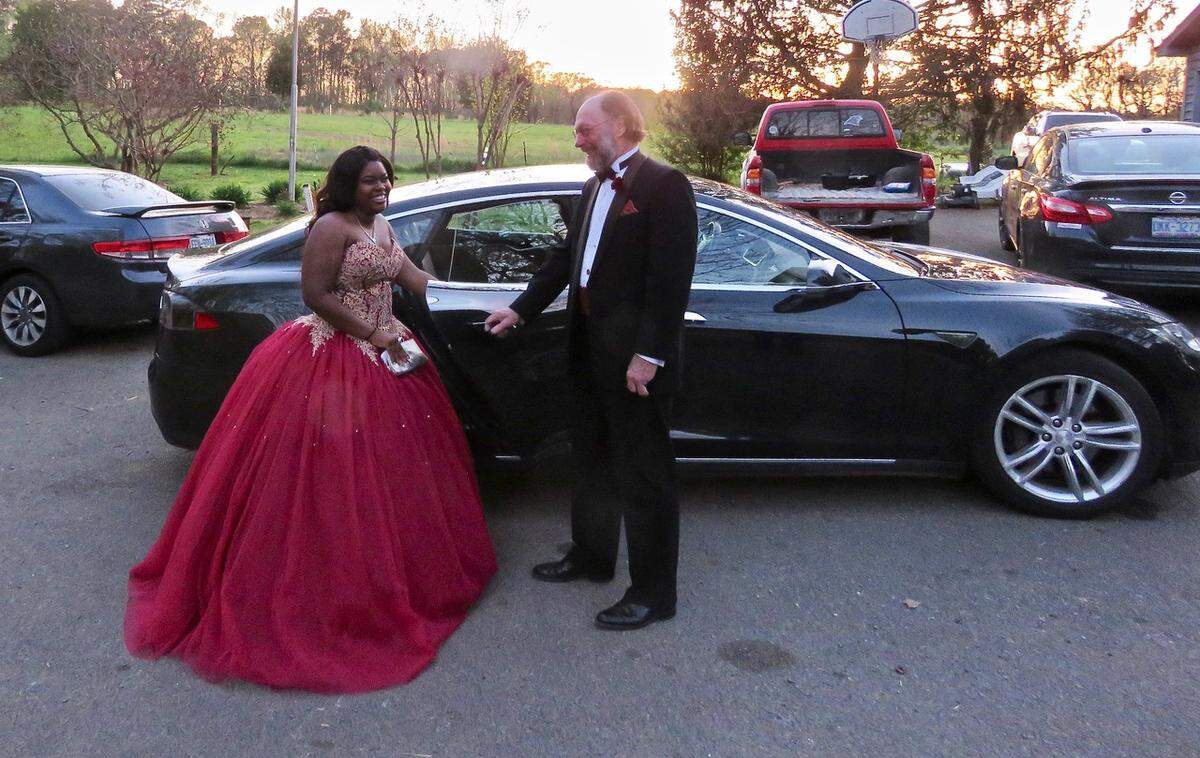
He thinks about Ron, then 75 years old, wearing a tuxedo with a red cummerbund.
And he thinks about his granddaughter Danielle and the bold request that put this all into motion in the first place: Danielle had seen Ron’s Tesla, and thought it was cool, and thought it would be particularly cool if Ron would chauffeur her and her date to her school prom in 2018.
But above all else, he thinks of a white person (Ron) doing for a Black teenager (Danielle) something that — well, frankly, something he just didn’t envision a white person would do for a Black teenager.
“I can’t think of any other white male I could ask to do that who would have done it just as openly and as welcoming as he did,” Walter, 83, says of Ron, whom Walter’s known now for just about a decade. The men are sitting together in the living room of the home Ron and his wife, Nancy Bryant, own near Norwood in Stanly County, and they’re reflecting on what thrust them into “best-friend” territory in their 70s.
Ron, though, can’t put a finger on it.
“It wasn’t something (specific). It was just sort of a process,” he says. “I would just say ‘friend,’ and then ... I don’t know at what time, at what click, came about that I said, ‘OK, best friend.’ It evolved.”
Walter, meanwhile, keeps a tight focus on his granddaughter, the Tesla, and the astonishment he vividly recalls of that spring evening. “I stood out there and watched them take the pictures and all that stuff, and I don’t think I had much to say at that time,” Walter says. “I just saw it all happening ... and I’m thinking to myself, He really is gonna do this.”
“I was oblivious to that,” Ron chimes. “I mean, I just thought, This is great! How many 75-year-old guys get to take a high school senior to her prom? It was big fun.”
He gets it now, though.
And Ron, who knows Walter better than anyone except his wife, now fully understands why a gesture like that would mean so much to his best friend.
‘Of course you’re welcome here’
Walter has spent most his life living in Norwood — about 50 miles east of Charlotte — and all of it being hyper-aware of the color of his skin.
When he was growing up, Jim Crow laws were still being strictly enforced throughout the South. He was forbidden from drinking from the same water fountains as white people. At his doctor’s office, he was examined in separate, less-equipped wards for Black patients. He could only watch movies from a balcony section designated for Black theatergoers only.
In 1961, as the civil rights movement intensified, he helped integrate the swimming pool at Morrow Mountain State Park while on leave from the Air Force.
After his service was completed, he returned to Stanly County, where the Aluminum Company of America (ALCOA) — motivated by a swell of race-conscious affirmative action efforts — tapped then-23-year-old Walter to be the company’s first Black supervisor. (He wound up working at its plant in the nearby town of Badin for three decades.)
And in 1985, he caused something of a stir in Norwood when he married his second wife, Marianne Bumgarner-Davis, a white woman.
Walter says they were the only openly biracial couple that they were aware of; that they didn’t feel comfortable enough to eat together at local restaurants; and that the priest at Marianne’s church “didn’t think it was a good idea” for them to attend together after the congregation put the matter of allowing a Black man there to a vote shortly after their wedding (he says it was split, 50-50).
So Marianne went looking for a church that would accept them and, in 1986, found one: Christ Episcopal Church in Albemarle.
The congregation at Christ Episcopal also was basically all-white, but the priest there told her, “Of course you’re welcome here. It’s not my church. It’s God’s church.” That was good enough for Walter.
Twenty years later, Ron and Nancy rolled into town, fresh off a move from the center of uptown Charlotte to the middle of nowhere — more specifically, into a custom round home they built on a 170-acre tract of forest and farmland designated by the state as a wildlife habitat and for sustainable agriculture. (They’d been environmental advocates since the late ’80s, with Ron having served as the founding chair of the Catawba Riverkeeper Foundation and as first president of the Catawba Lands Conservancy, and Nancy having helped found Clean Air Carolina.)
The Bryants were at a Lutheran church for several years, but were drawn to Christ Episcopal, Ron says, “because they had an environmental focus that a lot of churches don’t have.”
At one point, Ron and Nancy went there to view a presentation of Al Gore’s climate-crisis-oriented slide show, which had become the basis for the 2006 documentary film “An Inconvenient Truth.” At another, the couple noted that a trailer had been placed in the church’s parking lot for the purpose of collecting aluminum beverage cans.
They finally joined Christ Episcopal in 2013, and Ron almost immediately volunteered to help whoever was leading the can-recycling efforts.
It was Walter, and at that point, he was a one-man operation.
But then there were two.
Learning to look at things differently
So, the relationship started over cans.
For the next several years — sporadically in the wintertime but every two weeks in the summertime (when people were “drinking a lot of beer,” Walter says) — the two men would spend the better part of a Saturday driving around together picking them out of the three trailers the church was responsible for; bagging them; and taking them to the recycling center.
The bond was built over everything from complaints about the fire ants and the soiled diapers they had to negotiate to get to the cans to thoughts about both church and family matters. But they weren’t hanging out away from the dirty job they shared.
Then one day Ron and Nancy encouraged Walter and Marianne to attend a spiritual retreat that Christians call “Cursillo,” which is built around three days of talks about Christian life. Ron sponsored Walter, Nancy sponsored Marianne, and the Cursillo they went to was in Concord. Upon completing it, Walter joined a small group of men who were Cursillo “alumni” that met every Wednesday morning for breakfast. Ron, of course, was one of them.
As they learned even more about each other through these weekly meetings, Ron says he barely thought about the color of Walter’s skin at all.
The opposite, however, was not true.
“During the period of Jim Crow, most white people thought they were better than you,” Walter says, trying to explain why. “And being married to this white woman made me a little bit more cautious also, because you’re never knowing what the person I’m talking to felt about my relationship. I don’t know if it was so much of distrust as it was being conscious. But there was just nobody that I touched base with that I felt really comfortable enough with to share most of my life.”
In a nutshell, he says: “Most white men that I had any contact with looked at me in a different light, probably had different ideas about what Black people were like.”
With that in mind, Walter himself continued to look at Ron in a different light, and held onto his own different ideas about what white people were like — even after all that time they spent sorting cans before the church stopped doing it a few years back, and even after Ron offered heartfelt condolences to Walter when Marianne died in 2017.
Indeed, it wasn’t until Ron agreed, happily, to drive Danielle and her date to their prom that Walter was ready to fully commit to the friendship.
“I know a lot of people in this town,” Walter says. “I’ve been around ’em a lot. And got along with most of ’em. But I was not willing to put myself out there. To sit down and say, ‘I’ve got a problem. Can you help me with it?’ Until I met this guy.”
“I really don’t know how to let you guys know how very special he is to me.”
‘We will have left happy’
One of the biggest things the two men have in common is the disgust and hatred they have for racism in all of its forms.
Though they’re too old to go march on Washington, Ron says, they frequently talk about white privilege and the Black experience (says Ron: “When Walter tells me some of the things that happened as he was coming along ... I’m ashamed that I’m part of a race that did that to him”); and, as Ron explains, about ways they can “provide an example to our divided communities that this kind of friendship and cooperation between (people of different races) is not only possible but enjoyable and productive.”
They talk about their church lives, their faith and their values, their families, their childhood memories, and their work histories. They compare health and medical issues, and offer to drive each other to appointments.
Basically, they just try to talk and connect as much as they can.
“It would have been nice if it had happened (earlier in our lives),” Walter says. “If we had more time together. But ... I think about it in this perspective: That it doesn’t matter to me whether it was in my 20s, my 30s or my 80s. It’s just important because it happened. Period.”
Ron nods his head. “You’re right, Walter. Because both of us had very, very busy lives up until the time we did meet and start doing things together. I may not have even had time for a best friend during those years, before I met you.”
“When you deal with things like I’ve dealt with in my life,” Walter says, “and then you find somebody like this, you treasure that. You’re a fool if you don’t.”
“Both of us will not be here 20 years from now,” Ron says. “But we will have left happy.”
Walter looks over at the closest male friend he’s ever had in his life — the guy who still drives that dark green 2012 Tesla Model S sedan — and he smiles at him, before closing with this: “The timing — the age and all that stuff — is not relevant to me. I’m just happy that it happened. That I can call him up and say, ‘I need you. I want to talk to you.’ And ... he’s gonna be there.
“I hope you have somebody in your life like that.”
This story was originally published January 25, 2023 at 6:00 AM.