He’s spent 40 years looking for people — both Black and white — who share his last name
READ MORE
Tracing Black Roots
Watch & Read More:
Expand All
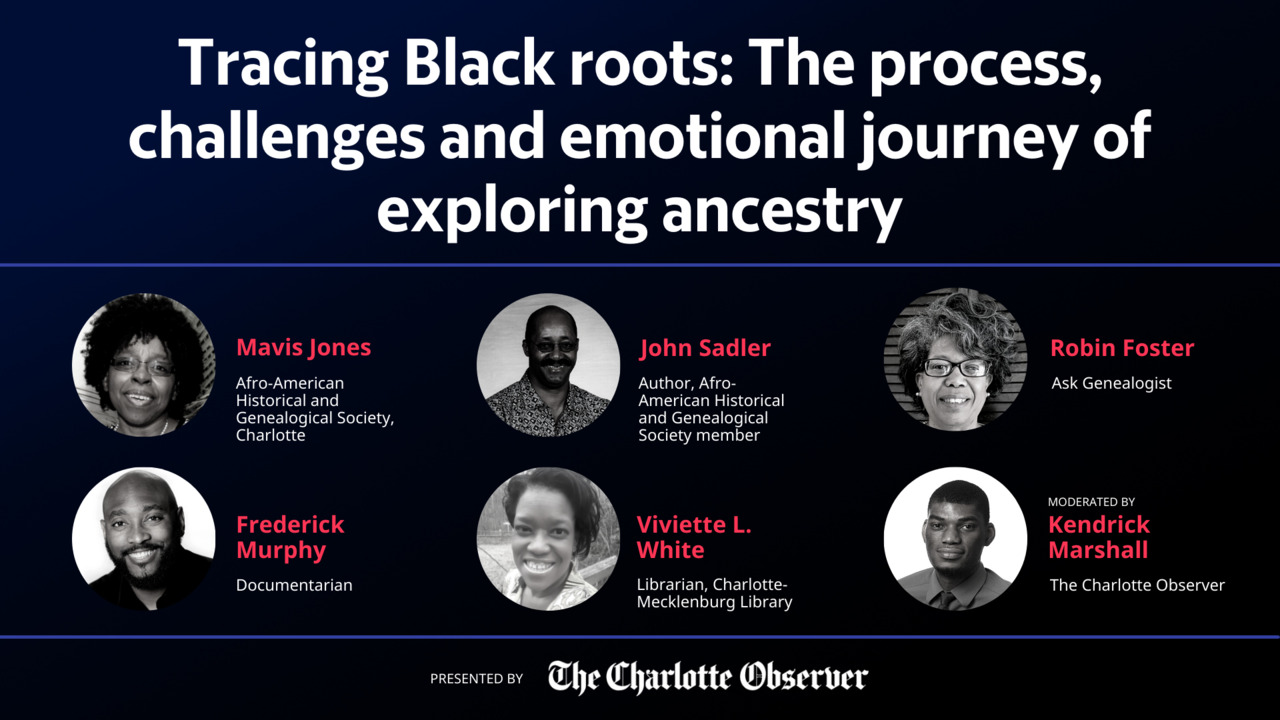
John Sadler is standing in the dining room of the Belmont neighborhood home he shares with his wife, Linda, thumbing through the pages of “The Road to Freedom,” a book about his family history that he self-published last year.
“This,” the 69-year-old retired Charlottean points out, as he spreads the volume open with two fingers, “is a census record from 1870, and it shows my great-great-grandfather and his wife, and then all his children. ... I also have in here how I found him, through wills and probate records of the white Sadlers.”
That’s the family, he explains, that owned his great-great-grandfather.
He flips to another page. “And here it shows the list of slaves owned by this person, and how much each slave was worth.”
Sadler quickly concedes this was not the most pleasant part of his genealogical research, the part that involved delving into his family’s history as slaves. Yet, not only did he not shy away from it, he actually wound up writing extensively about these white Sadlers, in a second self-published book titled “Behind the Cotton Curtain.”
All of this started for Sadler roughly half a lifetime ago. It was the early 1980s, best he can recall — though he can’t pinpoint an exact year — when he was assigned a job at his family’s annual reunion that sounded straightforward enough: Gather as much historical information as possible about his father’s side.
Thousands of hours of research, two four-volume books, and one explosion of the internet later, Sadler is still plugging away at the task.
In fact, in some ways it seems like he’s just getting started.
‘It became a passion’
Sadler says he thinks he was chosen to be the family historian in large part simply because he was in his early 30s, someone who had enough energy to handle the job while also working full time as an equipment operator at McGuire Nuclear Station in Huntersville.
The general idea was that the family wanted him to collate whatever information he could collect so it could be passed on to the next generation. But nobody told him how far back they wanted him to go. Nobody gave him a deadline. Nobody gave him any idea how he was supposed to pull this off.
So he started off by doing the only things he could think of to do — interviewing family members (including his father, James Sadler, who was born in 1911 and who “knew everything and everybody”) armed with a pen and a notebook; diagramming family trees on paper; and using the word-processing application WordPerfect to put important details and timelines and stories into documents that he’d save to 5.25-inch floppy disks.
And he soon found himself obsessed.
“Once I started ... finding out all these people that had lived all around me that I had never known, but ... were all related to me, it became a passion,” Sadler says. “I realized that I really, really, really wanted to know who my extended family was. So I set out to extend (my research) out as far as I could.”
At the annual family reunions, he spent large chunks of time interviewing members of his father’s side of the family. He looked through census records at county libraries around the area.
In 1989, someone introduced him to a piece of genealogy software called “Family Tree Maker” that made organizing the information he had amassed much easier.
Then in the early ’90s, someone turned him on to the Charlotte chapter of the African-American Genealogy Interest Group (which would later become the Charlotte chapter of the Afro-American Genealogical and Historical Society); and that group turned him on to methods of research he hadn’t yet explored; and those methods helped him determine that his great-great-grandfather, Tom Sadler, was born sometime between 1822 and 1824.
But beyond homing in on the window of time during which he’d been born, John Sadler couldn’t find much information on his great-great-grandfather before 1870, the year of the first U.S. Census after the end of slavery. That’s because, prior to that point, the census did not list enslaved and formerly enslaved Africans by their names, instead only including them in counts of slave owners’ household property and labeling them by gender and approximate age.
So, like countless Black Americans trying to trace their families’ roots before him, Sadler hit a wall in his research.
And, like so many others before him, he realized the only way through it was for him to get to know the white slave owners who gave him and his ancestors the last name Sadler in the first place.
Down the genealogy rabbit hole
In the 1990s, the full power of the internet was still many years away, and Sadler had to do some good, old-fashioned sleuthing to chase down information about the white people who owned his great-great-grandfather.
Most of it involved a parade of trips to buildings and agencies that housed historical public records, where he hunted for anyone with the surname Sadler. Needless to say, it initially proved a tedious task: There had been a lot of Sadlers in York County.
But his search got a big boost when he learned that one particular set of Sadlers was one of the county’s most prominent families — and that they long ago had drawn up a family tree that was now available to the public.
Before long, he found his great-great-grandfather’s first name on a probate record tied to these Sadlers. After cross-referencing the date with the age listed for this enslaved man, John had a feeling he’d scored a hit. The only way to be sure, though, was to keep poring over probate records between 1822 and 1869 that were registered to white men with the last name Sadler.
So he did, the father of five at one point even going so far as to spend a two-week vacation from his Duke Energy job to focus on his genealogy research.
It’s work he recalls making him “extremely” emotional, due to the various conclusions he came to based on the records he found related to the Sadlers of the 1800s.
One example: “A lot of times I would see where slaves that were owned by white Sadlers were like 3, 4, 5 years old, and there was not an older slave there that I would think would be able to take care of ’em.”
Another: “In 1850, this gentleman or lady had, say, a certain number of slaves in a certain age group. Well, in 1860 you would expect to see that same list of slaves 10 years older. But in a lot of cases I did not. Instead, I would see younger slaves — about the same age as the ones I saw 10 years earlier — and I wondered what happened to all those other slaves in that 10-year time period. Were they sold off? Did they die?”
“Those were times,” John says, “where I had to just put it down, and go off and contemplate something else.”
In the end, though, his painstaking efforts paid off: He was able to clearly establish his great-great-grandfather’s path from birth, through slavery, to his appearance on the 1870 census as a free man. And he went on to piece together the paths of Tom Sadler’s wife, Margaret, and their 15 children.
By the early 2000s, John basically had done all the research he could do and he knew he had a family history book in him.
Unfortunately, he also knew he couldn’t possibly write it. Not yet, anyway. His job had become more demanding, and as he moved into his 50s, he felt much more wiped out after a long day at the nuclear station than he had when he was in his 30s and 40s.
So his yearslong project became relegated to the back burner — something he only attended to when there were births or deaths or marriages in the family — for the better part of the next two decades.
On Dec. 31, 2018, he retired from Duke Energy.
And on Jan. 1, 2019, John Sadler went right back to work.
‘I wanted to give my family the whole story’
He quickly discovered how much the internet had changed the genealogy game.
The first tool Sadler exploited was FamilySearch.org, a free, easily-searchable database that at the time offered an archive of hundreds of millions of family-history records and images (it’s since grown to encompass several billion). Once he had found every possible detail about every possible Sadler via that website, he bought a membership for Ancestry.com, which he says yielded a robust trove of Sadler-related information, from Social Security records to images of family members’ grave markers.
Then he started writing.
For two years, he says, he spent virtually every second of his free time working on not one book, but two.
The first one, spread across four volumes and 1,000 pages, is about his own family. It’s titled “The Road to Freedom: The Black Sadlers of York County, South Carolina.” The second one, also four volumes but this one in excess of 1,200 pages, extensively chronicles the slavery-era history of white families in the area who bore the last name Sadler. It’s titled “Behind the Cotton Curtain: The White Sadlers of York County, South Carolina.”
“I wanted to give my family the full story. I wanted to put it down on paper so that we could pass it on to the next generation.” And, he says, it’s a testament to “how my family emerged from slavery, and how we have come to ... thrive since slavery. Because we can boast of doctors and lawyers in the family now.”
Both of the books were independently published through Amazon and made available for purchase publicly on the website last spring, although John Sadler says they’re really just for his family members.
And those family members have been duly impressed with his efforts.
His second cousin, Hazeline Sadler Smith of Charlotte, compared him to Henry Louis Gates Jr., host of PBS’s long-running genealogy-centric documentary TV series “Finding Your Roots.” “He’s just a thorough person,” Smith says. “He just amazing. I mean ... we just couldn’t believe how much history (he uncovered). ... We are grateful for him, and I’m sure he’s gonna find some more.”
Adds his father’s cousin, Isiah Sadler of Philadelphia: “John is one of a kind. If he gets involved in anything ... he’s not satisfied until he works to the (bottom of it). ... If you wanna know something, there you go. You ask him and I’ll guarantee, if he don’t have it, he’ll get it. And when he get it, he’ll let everybody know it.”
As for the book on the white Sadlers specifically, John Sadler says he simply wanted to give members of his family a better understanding of the people that owned their ancestors. But for obvious reasons, working on “Behind the Cotton Curtain” was emotional; the information he came across often left him feeling disgusted.
It also was a frustrating process, because — despite all the facts he was able to amass about the white Sadlers — there were still so many unknowns that haunted him.
“My great-great-grandfather was passed along from one (member of the Sadler family) to the other, from grandfather to father to son to the father’s wife was the last one that he was with before 1865,” John Sadler says. “Basically he stayed his entire life with that same family, which in a lot of cases they say was unusual for slaves. A lot of ’em got sold around. But he never got sold around.
“And I wondered, what was the reason for that? Did they have some kind of emotional ties to him? Were they trying to protect him? Or was it because he meant so much to their bottom line? Or, you know, from around 1820 and up they had banned the importation of slaves into the United States, and so they had gone into slave breeding, and I was wondering if that was the reason they wanted to keep him around, because he could’ve been a good breeder.”
John Sadler says he’s never met a descendant of the slave owner of his great-great-grandfather and has not yet tried to track down any living white Sadlers, but he would like to — not necessarily to form a relationship with them, but because he’d love to find out if they kept a plantation record and account book that might reveal how the white Sadlers came to own his great-great-grandfather in the first place.
Even in the absence of that stroke of luck, though, his work continues; in fact, he says he spends “every waking second I can” doing family history research.
Since publishing his books last spring, he has unearthed vast amounts of additional information about his family via ongoing searches on Ancestry.com, enough that he thinks he’ll be able to assemble as many as five more volumes to add to his “The Road to Freedom” book. (He does not, however, plan to add to “Behind the Cotton Curtain.”)
Sadler hopes to finish by the end of the year. After that, he claims, he’ll pass the torch as family historian to another, younger relative. With that, he claims, he’ll stop obsessing. Maybe...
“I’ll still do updates if I come across something that I think needs to be added,” he admits, smiling.
But later, while talking about why he thinks he became so interested in his family’s genealogy, Sadler blurts: “If I could possibly do it, I would like to trace my family all the way back to the boat arriving, to the Middle Passage, ... to whatever western coast of Africa they came from. I would love to do that.”
After four decades and counting of research, who’s to doubt him?
This story was originally published February 27, 2022 at 5:00 AM.