NC car dealers say they’re ‘all in on EVs,’ but they’ll continue to resist direct sales
READ MORE
A vehicle to fight climate change
A 2018 executive order from Gov. Roy Cooper was North Carolina’s most ambitious approach to fight climate change in more than a decade. The plan forecast a future that is likely to be powered by renewable energy and driven by electric vehicles. But is the state meeting those goals? Are consumers and car dealers embracing zero-emission transportation? And can lawmakers cross the political divide to enact additional guidance for the state’s future?
Expand All
Two years ago, the president of the N.C. Automobile Dealers Association, Robert Glaser, thought electric vehicles would be slow to catch on in the state.
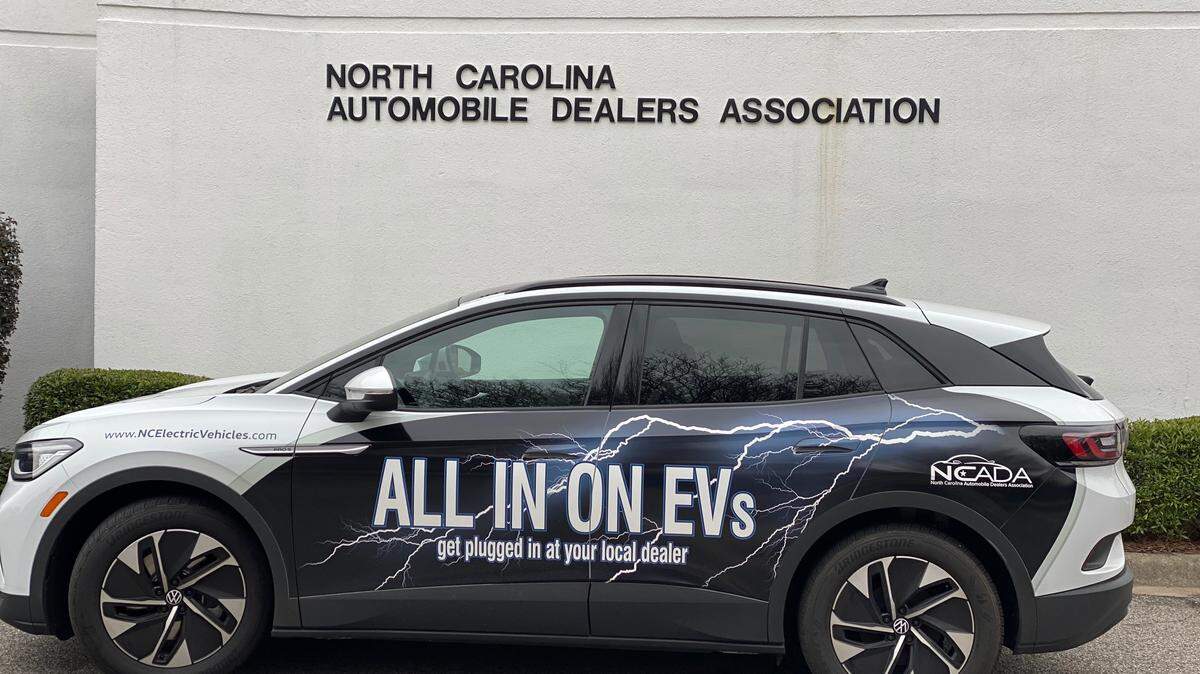
Now Glaser drives around in an electric Volkswagen ID.4 with the words “All in on EVs” and the NCADA’s logo on the side. Wherever he goes, he says, people are full of questions about electric vehicles.
“The consumers are very much interested in EVs,” he says.
So, increasingly, are car dealers, a potentially important bellwether of how quickly electric vehicles will take off in North Carolina. After all, if anyone might be expected to cling to the internal combustion engine it would be dealers who have sold them for decades and still overwhelmingly make most of their living from them.
Dealers look ahead
But several factors have dealers looking ahead to the transition to EVs, Glaser said. For starters, legacy companies such as Ford, GM, Toyota and Honda are all pushing to get their new electric models into dealer showrooms as fast as they can.
He also says marketing by automakers is starting to catch people’s attention. Hyundai, Kia, Nissan, GM and BMW were among the companies who bought pricey ad time during the Super Bowl, TV’s biggest event of the year, to try to whet consumer appetites for EVs.
And then there’s the price of gas. Already rising as the economy recovered from the COVID-19 pandemic, gas prices spiked this winter after the Russian invasion of Ukraine upended the world’s oil market.
“When the price of gas goes up, I think there’s a natural inclination to look at EVs,” Glaser said.
Dealers are preparing for the transition, Glaser said, by retraining their employees to sell and service electric vehicles, overhauling service bays to handle EVs and installing charging stations.
“There are dealers in the Raleigh area who have 12 in-ground chargers in front of their dealership. They’re just waiting for the demand to catch up,” Glaser said. “So dealers are on board and sort of part of the revolution.”
Will dealership protection law hurt EV sales?
Still looming, though, is a state law that prevents electric vehicle makers from bypassing third-party dealerships and selling directly to consumers. The business models of EV startups such as Lucid, Rivian and Tesla are built on direct sales.
The state is one of only four in the country that also ban manufacturers from directly servicing their vehicles.
Three years ago, the General Assembly carved out a carefully worded exception that allowed Tesla to own and operate up to six dealerships in the state. The auto dealers association supported the bill as a compromise measure but is not inclined to further undermine the state’s system of third-party dealerships, which it says protects consumers and provides them the best options.
“We are very hopeful that, for the benefit of the car buyer’s protection, the current laws prohibiting factory direct sales remains in place,” Glaser wrote in an email. “We believe that the consumer is best served by a highly competitive, intra-brand marketplace where the consumer has multiple outlets to purchase the vehicle and even more importantly, multiple outlets to have the vehicle repaired.”
A dilemma for North Carolina
That creates a dilemma for North Carolina policymakers who want to encourage a transition to electric vehicles. Gov. Roy Cooper and leaders of both the House and Senate hailed the decision by Vietnamese automaker VinFast to begin building electric SUVs in Moncure in 2024, but it’s not clear how those SUVs will be sold in the state.
The auto dealers association reached out to the company to encourage it to use dealerships, Glaser said.
Last year, Rivian told recruiters in North Carolina that the state’s ban on direct sales would preclude it from considering North Carolina for a manufacturing plant. The electric truck maker chose to build the $5 billion plant in Georgia instead.
Another startup, London-based Arrival, opened its American headquarters in Charlotte and plans to begin producing electric vans there late this year. But at a clean technology event in Chapel Hill last month, Arrival spokeswoman Suzanna Merkelson said the law will hurt EV sales in the state and should be reconsidered.
Through an executive order in January, Cooper set a goal of 1.25 million registered electric vehicles in North Carolina by 2030, up from about 36,000 today. Ultimately, Glaser said, it will be up to consumers to decide when the state reaches Cooper’s goal.
“If it takes five years to get to 1.25 million or 25 years, dealers are going to be there to represent their customers,” he said. “Dealers are going to sell whatever safe, reliable car the consumer is looking for.”
This story was originally published April 17, 2022 at 6:00 AM with the headline "NC car dealers say they’re ‘all in on EVs,’ but they’ll continue to resist direct sales."

.JPG)