Mecklenburg sees 65% growth rate in homes owned by corporate landlords, study finds
AI-generated summary reviewed by our newsroom.
- Corporate landlords owned nearly 20,000 single-family homes in Mecklenburg by 2023.
- Corporate market share in single-family homes rose from under 5% in 2019 to 7.5%.
- Ownership concentrates in low-income areas, raising affordability and equity concerns.
Corporate landlords continue to gobble up single-family housing stock in Mecklenburg County, owning about 20,000 homes at the end of 2023.
That’s according to a new report from the UNC Charlotte Urban Institute, which found that corporate investors went from owning under 5% of single-family properties in 2019 to about 7.5% in 2023. That’s about a 65% increase in market share, according to report author and senior research associate Eric Moore.
The report, released on Wednesday, is one of a three-part series where Moore examines what a corporate landlord is, where they own property in Mecklenburg County and what that means for residents. Corporate landlords are businesses that own properties, often many at a time.
The rise in corporate landlords expands upon the numbers found in The Charlotte Observer and Raleigh News & Observer 2022 investigation, “Security for Sale.”
The investigation revealed that corporate landlords owned about 25% of all rental homes in Mecklenburg County. And across North Carolina, at least 40,000 single-family properties were held by about 20 companies.
Some Realtors told the papers that corporations’ cash offers above the asking price, and other purchase activities, can make it challenging for local residents to compete for homes, especially in hot markets like Charlotte. What’s more, tenants have filed a steady stream of complaints about their corporate landlords to state authorities, on issues such as maintenance neglect, undisclosed fees and wrongful evictions.
The single-family rental industry defended its practices, saying its growth was in response to demand and that they provide an option for people who can’t afford to buy.
Moore noted that some of the information from the papers’ series was used in his reports.
The rise in corporate ownership of single-family homes is still continuing, according to Moore’s report. Neither Moore nor the institute immediately responded to a request for comment from The Charlotte Observer Thursday.
But here are more details from the latest report from the Urban Institute:
What is a corporate landlord?
The definition is broad, but typically corporate landlords involve property owned by Limited Liability Companies or real estate investment trusts, according to Moore.
The size of the housing portfolio also defines corporate ownership. Small corporate landlords own three to nine properties; medium-size ones own 10 to 99; large owns 100 to 999 and mega corporations own more than 1,000.
For his study, Moore looked at landlords who owned at least 15 single-family homes in the county. There are about 145 corporations that fit that definition.
Some of the mega companies in the county include Invitation Homes, Tricon Residential and American Homes 4 Rent.
What does the corporate landlord growth look like
Moore found that in 2019, corporate landlords owned under 5% of all single-family properties in the county. That’s over 12,000 homes.
At the end of 2023, those landlords owned about 7.5% of single-family homes in Mecklenburg County. That’s about 20,000 homes, according to Moore.
Where are the corporate-owned single-family homes?
They are in the crescent, or the historically low-income neighborhoods, of Charlotte, according to the report.
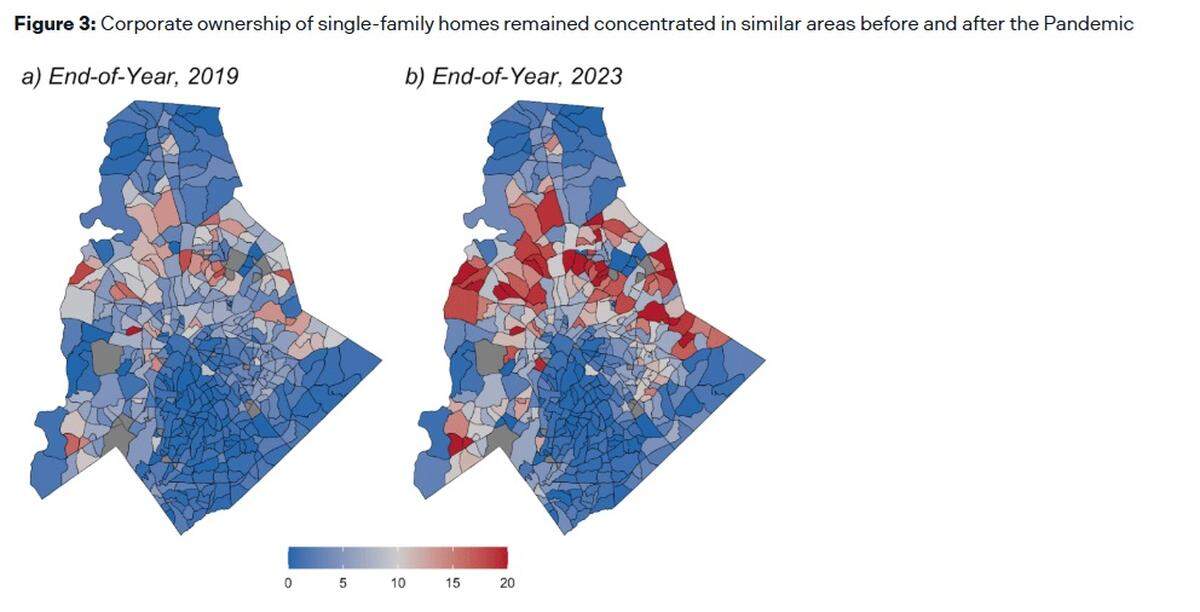
Moore found that the high concentration of corporate ownership, at least 20%, were in northwest Charlotte neighborhoods such as Coulwood and Oakdale. They were also in northeast Charlotte including University City, a portion of southwest Charlotte like Steele Creek and some areas of Huntersville.
Ultimately, Moore writes that corporations owned at least 15% of all the single-family properties in 58 neighborhoods in the county.
Why does this matter?
IIn Moore’s first report from June 2024, he wrote about why the rise of corporate landlords matters to Mecklenburg residents
- Residents believe corporate landlords have a negative impact on the community regarding affordability, economic mobility and community safety.
- The impact is concentrated in low-income and/or Black households.
- And a rise in corporate ownership of single-family homes can decrease homeownership opportunities.
What’s next for corporate landlords in Mecklenburg?
Moore noted that this issue isn’t going away, especially as the number of single-family houses owned by corporate landlord keeps growing. More studies are being done on the issue and more politicians are looking at the impacts.
Earlier this year, the Federal Trade Commission began seeking public comment on “mega single-family rental” operators. Those comments would be used to steer a possible FTC study on the mega investors and how those entities affect home prices and rents in the single-family rental market.
It’s unclear whether the study is underway under President Donald Trump.
Moore wrote that his study is one step in understanding the issue of corporate landlords.
In the most recent report, he added that understanding where the corporate ownership is located will help researchers answer questions regarding affordability, stability and monopolization of single-family homes.