Your Mecklenburg property values are rising. That’ll factor into your next tax bill
Inside the Valerie C. Woodard Center, David Strafel’s computer monitor lights up with an aerial view of one of Mecklenburg County’s 3,000 neighborhoods. He can zoom in further and see one of 400,096 parcels.
On this Wednesday morning in early August, the county property appraiser spends his days digging through sales data, cross-checking information other appraisers got in the field against neighborhood real estate sources he can easily pull up on his monitor.
As one of eight people on the county’s revaluation team, the detective work Strafel and his colleagues are doing in a government complex off Freedom Drive will help determine your real estate taxes next year.
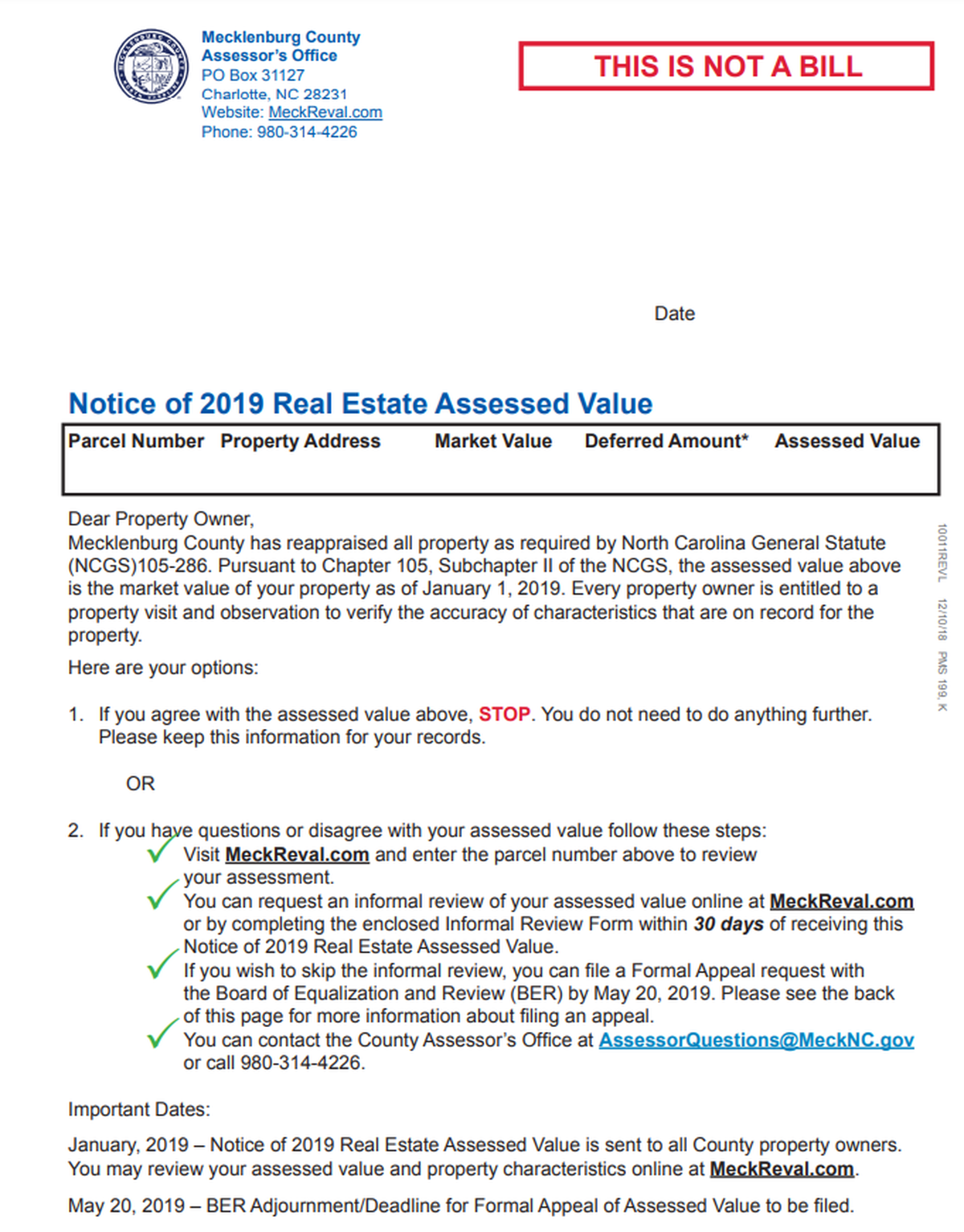
By late January, county taxpayers can expect a notice in the mail detailing their 2023 real estate assessed value. And by next spring, county commissioners, Charlotte City Council and surrounding towns will use this new appraisal information to help set tax rates that go into determining your property tax bill.
A handful of surrounding counties also have property revaluations scheduled for 2023, according to the North Carolina Department of Revenue: Gaston, Lincoln, Catawba, Iredell and Rowan.
In Mecklenburg, the assessor’s office, led by Ken Joyner and Brad Fowler, are expecting large increases in assessed value from the last revaluation in 2019.
Through an initial review of all residential and the majority of commercial parcels, their office found the median value of real estate in Mecklenburg has increased about 45% from the 2019 revaluation, Joyner told county commissioners this month.
That includes a median increase of 48% for residential property and around 36% in commercial property. Commercial values could change as that review didn’t yet include uptown and parts of South End, Joyner said.
But just because values are going up doesn’t necessarily mean your property tax bill also will go up next year.
That’s because tax rates set by local governments could be lowered in favor of a revenue-neutral rate — the rate needed to bring in the same amount of money as the previous year’s budget. By law, local governments are required to publish the revenue neutral rate, but can choose to set it higher.
While homeowners will likely be paying the most attention to the upcoming revaluation, renters should also keep up with new property values. Depending on how much commercial values go up, rising rates can eventually get passed along to renters, as well.
Thousands of data points
Strafel has been in the appraisal business for about 30 years, with the past eight working as a county appraiser. At first, he spent time out in the field, making property visits to measure building dimensions or speaking with homeowners about any improvements they’ve made.
Four years ago, he switched to the revaluation team.
Strafel and his colleagues painstakingly go over thousands of data points of recent property sales. They make sure property sales in a neighborhood generally match up with the average price.
If something stands out, Strafel will often make a note and investigate further.
Strafel and his team continue to analyze sales data from this year. His detective skills will come in handy in a growing region like Charlotte, where home values have been soaring in recent years.
The work is cyclical in nature, meaning it comes around every few years. But it requires a team to analyze thousands of data points to ensure accuracy, said Fowler, the assistant assessor.
“A lot of folks I think envision that it’s a push of a button,” he said, “and it’s not.”
What is property revaluation?
The work Strafel and company are doing is a requirement under state law.
In North Carolina, counties must perform a property revaluation at least every eight years. Appraisers work to determine the value of properties given recent sales. The revaluation appraises everything from Bank of America Stadium in uptown to someone’s half-acre lot in northwest Charlotte.
The intention is to distribute the overall tax burden more equally across Mecklenburg County. It’s also meant to bring values up to what the current market value is.
In 2019, Mecklenburg County commissioners voted to switch the revaluation cycle to every four years. The upcoming 2023 revaluation will be the first under the new cycle.
More counties are opting for the shorter turnaround, said Christopher McLaughlin, a public law and government professor at the UNC School of Government.
“In a perfect world we would reappraise every year,” McLaughlin said. “But of course there’s time and money from a practical standpoint.”
With the shorter cycles, taxpayers can expect less of a sticker shock when they get their property tax notice in the mail. The shorter cycle also means the public will be more in touch and engaged about the process, according to the assessor’s office.
“If you wait eight years, (property values) may have gone up or down,” McLaughlin said. “But they won’t be the same. We know if you wait eight years there will be some imbalance there.”
What the revaluation process looks like
Since he joined the assessor’s office in 2013, Joyner has made a point to canvass more properties in person. That was one lesson learned as a result of the troubled 2011 revaluation.
The county angered thousands of property owners after mistakenly over-valuing properties, according to Charlotte Observer files. Mecklenburg ultimately issued around $100 million in refunds.
Here’s how site visits work.
Appraisers like Strafel go out with what’s known as a property record card. The cards break down a property by land and building value, the last sale price, when the home was built, how many stories it is and total square footage, among other things. Anyone can search their address on the county site to pull up their own card.
Appraisers will check to make sure all the information is accurate, sometimes working with the homeowner. Homeowners are encouraged to search their properties now to make sure all the information is correct. If not, they should contact the assessor’s office.
On some visits, appraisers will use a laser to help measure a home’s dimensions. The office has been using them for the past 10 years. The laser pointers are a quicker, more efficient option over a traditional tape measure, though those are still used too.
For Strafel, his work today means going back over canvassing efforts and using sales data to make sure values they’re putting on homes are accurate.
That involves coming up with median sales prices in all 3,000 neighborhoods. The work is pretty straightforward in neighborhoods where homes were all built in the same year — like in a new subdivision that has the same two or three floor plans.
He has to be more careful in what his office calls heterogeneous neighborhoods.
In one he pulled up at his desk this month, homes ranged in age from 1911 to 2021. Most properties were built between the 1940s and 1960s, but like many parts of Charlotte had seen older homes knocked down in place of newer ones.
The office will also use effective year built dates if an older home has gone through extensive renovations, all components that can change a valuation.
Strafel will typically make sure to only compare newer homes to other newer homes of the same size and build. The office doesn’t want to assign similar values to homes that possess vastly different characteristics.
That’s a big reason why there are so many neighborhoods around the county. A single neighborhood like Myers Park may be broken into around 13 neighborhoods by the assessor’s office due to varying house qualities.
“It ends up being a situation where you have to keep your finger on the pulse of it,” Strafel said. “You don’t want to group together too many properties that are starting to have different features.”
Why are property values rising?
One reason taxpayers are seeing their assessed values go up is a lack of housing supply, said Lee Allen, president of the Canopy Realtor Association. The association provides monthly reports on residential real estate market activity for the Charlotte region.
Right now, the typical home on the market in the region is seeing over nine showings. There has not been enough home building to keep up with demand, Allen said, so supply is a major contributing factor in home price appreciation.
The median residential sales price in the county is $413,880, according to the assessor’s office. Home values at the time of the 2019 revaluation were around $250,000, according to Redfin.
Whether your property tax bill will go up depends on how much or little your property appreciated when compared with the average, said Aaron Houck, director of regional policy at the UNC Charlotte Urban Institute.
If local governments choose a revenue-neutral rate, people whose properties appreciated at or below the average county rate will likely not see any increases to the amount they pay in taxes, Houck said.
It’s those who live in neighborhoods that have seen significantly higher rates of appreciation than the county as a whole that should expect bill increases — even with local governments lowering the tax rate.
In turn, people who live on lower or fixed incomes in high appreciation neighborhoods might feel added pressure when it comes time to pay the property tax bill, Houck said. The exact number of people won’t be known until next year, after values come out and the new tax rate is set.
“I don’t think anyone wants that number to be very high,” he said.
The revaluation can be a challenge for those residents who don’t have an intention of selling anytime soon.
If that person is living on a fixed income, for example, the equity in their home might be going up but they don’t necessarily have more cash in the pocket. So if they end up with a larger tax bill, it can feel like they’re taking a hit, Houck said.
You can appeal valuation decisions
It’s not realistic that the county office will get every valuation correct. It uses a mass appraisal process because of how many parcels there are in Mecklenburg.
For that reason, if a homeowner feels like the valuation they get come January is not correct, they can reach out to the county and appeal if they feel their assessed value was substantially higher or lower than market value. They can also appeal if the value is inequitable with similar properties.
However, residents cannot appeal just because of receiving an increase in assessed value over the last revaluation or if they have an inability to pay the taxes.
There are two types of appeals. Informal appeals involve a property owner contacting the tax office for an initial review of their new appraisal value. A formal appeal is heard by the county Board of Equalization and Review. Both types could lead to a reduction in appraisal value.
Once the revaluation comes out, you can click the “comper” tab on the county’s website. That will allow you to see which comparable home sales the county looked at for your assessment.
This story was originally published August 18, 2022 at 6:00 AM.