
Worker shortage leads Charlotte companies to offer up to $1,000 and perks for new hires
Signing bonuses of up to $1,000, profit sharing options, free meals for family members. These are among the many incentives restaurants around Charlotte are rolling out as they confront dire labor shortages just as the state ends most coronavirus restrictions.
Last week, N.C. Gov. Roy Cooper ended most COVID-19 restrictions, including capacity limits. That means businesses like restaurants need to find creative ways to fill thousands of positions across Charlotte just as more customers are headed their way.
FS Food Groups based in Charlotte — Little Mama’s, Mama Ricotta’s, Midwood Smokehouse, Paco’s Tacos & Tequila and Yafo Kitchen — recently said it was trimming its menu because of hiring challenges. The restaurant group also is offering employees referral bonuses that include $300 for referring an new hire for any position up to $3,000 for suggesting executive chefs and general managers.
Other restaurant groups are upping the ante, too.
Last month, Tupelo Honey restaurant chain, with a location on South Tryon Street in uptown Charlotte, launched a sign-on bonus of $600. Five Guys burger chain also promoted a $300 hiring bonus for employees who stay for six months.
And more companies, including Bojangles, have followed suit this month with financial incentives and other perks.
“The labor shortage is an industry-wide issue we’re all working through right now, which is why Bojangles is piloting several initiatives to attract and retain employees,” said Stacey McCray, spokeswoman for the chicken and biscuit chain based in Charlotte.
Not just restaurants offering money
But it’s not just restaurants.
Last month, Carowinds said it would give $500 bonuses to all seasonal hires at the amusement park and expected to hire 900 part-time positions. Carowinds is opening for the season on Saturday.
“This has been very successful for us,” Carowinds spokeswoman Lisa Stryker told the Observer. She said the park also has promoted employee perks like free visits.
Other companies competing for workers include Amazon, which is offering a $1,000 sign-on bonus and an additional $100 for fully COVID-19 vaccinated. North Carolina jobs include seasonal and non-seasonal warehouse positions in Charlotte and Concord.
Many other industries — such as health care, insurance and truck driving — also are advertising hiring bonuses, according to company job postings. That includes $250 at Spin, an electric scooter company, $500 for a housekeeper at Aloft Charlotte Ballantyne and $1,000 at Deluxe Corp., a tech company that serves small businesses and financial institutions.
Job applicant shortage rises during COVID
Limited staffing has been an issue throughout the pandemic since restaurants reopened last May after shutdowns, said Doug Bell, managing partner of RoCo Holdings — which includes The Roasting Company at Montford Park, Plaza Midwood and Rock Hill, Eddie’s Place and Providence Road Sundries.
“But it’s so much worse now than it was then,” Bell said. “I haven’t had a single applicant in three weeks.”
Bell said each of his restaurants needs at least five more employees. The pay is about $14 to $18 an hour, Bell said.
“We’re trying to hire as restrictions are easing and business is picking up, but we don’t have enough people to go back to our pre-COVID operations,” he said.
RoCo Holdings also is giving a $200 hiring bonus after three months. “We may have to up that since it doesn’t seem to be working so far,” Bell said.
Where are the workers?
Along with restaurants, thousands of jobs are available in the Charlotte area at places like FedEx, Lowe’s and Spectrum.
Several factors are causing the shortage, including matching skills to available jobs and wages, said UNC Charlotte economics professor John Connaughton.
“It’s a tight labor market and it’s tough on employers to try to find people to fill the jobs,” Connaughton said.
But he said the top reason employers aren’t seeing applications is because of the federal unemployment insurance benefit boost. Early in the pandemic, the federal benefit was $600 a week, and now it’s $300 a week, in addition to state unemployment benefits.
“It’s created a significant disincentive for people to work,” Connaughton said. “It’s become problematic.”
South Carolina and some other states are ending participation in the federal pandemic unemployment programs believing it will prod people to return to the workforce. But some economists say that’s not the answer.
“The idea that a governor is going to cut off the federal (unemployment insurance) benefits while the economy is improving but still very weak is terrible economics,” Heidi Shierholz, policy director at the Economic Policy Institute, said on this week’s Off-Kilter podcast with Rebecca Vallas. “It absolutely will hurt workers who either can’t find a job right now or can’t work right now.”
Employment in leisure and hospitality increased by 331,000 in April, with more than half of the increase in food services and drinking places, according to the latest U.S. Department of Labor statistics. Still employment in the industry is down by 2.8 million, or 16.8%, since February 2020.
“Low-wage sectors saw much faster job growth, which is the opposite of what you’d expect to see if unemployment insurance was keeping people from working,” Shierholz said on the podcast.
She said the pandemic unemployment benefits are playing some role with driving higher wages in the industry by making the labor market function better and helping workers not be “absolutely desperate” to take a low-quality job.
”Any recovery from an economic downturn requires a period of labor shortage and accelerating wage growth,” Shierholz said in her Working Economics blog. “Some degree of wage acceleration was clearly necessary.”
New employee incentive program
This month, Mac’s Speed Shop restaurant rolled out a seven-part employee incentive program for new and long-term employees.
The program includes a $1,000 bonus for new kitchen hires who stay until Sept. 1, Mac’s Hospitality Group said in a news release.
“We are eager to demonstrate in a meaningful way just how much we value and care about those who are part of our team,” Mac’s president Shang Skipper said in a statement.
All hourly employees are getting a one-time bonus based on tenure, and profit sharing every four weeks at qualifying locations. There’s also a $250 referral bonus and a new manager hiring bonus.
Other perks include health insurance for employees who work at least 25 hours a week after 60 days of employment and free employee family meals.
Bojangles testing retention bonus
In the Charlotte area, Bojangles is paying newly hired restaurant workers a retention bonus of $500 over the course of six months, said McCray, the company spokeswoman. New employees will receive bonuses of $100 at 30 days, $150 at 90 days and $250 at 180 days.
“We’re testing this program over the next several weeks to determine its effectiveness,” she said.
The iconic Southern chain also is offering recognition for workers, an employee referral bonus and free meal programs.
“Right now, our teams are working around the clock to ensure we have the staffing to meet our customers’ needs,” McCray said.
Viva Chicken sign-on boost
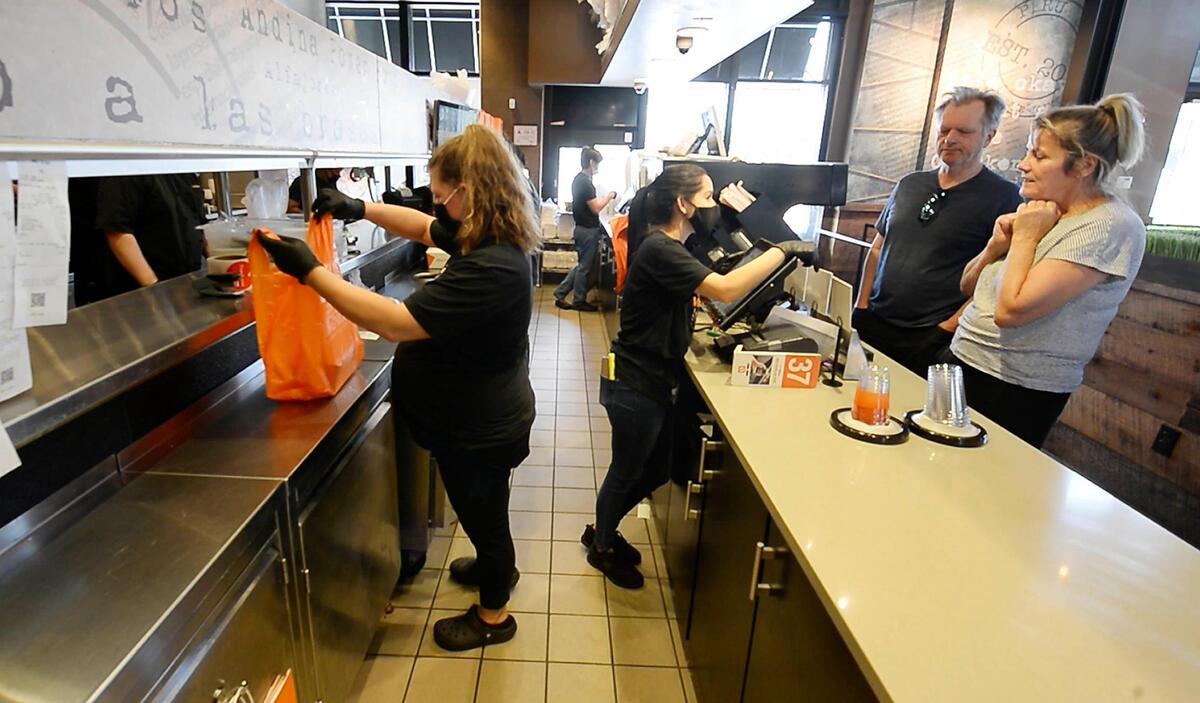
Viva Chicken, a fast-casual Peruvian rotisserie chain, said Monday it’s seeking new workers at its 12 Charlotte-area locations, and offering a sign-on bonus of up to $400.
New employees who work 100 hours in their first month will receive $200, and an additional $200 after 200 hours in 60 days, the company said in a statement.
After 90 days and a performance review, there’s also potential for a pay increase. In addition, Viva Chicken workers receive an annual bonus equal to one week’s pay.
Viva also raised its hourly pay $1 so the the lowest hourly wage starts at $11 an hour.
“We’ve had to look at ways to creatively incentivize new team members to be attracted to our brand,” said Trevor Scott, vice president of operations for Viva Chicken. He believes the incentives will help attract more employees.
Fewer workers driving other adjustments
Restaurants are facing other issues along with the hiring shortage, including food supply shortages, having to limit menus and hours, and being able to serve people at full capacity.
Jon Dressler, owner of Rare Roots Hospitality group which includes restaurants Fin & Fino, Dressler’s, Birkdale, Dogwood and The Porter’s House, said before the pandemic, there were no staff shortages. Now, he’s looking for about 10 more people.
And even though there are no capacity limits, his restaurants will ease back to full operations. “It’s not as grave for us as other businesses,” he said of the worker shortage.
Over at Fat Cat Burgers + Bakeshop in Dilworth, hours have had to be adjusted.
Last week on social media, the restaurant said the dining room would be closed temporarily on Mondays “due to the labor shortage.” But the walk-up doughnut window will be open Mondays from 8 a.m. to noon.
Owner Fran Scibbeli rebranded her Dilworth restaurant from Fran’s Filling Station to Fat Cat Burgers. She recently told the Observer before the pandemic she’d see more than 100 applicants a week, but had just three in three days recently.
“We just need about four or five more people,” she said. “We can’t even be open exactly when we’d like to.”
This story was originally published May 20, 2021 at 2:33 PM.